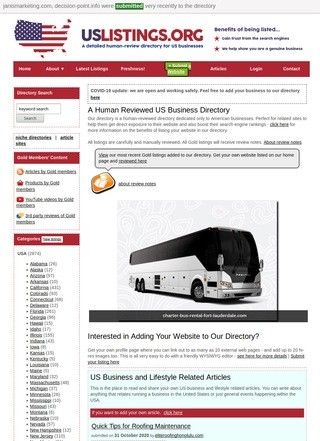
You have a business to list and roughly ten minutes to decide whether US Listings is worth submitting to. The catalogue launched in 2009, is headquartered in Colchester, Connecticut, and currently holds about 8,738 American entries and 1,397 Canadian ones, sorted by state and trade category. That footprint across two countries, accumulated over seventeen years, is a base you can at least measure. A submission portal is open for new entries, and every submission goes through human review before anything appears in the index, which keeps automated spam from overwhelming valid records the way it tends to on open-submission platforms.
Profile features and content options
Profile depth at US Listings is more developed than what most free alternatives allow. Each entry can carry a custom write-up, FAQ sections, a selling-points breakdown, up to twenty high-resolution images, ten external links, embedded YouTube videos, and an attached product catalogue. A small business with a separate booking page, a product store, and a portfolio site can point to all three from one profile. That level of granularity makes a listing here closer to a compact company page than a bare name-and-URL row in a table, and for a small operation without the resources to maintain multiple web presences independently, the difference is practical rather than cosmetic.
Monitoring for outdated listings
US Listings runs an internal spider that performs AI-powered audits of the sites it indexes, tracking content changes and flagging when a member site has been updated. On a catalogue approaching 10,000 records, active monitoring for staleness has a measurable effect on whether the index stays useful over time. Dead-end links accumulate quickly in any large catalogue and quietly degrade the value of every valid entry around them. Most directories skip this maintenance entirely, and it shows after a few years.
Editorial content and cross-platform referrals
User reviews collected on the platform pass through a sentiment analysis layer before display, so feedback is read and weighted before it appears. The site also publishes editorial content spanning home improvement, HVAC, kitchen design, pest control, and digital marketing, aimed at the same small-business and homeowner audience the listings serve. Alongside that, US Listings maintains a curated list of outside review services and recommended partner directories, explicitly directing users elsewhere to cross-check companies they find here. Sending traffic off-platform cuts against the usual instinct to keep visitors contained, and it reflects a particular stance on how US Listings sees its own role relative to the services it indexes.
Physical address and BBB registration
The BBB file for US Listings lists a physical address in Colchester, Connecticut, and a working phone number. The operation has a findable street presence and a callable line, even if the homepage itself keeps those details understated. The BBB classification places US Listings under real estate services, most likely a legacy categorisation from when the entity was originally filed.
Limited external validation
Outside the BBB entry, independent validation for US Listings is limited. The BBB record carries no accreditation and no customer reviews. A search across Google, Trustpilot, and Yelp returns no review presence. Directories of this kind rarely accumulate ratings the way consumer-facing businesses do, but the outcome is the same: the Connecticut address and the BBB record are the only external anchors available for anyone assessing US Listings outside its own materials. A prospective submitter is working almost entirely from what the platform says about itself.
Assessing risk without lister reviews
For some businesses, seventeen years of continuous operation and a catalogue of close to 10,000 entries that has clearly been maintained are enough to justify a listing, especially if the submission cost is low or free. For others, particularly those in competitive sectors where directory placement represents a meaningful spend, the absence of any outside corroboration of results is a harder problem. There is no review on record from a lister saying the traffic came through, or did not. US Listings has operated long enough that such records should exist somewhere publicly; the fact that none surface is the one gap worth sitting with before submitting.
Technology infrastructure
The infrastructure here is more developed than the homepage presentation leads you to expect. The technology layer, the two-country coverage, the profile depth, and the longevity all point to a platform that has been actively maintained. What is missing is any external account of outcomes, and in a field where word-of-mouth among listers is the normal currency, that absence does genuine work in shaping how much confidence a new submitter can reasonably carry in.
Verify terms and pricing before submitting
Check the submission terms and any associated pricing on the US Listings site directly, then run the Colchester address through a business registry search to confirm the entity is current. If the cost fits your budget and the category coverage matches your market, the platform is worth a submission; if the spend is substantial, spend an equal amount of time looking for independent lister accounts before you decide.