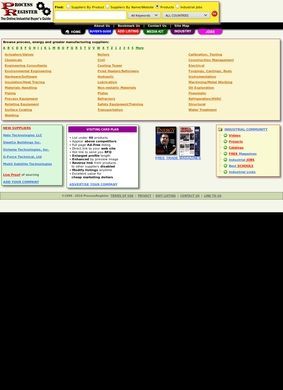
Process Industries Supplier Directory is an online industrial buyer's guide that has been running at processregister.com since 1998, aimed squarely at the process, energy, and manufacturing sectors. Process Industries Supplier Directory sorts suppliers into more than forty product categories, and the categories themselves tell you who the site is for. You find boilers, cooling towers, rotating equipment, and general process equipment under the hardware headings. There are material listings for forgings, castings, plates, and non-metallic materials. Systems get their own grouping too, covering instrumentation, HVAC and refrigeration, piping, and electrical work. The service side reaches engineering consultants, calibration and testing firms, and construction management. That spread is wide but stays inside one coherent world, the kind of procurement an industrial plant or contractor does.
How to search the supplier directory
Search is handled three ways. A user can drill down by product category, look up a specific company by name or website, or browse the alphabetical index when they are not sure what they want yet. None of these is novel, and the lack of novelty is fine. A buyer hunting for a cooling tower vendor wants a list of cooling tower vendors, not a clever interface. Process Industries Supplier Directory keeps the path short, which is the main thing a tool like this owes its users. The alphabetical browse in particular is a small mercy for anyone who half-remembers a supplier name but has lost the exact spelling.
Free trade magazines and industry links
Beyond the supplier listings, the site bolts on a few extras: free trade magazines, a set of industrial videos, and an industry links section. These read as filler more than draw, the sort of resource section a directory adds to give a return visit some reason to happen. I would not pick the site for the magazines, but they cost nothing and do no harm sitting there. The core value of Process Industries Supplier Directory stays the supplier index, and the site is honest enough about that in how it is laid out.
Paid placement through the Visiting Card Plan
For the companies being listed, there is a paid tier called the Visiting Card Plan. It promises enhanced placement above competitors, direct traffic to the supplier's own website, and routing of RFQ (request for quote) submissions straight to the listed company. This is the standard pay-for-position model that directories of this age tend to run on, and it is worth a buyer of Process Industries Supplier Directory knowing it exists. When the top results in a category have paid to sit there, the ordering reflects who spent money as much as who fits best. That does not make the listings useless. It just means a careful user keeps scrolling past the promoted slots and reads the full category before settling.
No external ratings or third-party reviews
This is where Process Industries Supplier Directory asks for a little caution. The site itself has no third-party reputation that turned up in any search. No Google rating, no Trustpilot score, nothing on Yelp or the BBB, no review count anywhere that maps cleanly onto processregister.com. Searches mostly surfaced unrelated companies and rival directories. The absence cuts two ways. It means there is no chorus of complaints, which for a quiet B2B tool that has existed since the late 1990s is unremarkable. It also means a first-time visitor has nothing external to lean on, and has to judge Process Industries Supplier Directory on its own contents and on how the categories are filled.
Broad categories require verification of leads
On that internal evidence, Process Industries Supplier Directory makes a reasonable case for itself. A category structure this specific is not the work of an afternoon, and the supplier coverage across equipment, materials, systems, and services is broad enough to make a search worthwhile. What the listings cannot promise is current accuracy. Directories that have run for over twenty-five years carry dead entries and stale contact paths, and a buyer should treat any supplier they find here as a lead to verify, not a vetted recommendation. The site connects you to a company; confirming that company is still active and still does what the listing claims is on you.
Limited contact information for site operators
Contact for the people behind Process Industries Supplier Directory is sparse. A contact page sits in the about section, alongside an About Us page and a site map, so the route to reach someone does exist. The homepage itself shows no phone number, no email, and no street address, which leaves the operator a little faceless. For a self-service tool that is mostly about connecting buyers to suppliers, the missing operator details matter less than they would for a business you are buying from directly, but a visible phone line or a posted address would have steadied the impression. As it stands, a user who hits a problem has one form to fill and then a wait, and no quick way to escalate if the form goes unanswered.
Best suited for procurement professionals
Who gets the most out of Process Industries Supplier Directory? Procurement people and engineers at process plants, energy facilities, and manufacturers, the ones who already know the vocabulary and just need a starting roster of vendors in a narrow category. Someone sourcing forgings or trying to line up a calibration house has a real reason to be here. A general searcher or a small business outside heavy industry will find the whole thing too specialized to bother with. Process Industries Supplier Directory is built for a trade audience and does not pretend otherwise, which counts in its favor. It is not trying to be everything, and a tool this focused tends to age better than one that tried to cover the whole economy.
Read full categories to avoid paid placements
The Visiting Card Plan deserves one more honest note. Because placement can be bought, Process Industries Supplier Directory works best as a wide net rather than a ranked verdict. Read the full category, note several candidates, and shortlist by your own checks instead of trusting the top slot. Used that way, Process Industries Supplier Directory does the job a sector index should: it shortens the distance between needing a calibration firm or a forgings supplier and having a list of names to call.
How does this compare to Thomasnet?
Where does that leave it against the obvious alternative? Most industrial buyers in this space will already know Thomasnet, the larger and far better-resourced North American supplier network, and on raw breadth, supplier verification, and depth of company profiles Thomasnet is the stronger tool. What Process Industries Supplier Directory offers instead is a tighter, process-and-energy focus and a simpler search that does not bury you in features. If a buyer wants the deepest possible pool with richer vendor data, Thomasnet wins. If they want a quick, no-friction scan of process-sector suppliers and are willing to verify each lead themselves, this older directory still earns the few minutes it takes to run a search, with the paid-placement caveat kept firmly in mind.