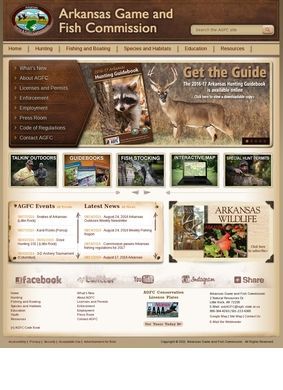
Where does an Arkansas hunter or angler go to confirm the season dates, buy the right license, and report a harvest without guessing? The Arkansas Game and Fish Commission puts all three on one site, and the practical answer to that question is most of why the site exists. It is the working hub for anyone who fishes, hunts, boats, or spends time outdoors in the state, and it treats those activities as things you do with rules attached, not abstractions.
Regulations for hunting and fishing species
Start with the regulations, because that is where most visits to the Arkansas Game and Fish Commission site begin. The species coverage is broad and specific at the same time. On the hunting side there are dedicated guides for deer, waterfowl, turkey, alligator, bear, elk, and feral hogs, which is a wider list than many states bother to publish in detail.
Alligator and elk hunting in Arkansas are tightly managed, limited-permit pursuits, and the fact that they get their own guidance tells you the site is built for the full range of what is legal in the state, down to the rare permits. Fishing is handled the same way, with separate guides for trout, black bass, catfish, striped bass, walleye, and panfish. Anyone who has tried to read general fishing rules and then guess how they apply to a specific species will appreciate that split.
Buy licenses and report harvests online
The transactional parts of the Arkansas Game and Fish Commission site are genuinely useful. License purchase and renewal happen online, which removes the old chore of finding a vendor before opening day. The game check system lets hunters report a harvest electronically, a requirement in Arkansas for several species and the kind of thing that used to mean a phone call or a physical check station. Pairing the rulebook with the actual license sale and the mandatory reporting on the same site is the part that makes it genuinely useful instead of merely informational.
Wildlife management area maps
Beyond the paperwork, a large share of the content is about places. Wildlife management area information sits alongside leased-land permits, so a visitor can see what is open to public hunting and which parcels the Arkansas Game and Fish Commission leases for that purpose. For Arkansas, where a meaningful amount of huntable ground is WMA land, those maps are the starting point for anyone planning a trip onto unfamiliar territory.
Recreational areas beyond hunting grounds
The recreational side is fuller than the hunting-and-fishing framing might suggest. The Arkansas Game and Fish Commission lists nature centers, hiking and water trails, shooting and archery ranges, state fish hatcheries, and public fishing areas that come with lake maps and marked fish attractors. Those fish attractor locations are a small detail that experienced anglers will notice, since knowing where structure has been sunk in a lake is exactly the local knowledge that is otherwise hard to come by. The hatchery and nature center listings widen the audience to families and casual visitors who are not buying a hunting tag at all.
Programs add another layer. The Arkansas Game and Fish Commission runs the Arkansas Legacy Lunker Program and the Triple Trophy Award Program give anglers and deer hunters something to aim at and a way to have a notable catch or harvest formally recognized. Hunter and boater education rounds it out, with volunteer opportunities attached for people who want to teach the next group coming up. These are the kinds of programs a state agency runs to keep its constituency engaged across seasons, and seeing them documented rather than just named suggests they are active.
Programs recognizing angler achievement
There is current material too. The 2025-26 and 2026-27 regulation guidebooks are both available, which means a visitor can read the rules for the season they are in and the one ahead. Publishing two cycles at once is a small sign that the regulatory calendar is being kept current here, and it spares the common frustration of finding only last year's book. An event calendar and news updates sit alongside the guidebooks for anything that falls outside the printed cycle.
The Arkansas Wildlife magazine is offered by subscription, which is the agency's longer-form outlet for features on conservation work, profiles of management areas, and the sort of content that does not fit in a regulation table. Social presence reaches across Facebook, YouTube, Twitter, Instagram, and Fishbrain. That last one is worth pausing on: Fishbrain is an angler-focused platform, and the choice to be present there rather than only on the general networks shows the Arkansas Game and Fish Commission is meeting anglers where they already track their catches.
Following a trip from rule to report
What ties the whole site together is that it follows the actual sequence of a trip. You check the rules for your species, buy or renew the license that covers it, find a WMA or public fishing area to go to, then report what you took when the law requires it. The Arkansas Game and Fish Commission has the documents and tools for each of those steps in one place, which is more than can be said for a lot of agency sites that handle the reading and the transactions on separate, disconnected systems. The species-by-species structure repeats across both hunting and fishing, so a deer hunter and a trout angler each find their material organized the same way.
It is worth being clear about who gets the most from this. Someone who hunts or fishes Arkansas regularly will use the Arkansas Game and Fish Commission site every season, probably several times, for licenses, checks, and rule changes. A casual visitor planning a hatchery tour or a hike on a water trail will find relevant material, though the site's depth is plainly aimed elsewhere. The depth is plainly aimed at the resident sportsman, and the breadth of species and programs reflects that priority.
A few things round out the picture. The shooting and archery ranges give license-holders a legitimate place to practice, the lake maps turn a vague fishing plan into a specific one, and the volunteer track through hunter and boater education builds the pipeline that keeps the whole system staffed. None of these is the headline feature, and together they fill out what the Arkansas Game and Fish Commission covers beyond the obvious license-and-regulation core.
The breadth here is the most telling thing. Few state agencies publish dedicated alligator and elk hunting guides, marked fish attractor locations, and two consecutive seasons of regulation guidebooks all on the same site, and the Arkansas Game and Fish Commission does. A hunter checking a season date, an angler reading the trout rules, and a parent looking up a nature center all land in the same place and find their specific answer. That is the test a site like this has to pass, and the species lists, the WMA maps, the game check tool, and the current guidebooks are the concrete evidence that it does. The 2026-27 guidebook being posted before the 2025-26 season has even closed says plainly that the agency is staying ahead of its own calendar.