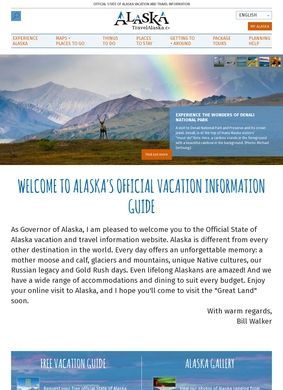
Where does a first-time visitor even start planning a trip to a state this large and this far off the road grid? Travel Alaska answers with a single official Vacation Planner, an interactive map a person can filter, and content sorted into five regional guides, all sitting on the state's own tourism site. It is run by the Alaska Travel Industry Association on behalf of Alaska, which makes it the primary source for the state's tourism information.
That official standing matters for a destination where logistics are half the battle. A visitor is trusting Travel Alaska to be current on the things that strand people: which roads connect, when the ferries run, where the trains actually go.
The planning tools at the center
The Vacation Planner is the headline resource, an official State of Alaska guide a visitor can use to frame a trip. Around it, Travel Alaska adds a vacation-planning guide, travel articles, ready-made itineraries, local tips, and seasonal highlights, so a person can either follow a suggested route or build their own from the parts.
Ready-made itineraries count for more here than on a typical destination site, because sequencing an Alaska trip is where newcomers go wrong. The distances are enormous, and some connections run only a few times a week. A suggested itinerary that already accounts for those gaps saves a planner from discovering, too late, that two stops they wanted are three ferry days apart. Local tips and seasonal highlights fill in the smaller decisions around them.
The seasonal angle deserves attention. Alaska is a wildly different trip in December than in July, and Travel Alaska organizes content around that reality, with winter activities and northern lights viewing sitting alongside summer fishing and hiking.
The interactive map and its filters
The interactive map is the piece I would open first. It layers the state's transport and land systems into one view and lets a planner filter by roads, parks, cruise routes, ferry lines, air services, the railroad, and Alaska Native lands. In a state where the capital cannot be reached by road, seeing the ferry and air links drawn on a map does more than a page of prose ever could.
It turns an intimidating geography into something a person can route through.
How the state is carved into regions
Travel Alaska splits the destination into five regional guides: Arctic, Inside Passage, Interior, Southcentral, and Southwest. Each is a genuinely different kind of trip, and organizing the site this way keeps a visitor from treating Alaska as one undifferentiated wilderness.
Under the regions sit a cities and towns directory and a section for national parks and public lands, which is where much of the reason to visit lives. Between the regional guides and the parks pages, Travel Alaska covers both the where-to-base-yourself and the what-to-actually-see halves of a plan.
That pairing is more useful than it first looks. So much of what draws people north sits inside parks and public land, and putting a cities and towns directory next to it lets a visitor pick a base town and then read straight across to the wilderness within reach of it. The two sections answer different questions, and they sit close enough that a planner can move between them without losing the thread.
The five regional guides
The value of the regional split is that it matches how Alaska really works. The Inside Passage is cruise and ferry country in the southeast; the Arctic is remote and seasonal; Southcentral holds Anchorage and much of the road system. A planner who reads the right guide gets advice calibrated to that area instead of generic state-level filler, and Travel Alaska keeps each region distinct.
Things to do and getting around
The Travel Alaska "Things to Do" catalogue is broad. It spans adventure tours, day cruises, festivals, fishing, food and entertainment, hiking, museums, wildlife viewing, spas, and sustainable tourism, which covers both the bucket-list Alaska and the quieter version of it. Cultural information about Alaska Native peoples runs through the content too, giving a trip a dimension past scenery.
Sustainable tourism sitting in that same list is worth noting. It points to a state aware that its wilderness is the product, and that too many boots in one spot degrades the very thing visitors come for. The cultural material on Alaska Native peoples pulls in the same direction, framing the land as lived-in and not empty scenery.
Getting there and getting around
Transportation is where Travel Alaska proves its practical worth. The site lays out flying, cruising, train travel, driving, ferries, and motorcoach options, the full set of ways a person moves through the state. In a place where a wrong assumption about a single ferry connection can cost a day or a whole leg of a trip, having these mapped in one official place is the most useful thing on offer.
Each mode gets real treatment: ferries linking coastal towns with no road between them, a railroad running a scenic interior corridor, motorcoach service for travelers without a rental car, and driving routes for those who want the wheel. On a trip where the transport choice reshapes the whole itinerary, that level of detail is the practical payoff.
There is also a media center and travel-trade section for industry partners, so tour operators and journalists have their own resources. For the ordinary visitor that part is beside the point, but it signals that Travel Alaska works as the state's central tourism hub, serving the trade as well as the public.
The honest verdict is that Travel Alaska is close to indispensable for the logistics and organization of a trip and weaker as a source of candid opinion. Travel Alaska will tell a visitor how to reach Nome, which region to pick, and what tours and parks exist, but as the state's official promotional body it has every reason to present Alaska at its best, so a planner should pair it with independent reviews ahead of booking a specific operator. As the map and the mechanics of an Alaska trip, it is the first place to go.