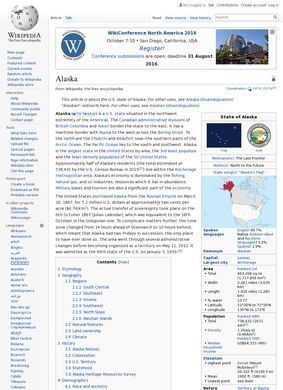
Someone planning a summer trip up the Inside Passage, or a student handed an essay on the 1867 purchase, or a reader who just wants to settle an argument about which U.S. state is biggest, all tend to land in the same spot. Wikipedia: Alaska answers each of those starting points without making the visitor hunt. The state covers 665,384 square miles, more than any other in the country, and Wikipedia: Alaska puts that number near the top where it belongs, alongside the nearly 34,000 miles of tidal shoreline that explain why so much of life there bends toward the water.
Alaska's geography and elevation
What makes Wikipedia: Alaska useful is how it splits a sprawling subject into parts a person can actually navigate. Geography gets broken into six regions: Southcentral, Southeast, Interior, North Slope, Southwest, and the Aleutian Islands. Denali shows up at 20,310 feet, recorded plainly as the highest peak in North America, with no straining for poetry. A reader who came only for the elevation figure can grab it and leave. A reader who wants the surrounding context, the climate shifts between those regions, the way the road system thins out north of Anchorage, can keep reading. That dual service, the quick fact and the deeper dive coexisting on one page, is the quiet strength of how Wikipedia: Alaska is built.
Timeline from Russian rule to statehood
The history runs long because the history is long. Indigenous habitation predates European contact by thousands of years, and Wikipedia: Alaska opens there before moving to Russian colonization in the 1700s. Then comes the sale to the United States in 1867 for $7.2 million, a sum that reads almost like a typo until you remember what oil would later be worth. Statehood arrived in 1959. The 1964 Good Friday earthquake, magnitude 9.2 and responsible for 133 deaths, gets its own treatment, as does the oil discovery between 1968 and 1977 and the Trans-Alaska Pipeline that followed. These are not decorative dates. They form a chain that explains how a remote territory became an economic player, and Wikipedia: Alaska lets that chain show rather than summarizing it into mush.
Alaska's population figures
Breadth is usually the enemy of clarity. A topic with this many facets, geography, demographics, economy, government, culture, can collapse into a wall of disconnected paragraphs. Wikipedia: Alaska avoids that by keeping each section disciplined. The demographic data is a good example. Population sits at 737,270, making Alaska the third-least populous and the most sparsely populated state. Native Americans make up 22 percent of residents, the highest proportion in the nation. Juneau is the capital, Anchorage the largest city. These figures arrive in a tight cluster, easy to copy into a report, and the prose around them stays plain instead of straining to dramatize them.
Government roles and economic sectors
The government section carries similar restraint. Wikipedia: Alaska names the sitting governor, Mike Dunleavy, and notes the 22 official languages, English alongside a long list of Alaska Native tongues, which is a detail many readers would not expect and would not find as cleanly stated elsewhere. The economy coverage does real work for researchers. Oil and natural gas extraction, commercial fishing, and tourism are laid out as the primary sectors, with more than 1.4 million annual visitors quantified instead of vaguely described. The note that federal lands exceed half the state's total area is the kind of fact that reshapes how a reader pictures the place, and it sits there matter-of-factly.
State symbols and nicknames
There is a lighter layer too, and it is welcome. State symbols get their moment: the willow ptarmigan, the Alaskan Malamute, the king salmon. The motto, "North to the Future," and the nickname, "The Last Frontier," are recorded without inflation. Wikipedia: Alaska also marks Alaska as the first state to legalize recreational marijuana, in 2014, which is the sort of cross-reference that makes the article handy for someone tracking national trends across states, beyond Alaska on its own.
Balancing coverage across regions
The pacing across all this is even. Wikipedia: Alaska does not front-load the famous bits and starve the rest. A traveler curious about the Aleutians gets roughly the same treatment as a researcher chasing pipeline economics. That balance is harder to pull off than it looks, and it is the reason the page works for audiences with almost nothing in common except a question about the same state.
Checking the numbers for accuracy
Accuracy questions are worth raising honestly, because no reference is immune to them. The strength of Wikipedia: Alaska is that its claims tend to come with the specificity that makes them independently verifiable. A figure like 20,310 feet for Denali, or $7.2 million for the purchase, or 133 deaths in the earthquake, can be checked against other sources, and Wikipedia: Alaska invites that by being precise rather than hand-wavy. A vague entry asks for trust. This one hands over numbers you can test, which is the better posture for any reference a student or reporter intends to lean on.
Orientation for travelers
For a traveler, the value tilts toward orientation. A person can read the regional breakdown and understand why Southeast and the North Slope are practically different worlds, why Anchorage anchors so much of the population, and what 34,000 miles of shoreline implies for getting around. Wikipedia: Alaska will not replace a guidebook on where to eat in Sitka. It does the upstream job, the framing, so the guidebook makes sense once you open it.
A launch point for students
For a student, the appeal is the density of dated fact in one place. The history section alone, from pre-contact peoples through Russian rule, the 1867 sale, 1959 statehood, the 1964 quake, and the oil era, covers most of what an introductory assignment would require, with the dates arranged so a timeline almost writes itself. The economy and demographics sections supply the supporting figures. Wikipedia: Alaska is a strong launch point, the place you start a paper and then branch out from, which is arguably the truest measure of a reference entry.
One fair limitation: an article this comprehensive moves fast for a casual reader. Someone who wanted a two-paragraph snapshot has to scroll past a great deal of detail to assemble one. That is the trade for thoroughness, and the section structure softens it by letting a reader jump straight to what they need. The page rewards patience more than it rewards a glance.
Set against what it sets out to do, Wikipedia: Alaska holds together. It treats geography, history, demographics, economy, government, and culture as parts of one coherent picture instead of a pile of loosely related entries. The numbers are specific. The tone stays even across a topic that could easily tempt a writer toward the grandiose, given Denali and the Last Frontier and all the rest. Whether you arrive for the elevation of a single mountain or the full arc of how a Russian colony became an oil state, Wikipedia: Alaska tends to hold the answer at the depth you needed it. The willow ptarmigan and the pipeline economics share the same page, and somehow both fit.