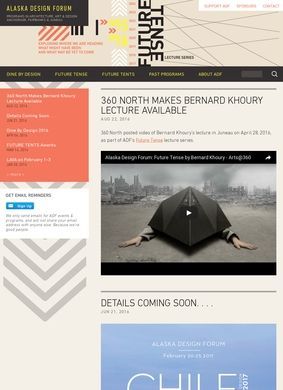
An all-volunteer nonprofit that flies leading designers and architects up to Alaska to give public talks is a genuinely odd and appealing thing to find, and that is exactly what the Alaska Design Forum is. Run by architects, artists, and designers who give their time to it, the organization exists to bring outside creative minds north and to put the design of the built environment in front of a local audience that would otherwise have to travel far to hear it.
The focus is narrow on purpose, and the Alaska Design Forum builds its programming around live events instead of a website full of resources.
The lecture series and its offshoots
The flagship of the Alaska Design Forum is its Lecture Series, which brings working designers, architects, and artists to the state to speak. At the time of viewing, the calendar centered on a triple-city tour carrying Cornell University architects Andrea Simitch and Val Warke to Anchorage, Fairbanks, and Juneau, with talks staged at venues such as the Anchorage Museum, Gather in Fairbanks, and the Amalga Distillery in Juneau.
Naming the speakers and the rooms they will stand in is the sort of concrete detail that tells a prospective attendee this is a real, scheduled thing and not a vague promise of culture.
Beyond the headline talks, the Alaska Design Forum runs several smaller programs that widen who gets to take part, and they are the part of the operation I found most persuasive because they turn a lecture audience into something closer to a working community.
PechaKucha Nights
PechaKucha Nights hand the microphone to local creative professionals instead of visiting names. The format is fast and constrained, a rapid slideshow with a fixed number of images and a fixed time per slide, which keeps presenters honest and the evening moving.
For a design scene in a place as spread out as Alaska, an event built around local voices gives the community a regular reason to gather and a low-stakes stage for people who would never headline the main series.
Inside the design challenge
The Design Challenge is an educational competition program, and it points the Alaska Design Forum at students and emerging designers rather than only at people who already have a practice.
A competition gives younger participants a brief, a deadline, and an audience, which is often what turns a casual interest into a serious one. It also quietly answers the question of whether an organization built on guest lectures has any pipeline for the next generation. This one does.
Anchorage design week
Anchorage Design Week is the most ambitious item on the calendar, presented in partnership with the Anchorage Museum. Pairing with an established civic institution gives the Alaska Design Forum reach and a venue it could not muster alone, and a full week of programming is a bigger commitment than a single evening talk.
The partnership cuts both ways in a good sense: the museum lends credibility and foot traffic, and the forum brings the design-specific speakers and format.
Who runs it and how to find them
The all-volunteer structure is the defining fact about how the Alaska Design Forum operates. No paid staff sits behind the programming; architects, artists, and designers organize it themselves. That explains both the strengths and the limits of what visitors see. The strength is obvious sincerity, since nobody is doing this for a salary. The limit is capacity, because volunteer organizations live and die by how many hours their members can spare, and a lean crew can only mount so many events in a year.
The site also lays out sponsorship opportunities for corporate partners, which is how a nonprofit like this one keeps the lights on, and it invites design professionals into its volunteer community.
Reaching the Alaska Design Forum is straightforward enough. The site carries its own Contact page with a program-inquiries email, a separate Sponsorship page for would-be partners, and an email newsletter to keep followers posted on upcoming talks. Social links to Facebook and an Instagram account are present. No phone number appears on the site itself, and a mailing PO Box in Anchorage shows up only on a business directory listing, unconfirmed elsewhere.
For an events organization that mostly needs people to know when and where to show up, an email route and a newsletter cover the essentials, though someone wanting to speak to a person directly has no phone line to call.
There is little outside feedback to weigh. A search turns up nonprofit-directory profiles on the likes of GreatNonprofits, Charity Navigator, GuideStar, and Yahoo Local, plus a Facebook page with a following of roughly eighteen hundred, but none of these carry an actual star rating with a review count on a recognized consumer platform. Charity Navigator states plainly that it has no Culture and Community score for the organization because it lacks the feedback data to produce one.
That is honest information, and it means anyone judging the Alaska Design Forum has to go on the substance of its programs, since there is no crowd verdict to lean on. For a small regional nonprofit that runs events rather than sells a product, that is unsurprising.
None of this changes what the Alaska Design Forum is for. The organization exists to put good design talk in a room and get people into that room, and the volunteer model, the sponsors, and the newsletter all bend toward that single end. A visitor judging the Alaska Design Forum should measure it on whether its events sound worth attending, because the website is a schedule and a sign-up, not the product itself.
Weighed against simply following the Anchorage Museum's own lectures and exhibitions, the Alaska Design Forum justifies a separate visit for one reason: its entire calendar is aimed at design and the built environment, and it drags in outside architects and designers a general museum program would rarely book. Someone who cares specifically about architecture and design discourse in Alaska will get more from the Alaska Design Forum than from a broader arts calendar, and the two clearly complement each other given they already share Anchorage Design Week.
The verdict is warm but conditional: it makes a strong case as an organization to follow in person, and a weaker one as a website to browse from a distance, because the value lives in the room, not on the page.