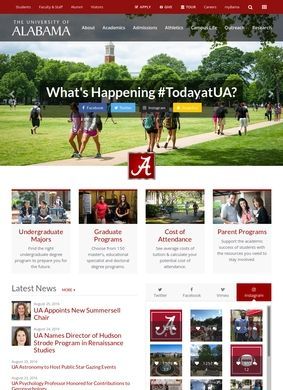
Prospective students and current ones alike get a fairly complete map of the institution from the main site of this public research university in Tuscaloosa. The University of Alabama presents more than 200 majors and degree programs spread across 12 colleges and schools, running the full ladder from undergraduate through graduate, doctoral, and certificate study. That breadth is the first thing worth knowing, and the site lays it out without much ceremony. This is a SACSCOC-accredited member of the University of Alabama System, which settles the academic standing before you read a single course description.
Academic programs across twelve colleges
The program count is large enough that it could feel like noise, but the structure underneath keeps it legible. Twelve colleges and schools each carry their own slice of the catalogue, and the recently created School of Data Science is where the institution is visibly putting fresh energy. It is built around artificial intelligence, analytics, and computing, which are the disciplines most universities are scrambling to formalize right now. Seeing it stood up as its own school, instead of bolted onto an existing department, says something about intent. A newcomer browsing the academic side gets a clear sense that the offering is not frozen in place.
School of Data Science signals institutional direction
A good deal of it. UA Online lists more than 100 programs delivered fully online, which is a serious commitment to distance study rather than a token handful of courses thrown onto the web. For someone tied to a job or a location far from Tuscaloosa, that range widens the pool of people who can treat The University of Alabama as a real option instead of an aspiration. The online catalogue sits alongside the residential one, so the two are presented as parallel routes into the same degrees, not as a lesser sibling.
Over 100 fully online degree options
Research is the other pillar The University of Alabama puts forward, and it does so with numbers that are easy to check against the institution's classification. Thirty research institutes and centers operate here, spanning science, engineering, the humanities, and assorted professional fields. The framing leans on addressing societal challenges, which is the standard language for this kind of work, but the count itself is the substance. Thirty distinct centers is a lot of organized inquiry, and it gives graduate students and faculty concrete homes for their work rather than a vague promise of a research environment. A long list of named centers is more telling than any mission statement, because each one represents budget, staff, and a reason to exist.
Thirty research institutes and centers
The way the research and teaching sides connect is worth a moment. A university running thirty centers while keeping more than 200 degree programs moving has to balance two appetites that often pull against each other, and the site presents both without pretending one is subordinate. Undergraduates get the full catalogue, doctoral students get the institutes, and certificate tracks sit in between for people who want a credential without committing to a full degree. The University of Alabama does not flatten these into a single pitch, which is the honest choice, because the needs of a first-year student and a postdoctoral fellow have almost nothing in common.
Student resources and campus infrastructure
What I find genuinely useful about how The University of Alabama presents itself is how much of the page is built for people who are already enrolled, not as an afterthought to recruitment but as an equal priority. The student-facing infrastructure is laid out plainly: the myBama student portal as the central hub, Blackboard as the learning management system, the campus libraries, IT support, and emergency management resources. A campus map and directory sit there too, along with student organizations and athletics. None of this is glamorous, but it is exactly the machinery a student touches every single day, and putting it within easy reach on the main site is a small kindness that plenty of large institutions get wrong.
MyBama portal, Blackboard, libraries, IT support
For the people on their way in, the admissions side covers the expected ground. There are dedicated recruitment pathways and a way to schedule a campus visit, which is the step that usually decides whether a student commits. A site trying to serve prospective undergraduates, graduate applicants, current students, faculty, staff, and researchers all at once can easily turn into a sprawl, and there is some of that here, but the major doors are findable.
Campus visit scheduling for prospective students
The visit-scheduling tool is a small detail that does real work. Plenty of large schools bury the campus tour behind a wall of marketing, and the fact that The University of Alabama keeps it close to the surface tells a prospective family that the institution expects them to come and look. For a high schooler narrowing a shortlist, the gap between an easy booking and a frustrating one can decide which campuses get a weekend.
It is worth being honest about what a homepage like this can and cannot tell you. The program counts, the number of colleges, the existence of the School of Data Science and the research centers, these are verifiable facts about scale. What they do not convey is the texture of any particular department, the quality of teaching in a given major, or how a specific online program compares with its residential twin. The University of Alabama is large enough that the experience almost certainly varies a great deal from one corner to another, and no top-level site can flatten that variation honestly. Anyone serious about a single program will need to dig into that program's own pages, and the catalogue gives them the starting points to do exactly that.
The data science move deserves one more line, because it is the clearest indicator of direction. Standing up a whole school around AI, analytics, and computing is an expensive, deliberate act, and it means The University of Alabama is reorganizing to meet the labor market instead of waiting for other departments to absorb the demand. Whether that school matures into a genuine strength or stays a name on the org chart is something only time will settle. But the bet is visible, and it is the kind of structural choice prospective students in those fields should weigh.
Athletics and student organizations
Athletics and student organizations get their place as well, which fits the reality of a flagship university where campus life is a substantial part of the draw. The University of Alabama does not oversell this; it simply points to it, and that restraint is welcome.
Pulling it together, The University of Alabama does the job a flagship institution's front door should do: it presents real scale honestly, serves both the recruited and the enrolled, and makes the academic structure legible without drowning the reader. The 200-plus programs, the dozen colleges, the 100-plus online options, and the thirty research centers are concrete facts a visitor can act on. My verdict is positive but measured. What the site cannot do, and does not pretend to do, is judge any single program, so the specific department that concerns you is where the real inquiry has to go. The depth lives one click deeper, and that is exactly where it belongs.