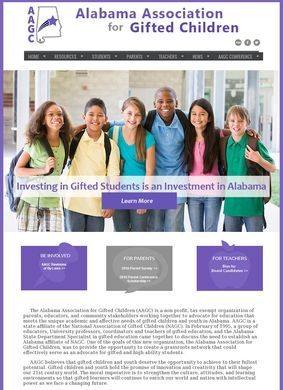
A parent whose child has just been identified as gifted usually walks in with the same worry: the label arrived, but the roadmap did not. What does the state actually require, who decides how much funding the program gets, and where does a family turn for something sturdier than a pamphlet? The Alabama Association for Gifted Children is built around exactly that gap, and it answers from two directions at once, the classroom and the statehouse.
The Alabama Association for Gifted Children is a nonprofit professional and advocacy body, the state affiliate of the National Association for Gifted Children. That affiliation gives the group its footing: the Alabama Association for Gifted Children plants a state-specific outpost on top of a national framework. The guidance stops being abstract. It gets aimed at Alabama's funding fights, Alabama's educators, and Alabama's families.
Advocacy that names the legislature
Plenty of education groups say they advocate. The Alabama Association for Gifted Children gets specific about the mechanism instead. The work centers on legislative advocacy for gifted-education funding, paired with guidance on how to contact elected officials, which turns a vague civic impulse into a task a parent or teacher can finish in an afternoon. Gifted programs are perennially exposed at budget time, treated as optional when money is tight, and the group is honest that the fix runs through the legislature.
Building the how-to for reaching a representative into the same place as the argument for why is a sensible piece of design.
That pairing is the useful part. Telling people to care about funding is easy. Handing them the steps to reach the person who controls that funding is where a group either does the work or does not, and the Alabama Association for Gifted Children clearly leans into the second half. It treats advocacy as something a member performs, with instructions, instead of something done on the member's behalf and reported back later.
I found the honesty of that framing quietly disarming, because it admits that a small state affiliate cannot move a budget alone and needs its members holding the phone.
The annual conference and its reach
The calendar anchor for the Alabama Association for Gifted Children is an annual conference. The 2026 edition carries the title "Unmasking Gifted Potential" and is set for October 7, 2026 at the Renaissance Mobile Riverview Plaza Hotel. Vendor and exhibitor registration is open, a sign the event is large enough to fill a floor with sponsors.
Naming a hotel, a theme, and a firm date does more for credibility than any mission statement could, because it shows the Alabama Association for Gifted Children plans in public and commits to specifics far ahead. An exhibitor track also means the conference works as a meeting point for the wider field, drawing in the people who build curriculum, tools, and services for gifted programs.
What a member gets for twenty-five dollars
Membership is refreshingly flat. Four tiers exist, Educator, Family or Parent, Student, and Vendor or Sponsor, and each one costs $25.00. No sliding scale, no premium level dangled above the rest. That single price carries a clear message: a student and a corporate sponsor pay the same to belong, and the Alabama Association for Gifted Children is not out to squeeze families for access.
The benefits behind the fee run wider than the flat price implies. Members get parent webinars reserved for the membership, along with professional-development resources aimed at educators, so the Alabama Association for Gifted Children is talking to the teacher during the school day and to the parent at the kitchen table after it.
That dual audience is the quiet logic of the whole operation. A gifted child sits between a classroom and a household, and support that reaches only one side tends to fall apart at the handoff. Keeping both webinars and educator resources under one $25.00 roof closes that gap in a practical way.
Two monthly podcasts extend the reach past the paywall. One, "AAGC Gifted Chat," runs fifteen to twenty minute conversations with leaders in gifted education. The other, "Think Like a...," explores different professions, which reads as content pointed at gifted kids rather than at the adults around them. Short episodes, a steady cadence, a clear audience. That is a podcast someone means to keep making. Two of them, on a monthly schedule, is a real editorial commitment for a state association, and it tells you the Alabama Association for Gifted Children wants a running conversation with its members all year long.
Grants, awards, and a video contest
Beyond the recurring media, the Alabama Association for Gifted Children runs an annual grant application program, award nominations, and a video contest. These are the pieces that turn a membership into participation. A grant gives a teacher or program a reason to write in with a real proposal, award nominations pull recognition into the open, and a video contest hands students something to make.
Each one asks the member to do rather than just receive, which is the mark of an association that expects its people to show up. A grant program in particular sends money back out to the classrooms, so dues fund the work directly.
None of these is enormous on its own. Together, though, they show a group that keeps handing members reasons to come back across the year, instead of collecting a fee and going quiet until the next conference. The mix of money, recognition, and creative work covers the three constituencies the Alabama Association for Gifted Children names most often: the educators who run programs, the families who support them, and the students at the center.
Where it fits for an Alabama family or teacher
The audience the Alabama Association for Gifted Children draws is deliberately broad: educators, parents and families, students, community partners, and the vendors or sponsors who back the field. That breadth is a strength for a state affiliate, because gifted education in practice depends on all of those parties talking to one another, and a single $25.00 membership is a low bar for any of them to clear.
There is a social layer too. The Alabama Association for Gifted Children keeps a presence on Facebook, X, YouTube, and Instagram, where the podcasts, the contest, and conference news most likely circulate day to day. For a parent who wants to sample the tone before paying, those channels are the front door. A search of the usual outside review platforms turns up no star ratings or public reviews attached to the group, which is ordinary for a small state-level nonprofit that runs on membership dues and an annual conference.
The obvious point of comparison is the national parent, the National Association for Gifted Children. NAGC carries deeper research libraries, a national conference, and a larger publishing arm, and a family that wants the widest possible base of material will find more there. What it cannot supply is Alabama. It will not tell you which state official to call about your district's funding, or gather you into a Mobile ballroom with the educators your own child will actually meet.
For that local, this-is-my-legislature specificity, the Alabama Association for Gifted Children is the sharper instrument, and a family can reasonably hold both memberships. Forced to pick just one, with the worry fixed on Alabama's own gifted programs and the district down the road, the state affiliate is the one that meets the problem where it lives, close enough to name the officials, the hotel, and the people in the room.