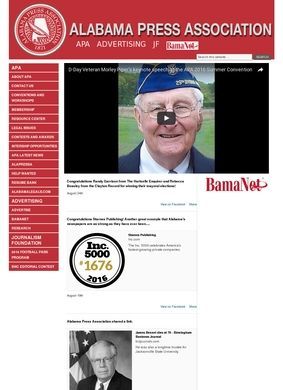
A legal hotline is the detail that tells you what the Alabama Press Association is really for. A newspaper editor in a small town, unsure whether a public body can lawfully close a meeting or withhold a document, can pick up the phone and get an answer instead of guessing. Add the legal manuals sitting alongside it, and you have an organization that treats access to public records as a working problem newspapers face every week, not an abstract principle.
The Alabama Press Association is the trade body for daily and weekly newspapers across the state, and the numbers give it weight: 105 active member newspapers, plus associate members drawn from vendors, colleges, universities, and other organizations tied to the industry. It exists to serve the papers themselves, the journalists who staff them, media professionals in the wider ecosystem, and students heading toward newsroom careers.
An association tied only to publishers would drift toward business concerns. One open to schools and vendors around the trade keeps a wider view of where the field is going, and the roster reads like a working industry rather than a shrinking club.
What membership buys
Strip away the mission language and look at what a member gets, and the picture is practical. A member directory to find peers and contacts. Industry news kept in one place. Help-wanted job postings, which for a sector that struggles to fill newsroom seats is a real convenience. Press cards. A football pass program, the kind of small, specific perk that only a genuine state association bothers to run because it knows what its members cover on Friday nights.
The legal side is the strongest part. A hotline plus manuals means a reporter facing a records refusal or an open-meetings dispute has somewhere to turn before the situation hardens into a lawyer's problem. That is the sort of shared resource no single small paper could staff on its own, and pooling it is exactly why an association like this earns its keep. For a rural weekly with one editor and no counsel on retainer, that phone line may be the single most valuable thing the Alabama Press Association provides.
Advertising and distribution as a revenue engine
The Alabama Press Association also runs a commercial arm, and it is not a token one. It places advertising across print, digital, and network buys, meaning a business wanting statewide reach can book through one point of contact instead of dealing with dozens of papers separately. There is also a press release distribution service. Placing that whole operation under the Alabama Press Association banner gives advertisers a single door into a market that would otherwise take weeks to work paper by paper.
For members, this is the money side of belonging. Network advertising and statewide placement bring in revenue that individual papers would find hard to chase alone, and the release distribution service turns the membership roster itself into a product. It is a sensible arrangement: the collective bargaining power of 105 titles put to work.
Events, contests, and the Foundation
The calendar centers on two gatherings, an annual summer convention and a media summit. These are the moments the membership comes together in person, which counts for something in a profession that can feel isolated at the small-paper level.
Then there are the contests. The Better Newspaper Contest hands out media awards, and the Alabama Press Association also recognizes lifetime achievement and emerging journalists. That last category is worth noting: an industry facing hard economics still bothers to name and reward its newcomers, which points to an interest in building a next generation, not managing a decline.
Foundation programs for students and newcomers
The Foundation arm carries the forward-looking work: scholarships for students, internship opportunities, and grant programs. This is where the interest of the Alabama Press Association in journalism students becomes concrete instead of rhetorical. A student in an Alabama journalism program has a named place to look for funding and a foot in the door of an actual newsroom.
Whether the grants are generous or modest is not something the site's overview settles, and anyone counting on this support would want to check the specifics. But the structure is there, and it connects the colleges and universities in the associate membership to the working papers in a way that could feed talent both directions.
Trade publications worth knowing
Two titles anchor the publishing output: AlaPressa and Alabama Publisher, described respectively as a bulletin-style read and a magazine. A media directory rounds out the catalog. For someone inside the industry, these are the channels where association news, member changes, and trade developments circulate.
A media directory in particular has value beyond the membership. Anyone trying to reach the right editor or understand the shape of Alabama's newspaper market has a reference to consult, and keeping it current is the kind of unglamorous work that makes an association useful to outsiders as well as members.
How the pieces fit
The Alabama Press Association is broad without being scattered. Legal defense, commercial advertising, professional recognition, student pipelines, and trade press each answer a real need a newspaper has, and they reinforce one another: the ad revenue supports the organization that runs the legal hotline that protects the reporting that the contests reward.
That interlock is the mark of an association that has been at this a long time. Nothing here feels bolted on to justify dues. Each service traces back to a problem newspapers actually have, from filling a vacant reporter slot to selling a statewide ad campaign to defending access to a sealed record.
A search for outside commentary on the Alabama Press Association turns up almost nothing in the way of public reviews or star ratings on consumer platforms; members interact with it directly through dues, meetings, and services, so its own site and publications remain the main source of information about how it runs. If there is a limitation to note, it is that nearly everything here is built for people already inside the newspaper world.
A general reader will find little to do with the site directly, and that is fine, because the Alabama Press Association was never meant to serve them. The value is aimed squarely at the trade, and it lands there.
The published material does not give exact dues figures, grant amounts, or scholarship values, so a side-by-side cost comparison is not possible from the site alone. What is clear is which pieces do the heaviest lifting: the legal hotline and manuals cover a recurring operational risk, the advertising network turns membership size into revenue, and the Foundation channels money toward students and new hires. Those three functions, taken together, describe an organization built around the actual mechanics of running a newspaper in Alabama rather than around dues collection for its own sake.