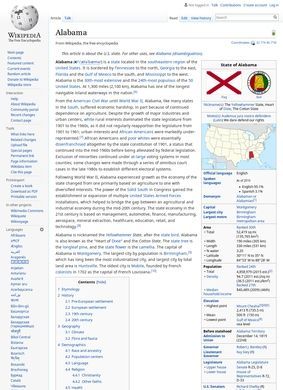
Alabama gets placed as the 30th largest state by area and the 24th most populous, admitted to the Union in 1819. Wikipedia: Alabama traces the state's name back to the Alabama people of the Muskogean language family, where the meaning is generally read as something close to "clearers of the thicket," though the page flags that this translation is disputed. That note is typical of how the article handles contested ground: it surfaces the disagreement instead of smoothing it over, which is more useful than it sounds when you are fact-checking in a hurry.
History and civil rights
History occupies the bulk of the page and moves in roughly chronological order. The pre-European material covers indigenous settlement and Mississippian culture before working through the Spanish, French, and British colonial periods. Then comes the antebellum cotton economy and its dependence on enslaved labor, followed by the Civil War, Reconstruction, and the long stretch of Jim Crow segregation that ran through the 1960s.
The civil rights section is among the most developed: the Montgomery Bus Boycott of 1955 and 1956 and the Selma to Montgomery marches both get substantive treatment instead of a passing line. Later sections pick up 20th-century industrial growth and the establishment of the NASA space program at Huntsville, then close with 21st-century natural disasters and economic modernization. Wikipedia: Alabama does not compress any of this into a timeline box; each period gets enough prose to convey cause and consequence beyond bare sequence.
Geography and natural features
The geography section is where Wikipedia: Alabama becomes genuinely useful as a quick reference. Total area is stated at 52,419 square miles. The terrain runs from the Gulf coastal plains up to the Appalachian foothills, with a humid subtropical climate and annual rainfall averaging around 56 inches. Those numbers sit in clean statistical tables instead of buried mid-paragraph, which makes pulling a specific figure fast. The section also names specific natural features: caves, waterfalls, and a meteorite crater all get entries. The biodiversity material goes further, noting nearly 4,000 plant species in the state. That figure points to real botanical surveys, not padded summary writing, and the citations underneath let you trace it back to the source if you need to.
Demographics, government, economy
Beyond geography, Wikipedia: Alabama carries the standard state-page structure: demographics, government, economy, education, and a cultural block covering music, sports, and the arts. Transportation infrastructure has its own treatment. None of these read as filler. Each section links outward to dedicated Wikipedia articles, so the page works both as a self-contained overview and as a hub for deeper reading. A reader following the cotton economy thread can jump directly into a detailed article on enslavement; someone interested in Huntsville can go straight to the history of the space program. That web of internal links is the main structural advantage over a flat fact sheet or a static encyclopedia entry.
The page also pairs its text with maps, photographs, and statistical tables throughout. Wikipedia: Alabama is a long read, and it rewards working through section by section instead of skimming the lead. A reader who wants the full account of the Selma marches or the Mississippian period will end up following links to the specialized articles, because a page this broad cannot go deep on everything. The lead and the section summaries are designed to point you there, which is the right approach, though it does mean the page is built for patience over a quick scan.
Sources and citations
Claims throughout carry inline citations, contested points are marked as contested, and the statistical tables are attributed. Wikipedia: Alabama does not present population figures or ecological counts as though they need no backing. For factual reference about the state, that combination of breadth and traceable sourcing puts it well ahead of most single-document starting points. The 4,000 plant species count, the 56-inch rainfall figure, the 1819 admission date: each one sits next to a citation rather than floating as a received truth.
Editorial standards
It is also honest about where coverage runs lighter. A contested etymology in the opening paragraph, a civil rights chronology that explicitly names dates and locations instead of gesturing at "events," and a geology section specific enough to mention a meteorite crater all suggest the article has been through serious editorial attention over time. Wikipedia: Alabama has the Wikipedia editing history to show what that attention looks like: not uniform perfection across every section, but a clear floor below which the sourcing does not drop.
Structure for navigation
Taken together, Wikipedia: Alabama is what a state encyclopedia entry should be: structured for fast navigation, honest about disputed facts, and transparent enough about its sources that a reader can go further without starting over. The practical approach is to read the lead for orientation, jump to the section you came for, and follow the inline citations out to primary material before quoting anything. The article holds that pattern consistently enough to work as a first stop, with the specialized articles handling the depth it cannot.