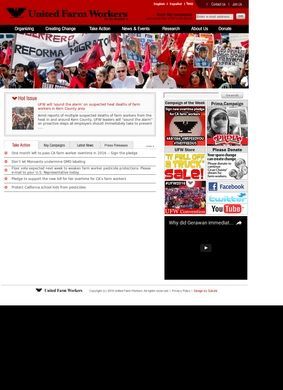
"Si Se Puede" is the United Farm Workers' rallying cry, and the website is built around living up to it. The United Farm Workers is a working labor union, one that organizes and represents the people who pick and pack the country's produce. The site puts its current fights up front: active organizing drives, petitions against specific bills, an ongoing boycott, and practical resources for workers who are in the fields right now. There is nothing ceremonial about it.
The United Farm Workers runs the site in English and Spanish, which is a plain necessity given who its members are, and the whole thing reads as an organizing tool, built to move people to act. Sections carry names like Organizing, Key Campaigns, Worker Voices, Know Your Rights, and Creating Change. Each one points at something a person can do.
Organizing drives and the campaigns in motion
The heart of the United Farm Workers site is its campaign work, and the list is specific enough to check. There is a New York organizing campaign, national advocacy for heat regulations to protect people laboring in extreme temperatures, and a push on immigration reform that runs through much of the United Farm Workers agenda. An action center gathers the legislative fights: opposition to a federal bill that would cut farm-worker wages, resistance to H-2A visa cap legislation, and petitions against immigration raids and ICE funding.
What makes this section worth reading is that it is current and concrete. These are named bills and named employers, with a specific ask attached to each one. A visitor trying to understand what farm labor is fighting over gets a clearer picture from the union's action center than from most news coverage, because the union states plainly what it wants and why. The tone is combative, which fits an organization whose whole purpose is a fight, and there is no pretense of neutrality.
The Windmill mushrooms boycott and union labels
The most pointed campaign is a boycott of Windmill, the Ostrom mushrooms brand, and it shows how the United Farm Workers still uses its oldest tool. A boycott turns the checkout line into pressure, asking the public to skip one company's product until it changes how it treats the people who grow the food. Paired with this is the union label system, the UFW Labels section, where a mark on a package tells a buyer the food was picked under a union contract.
Together they let someone support farm workers with a grocery decision, which is a rare thing for an advocacy site to make that tangible. A shopper does not have to attend a rally to take part; the ask is small and repeatable, which is the point of a consumer boycott.
What the site hands directly to workers
Beyond the campaigns, a large share of the site aims at the workers themselves. The Know Your Rights section is the clearest example, a plain guide to what a farm worker is legally entitled to, and that plain guide counts for a lot in a workforce that often includes immigrants who may not know the rules or may be afraid to ask. Worker Voices gives space to first-hand accounts, and Member Benefits lays out what joining the United Farm Workers provides in return for dues.
The site is pitched at current members and at workers who have not signed up yet, and it treats both as people it needs to reach.
The bilingual delivery is doing real work here. A rights guide only helps if the worker can read it, and offering the material in Spanish reaches the people most likely to need it. This is where the United Farm Workers works as a service organization for its members, beyond the political campaigning, and the two roles reinforce each other.
Know Your Rights, for a workforce that needs it
A Know Your Rights resource is standard for a union, but the stakes are higher in agriculture. Farm work is dangerous, seasonal, and often staffed by people with precarious immigration status, so a clear account of wage rules, heat protections, and what to do about mistreatment is genuinely useful. The United Farm Workers builds this into the same site as its donation forms and its store, so a worker looking for help and a supporter looking to give land in the same place.
That overlap is deliberate, and it is one reason the site holds together as more than a set of press releases.
A union with its own archive and store
The United Farm Workers keeps a research section that doubles as an archive: history, white papers, photos, video, and links. For a union with a long and heavily documented past, this is a real resource, and it is where the movement's story gets told in its own words instead of a textbook summary. Students, journalists, and organizers all have reason to dig through it.
The rest of the site fills in the practical edges. An About Us area lays out the vision, the executive board, and the trademarks the United Farm Workers defends, the union label being one it has reason to protect. A store and a monthly-giving option keep the operation funded. Endorsements and a news operation, with releases and campaign updates, round out a site that behaves like the communications arm of an active organization, because that is what it is.
The research library and the movement's record
The archive is the part with value beyond the union's own membership. White papers and a documented history give the United Farm Workers a claim to authority on farm labor that few other groups can match, because it has been in the fight the longest and kept the receipts.
Photos and video land differently than policy prose does; the images of the work and the people doing it make an argument on their own. For anyone researching American farm labor, whether to write about it, teach it, or organize around it, this material is a primary source and not a secondhand account.
Someone drawn to this issue might also look at the Coalition of Immokalee Workers, the Florida-based group whose Fair Food Program presses large buyers into signing worker-protection agreements instead of organizing conventional union contracts. The two work different angles on the same problem. The Coalition leans on retail and restaurant purchasers; the United Farm Workers organizes workers directly, negotiates contracts, and runs boycotts under a name that carries decades of history.
The union model, with membership, bargaining, and a long track record, is where the United Farm Workers has built its strength; supply-chain pressure on corporate buyers is where the Coalition has built its own. Each organization is playing to that strength, and neither approach makes the other obsolete.