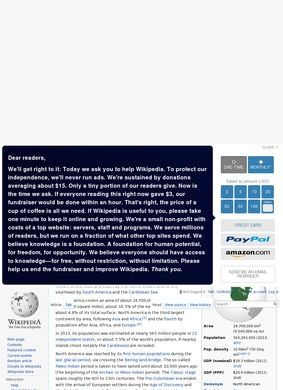
What does a single reference page need to cover before it can claim to explain an entire continent? Quite a lot, and Wikipedia: North America gets through most of it. The article opens with the basics a reader usually wants first: a landmass of 24.7 million square kilometres, roughly 16.5 percent of Earth's land surface, and a population north of 592 million spread across 23 independent states and territories. That places the continent fourth in the world by people, and the page states it plainly without dressing the numbers up.
Three subregions of the continent
From there the structure follows the shape geographers use. Wikipedia: North America splits the continent into three subregions, and the article keeps them distinct: Northern America (Canada, Greenland, the continental United States, Bermuda, and the small outliers of Saint Pierre and Miquelon), Middle America (Mexico and Central America), and the Caribbean. Splitting Greenland and Bermuda away from the obvious giants is the sort of precision that signals the entry was written by people who care about getting the boundaries right, not by editors who stopped at listing the famous countries. I found that breakdown more useful than the single-paragraph summaries you get on lighter reference sites.
How big is North America's economy?
The economic section carries real figures, not vague claims. GDP measured by purchasing power parity sits around US$36.6 trillion, second in the world, with nominal output near US$34.61 trillion and per-capita GDP in the region of US$67,000. Numbers like these date quickly, which is exactly why the volunteer-editing model behind Wikipedia: North America matters: estimates get revised as new data lands. Anyone using the article for coursework or background research should still click through to the cited sources, because that is where the original tables and methodology live.
Demographic and cultural coverage is similarly concrete. English, Spanish, and French anchor the language section, with proper acknowledgement of the many indigenous languages still spoken across the continent. Religious composition is given as roughly 74.6 percent Christian and 19.2 percent unaffiliated. The major urban centres are named, Mexico City, New York City, Los Angeles, Chicago, Toronto, and Washington D.C. among them, which gives the population figures somewhere to land. History gets honest treatment too, with at least 20,000 years of indigenous settlement recorded before European colonisation arrived in 1492, so the continent's story does not begin where older textbooks once started it.
Additional sections beyond the headline data
Beyond the headline data, Wikipedia: North America runs the full set of sections you would expect from a serious geographic overview: geology, climate, biodiversity, politics, transportation, and sport, each with its own treatment. None of these are dead ends.
Linking to deeper sub-articles
The article is built as a hub, linking outward to dedicated sub-articles, regional pages, maps, and related continental topics, so a reader chasing one thread, say the climate zones or the political makeup, can follow it as deep as they need. That web of internal links is the practical strength of the page; it works less like a finished essay and more like a doorway into a far larger reference. Among the countless entries you might land on through a business directory or a search result, Wikipedia: North America is one of the few that genuinely improves the further you click into it.
Weighing the caveats of crowdsourced editing
A couple of caveats are worth stating, because no reference is perfect. Wikipedia: North America is continuously edited by volunteers, which is its greatest asset and also the reason a careful reader verifies anything load-bearing against the footnotes. Figures shift between revisions, and the occasional section runs heavier or lighter than its neighbours depending on which editors have been active. The open licence, CC BY-SA, means the text can be reused freely, but it also means the page is a living document, not a fixed, signed-off publication. For most purposes that trade is well worth it. The breadth on offer here far outstrips what a static encyclopaedia entry could keep current.
Free access across language editions
Accessibility is one more point in its favour. Wikipedia: North America is free, carries no paywall, and the language-switcher lets a reader move between Wikipedia's many editions, which is useful on a continent where English, Spanish, and French each have a genuine claim to being the dominant language. A student in Toronto and a researcher in Mexico City can both reach a version in their own language without hunting for it.
Wikipedia: North America is the right starting point for a student building a report, a writer who needs reliable continental figures quickly, or a curious reader wanting one organised map of geography, economy, history, and culture in a single place. Treat it as the first stop, not the last: read the overview, then follow the citations and sub-articles to the primary sources behind any number you plan to quote. The page gives a clear picture and points toward better detail wherever you need to go deeper.