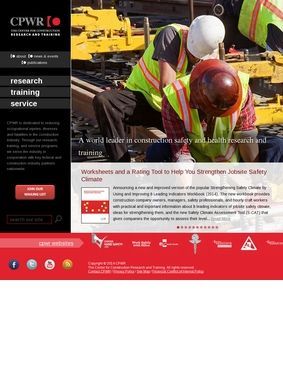
More than 50,000 construction workers a year pass through training tied to CPWR, and that one figure tells you what kind of operation this is: a research center that puts its findings in the hands of people swinging hammers and handling hazardous waste. CPWR sits at the intersection of academic occupational health research and the building trades, with funding ties to NIOSH and the unions that represent the people doing the work. That dual identity, half data shop and half field-training body, runs through everything on the site.
Research output and data tools
The research output is the spine of CPWR. The center conducts industry-driven studies on occupational hazards in construction and publishes peer-reviewed work, but the part that deserves attention is how much of the underlying data is open and interactive. The Construction Chart Book is the headline asset here, a long-running compilation of statistics on the industry with dashboards you can move through rather than a static PDF dumped onto a server. Alongside it runs the Construction FACE Database, drawn from Fatality Assessment and Control Evaluation work, which catalogs how workers died on the job and what could have prevented it. For a researcher, a safety officer, or an investigative reporter, that is raw material to dig into, not a summary you have to take on faith.
Construction Chart Book and FACE Database
Training is the other half of what CPWR does, and it is sizeable. The center runs hazardous waste worker training, programs tied to the Department of Energy's hazardous waste operations, HAZMAT disaster preparedness, and environmental career training. This is where that annual figure of tens of thousands of workers comes from. It is also where CPWR stops being abstract: the worker who completes a HAZWOPER course or a disaster-response module is the end point of the research-to-practice loop the organization describes. The r2p framing could easily be jargon, but at CPWR it maps onto something concrete, namely studies on one end and certified, trained people on the other.
Training programs for hazardous waste
The field-facing materials are the part of CPWR most likely to get used by someone who will never read a journal. CPWR produces toolbox talks, hazard alert cards, fall prevention resources, and a growing body of mental health and suicide prevention material aimed at a trade with a documented problem in that area. Many of these come in Spanish as well as English, which is no small detail given the makeup of the construction workforce. A foreman can print a hazard alert card and pin it to a trailer wall; that is a different kind of output than a peer-reviewed paper, and CPWR clearly treats both as legitimate work.
Field materials in multiple languages
There is also a deep library of on-demand webinars, more than a hundred of them, which means a contractor or worker can pull specific guidance without waiting for a scheduled session. Add to that the technical and regulatory assistance CPWR provides, plus its seat on advisory committees, and the picture is of an organization that feeds into rule-making and standards as well as front-line practice. The breadth is the strength here. The open question is whether a casual visitor can navigate between the scholarly tier and the toolbox tier without getting lost, because the two audiences want very different things from the same homepage.
From webinars to advisory committees
One more program deserves mention because it is unusual: CPWR operates the Building Trades National Medical Screening Program and manages an energy worker database. Medical screening for current and former workers, particularly those exposed in nuclear and energy facilities, is a long-tail public health commitment that most training bodies would never take on. It points to an institution thinking in terms of decades and exposure histories rather than course completions alone.
Medical screening and energy worker database
Who is CPWR for, in plain terms? Construction workers and the contractors who employ them are the obvious audience, but CPWR is equally built for site owners weighing safety obligations, academic researchers mining the data, union safety departments, and government agencies that lean on the center's evidence base. That is a wide tent. Serving all of them at once is part of what makes CPWR credible, and it is also part of what makes the site feel like several sites stacked on top of each other. The homepage cannot optimize for a hazmat trainer, a congressional staffer, and an ironworker all at once, and the strain shows in how the navigation is organized.
Multiple audiences, navigation challenges
The data tools are the clearest demonstration of what CPWR is and does. Maintaining an interactive fatality database and a regularly updated chart book is the harder, less visible version of a commitment to construction safety, and it is verifiable in a way that a mission statement never is. The numbers are there to be checked, argued with, and cited, which is exactly what you want from a body that shapes standards and feeds into federal rule-making.
A search across the main review platforms turns up no consumer ratings for the center, which is entirely expected. The organization's credibility does not rest on star averages; it rests on peer-reviewed publication records, NIOSH funding relationships, and the volume of trained workers that CPWR documents in its own reporting. Peer review and federal grant accountability are the trust mechanisms here, and both are visible if you follow the citations and the grant disclosures on the site.
If there is a weak seam, it is the sheer number of programs running in parallel. Hazardous waste training, DOE work, disaster preparedness, environmental careers, medical screening, the energy database, the chart book, the FACE database, the webinar library, the printed field cards: each is substantial, and a visitor arriving for one of them has to filter through the rest. The depth is considerable, and so is the risk that a contractor looking only for a fall-prevention card has to wade past nuclear-worker screening to find it. Whether CPWR does enough to route its very different users to the right shelf is the hardest thing to assess from the outside.
The answer has real consequences: the value of what CPWR has built depends entirely on a worker being able to reach the specific resource that keeps them safe, and a site that buries the right tool behind unrelated programs is failing at the last step. The research side clearly holds; the navigation question is the one that lingers.