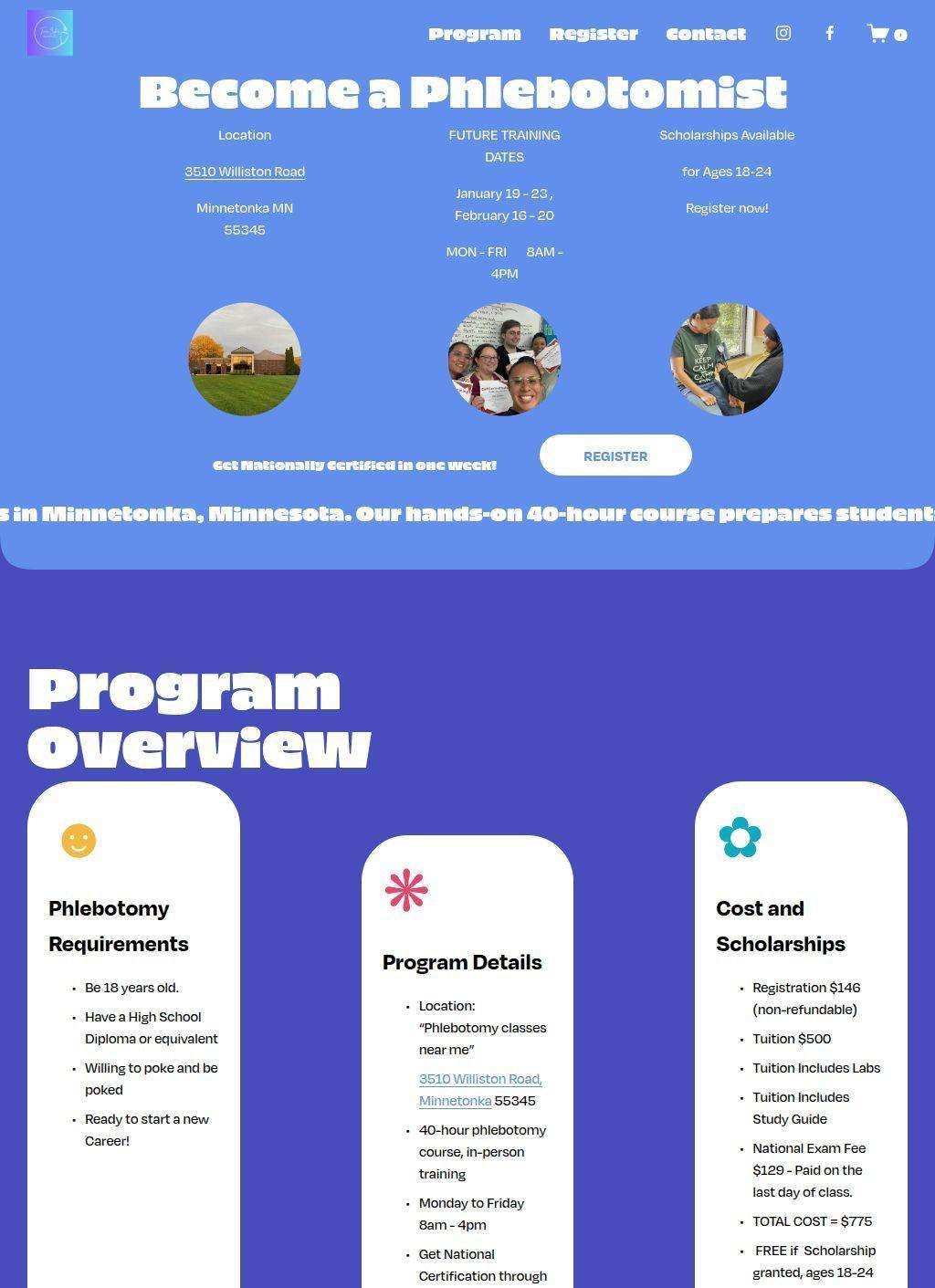
Can someone with no medical background get certified to draw blood in a single work week? Twin Cities Medical Training answers yes, and it attaches real numbers to the claim: forty hours, Monday through Friday, eight in the morning to two in the afternoon, in a classroom in Minnetonka, Minnesota. The course points students toward national certification through NAPTP and toward entry-level jobs in labs and clinics, and it is built for people starting from nothing.
The entry bar is set low on purpose. Twin Cities Medical Training asks a student to be eighteen, to hold a high school diploma or GED, and to bring no prior medical experience whatsoever. That makes the intended audience plain: career-changers and first-jobbers who want a usable credential fast, without committing to a semester-long college program to get it.
The certification is the payoff, and it helps to understand what it buys. National certification through NAPTP is the credential employers look for when they hire an entry-level phlebotomist, and Twin Cities Medical Training aims the whole forty hours at passing that exam. A course that ends without a recognized certificate is just practice. This one ends with the paper that opens a lab door.
One week to a certification
The whole pitch rests on speed and hands-on practice. Forty hours is a short runway for a clinical skill, so what gets packed into the week is what counts, and Twin Cities Medical Training front-loads the actual work over theory.
Registration and the fine print run through the site's lessons page, which lays out the program overview, the requirements, the cost and scholarship details, an FAQ, and the training schedule with dates. A prospective student can read almost everything they need before ever picking up the phone.
Inside the curriculum
The course covers venipuncture technique, specimen handling, infection control, patient communication, and preparation for the national exam, with lab materials and study guides folded into the price. That is the right spread for entry-level phlebotomy: the needle work itself, the safety discipline around it, and the human side of steadying a nervous patient who does not want to look at the tube.
In-person, hands-on instruction is the correct call for a skill nobody learns from a slideshow, and Twin Cities Medical Training keeps the whole thing in a physical classroom instead of pushing it online. For a student who will be sticking real people with real needles inside a month, that insistence on live practice is reassuring.
Compressing a clinical skill into a single week does put weight on the teaching, and there is a fair question about whether five days is enough repetition to leave a new phlebotomist confident with a live vein. Twin Cities Medical Training answers by keeping the format hands-on and in the room, which is the only honest way to build that muscle memory, though a cautious beginner might still want extra practice before a first real shift.
Cost, and the scholarship route
The money is laid out openly, which counts for a lot in a field thick with vague pricing. Non-scholarship students pay a registration fee, tuition, and a national exam fee that add up to a total in the high seven hundreds, with the registration portion marked non-refundable up front. A student knows the full number before enrolling, not after.
There is a genuine second path as well. Qualifying applicants between eighteen and twenty-four can receive scholarships or free training through a partner organization, Achieving Dreams, Inc. Free training toward a recognized certification is a strong offer for a young person weighing a first career step, and Twin Cities Medical Training printing the entire cost breakdown on the page, rather than burying it behind an inquiry form, is the sort of plainness that earns a little trust before anyone enrolls.
The Achieving Dreams partnership is the quietly generous part of the whole thing. A free path to a paid certification, aimed at eighteen-to-twenty-four-year-olds, is a real on-ramp for young people who could not front several hundred dollars, and it lifts Twin Cities Medical Training above the many private programs that leave cost as somebody else's problem to solve.
How it holds up
Getting in touch is easy. Twin Cities Medical Training shows an address and a phone-and-text line directly on the site, alongside links to its Instagram, TikTok, YouTube, and Facebook. Nobody has to dig for a way to reach the school, which is exactly what a prospective student wants from a small, local training outfit.
The visibility of those details, and the completeness of the lessons page, both work in the program's favor. That is a fuller profile than the average business directory listing manages, most of which stop at a name, a phone number, and a category. A student can assemble a full picture of the schedule, the cost, and the requirements on their own time, then make one call to lock in a seat.
The 98 percent claim and the review gap
The site advertises a 98 percent passing rate. That figure deserves the same caution any self-reported statistic does, because it comes from the school with no outside audit attached to it, and a passing rate is easy to state and hard for an applicant to independently confirm.
The wider gap is reputation. Twin Cities Medical Training appears on Yelp, filed as a vocational and technical school, and on Yahoo Local, plus its own Facebook and Instagram profiles, yet none of those listings carries a star rating or a visible review count. No notable third-party reviews turned up anywhere in a search. For a program asking students to part with several hundred dollars and a week of their lives, the absence of any independent feedback is the honest caveat to raise, and it is a real one.
None of that silence proves the training is weak. It only means a prospective student has to decide on the program's own presentation, with no crowd verdict to lean on, which is a fair amount to ask before handing over the fee.
So the offering itself is concrete and the terms are transparent: a short, hands-on course, a clear total price, a free route for younger applicants, and certification through a recognized body. What is missing is the voice of the people who have already done it, the graduates who spent the forty hours and walked into a lab job on the strength of the certificate. That is the one question the site itself cannot answer: where Twin Cities Medical Training's graduates ended up, and whether the forty hours actually opened the door it promises.
Business address
Twin Cities Medical Training
3510 Williston Road,
Minnetonka,
MN
55345
United States
Contact details
Phone: +1 (612) 451-8203