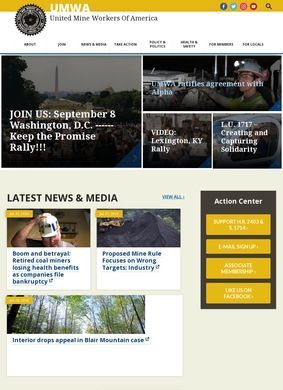
UMWA's website hands a would-be member an electronic authorization form on the way in, sets a Navajo Nation checkoff form and a public-employee checkoff form beside it, and keeps a whole members-only wing on pensions and retiree health care further in. This is the official site of the United Mine Workers of America, and the union it represents reaches a good deal wider than the name would suggest.
Coal is the history. The membership listed here spans mining workers, public employees, manufacturing and health care workers, Navajo Nation members, and retirees, which sets the tone for the whole site: a working tool for members first, a reference for everyone else second.
Who the union speaks for
The About section lays out the shape of the organization. There is a Who We Represent page, a Leadership page, and a Where We Are section that maps the union across numbered districts, District 2 through District 31, plus a UMWA Canada arm across the border. For a reader trying to understand how a national union is actually organized, that structural map is the useful part, and it makes plain that the UMWA is a federation of districts rather than a single office.
History gets real estate too. A History section with a Collection and Archives holds the union's documentary record, and the archive is the piece I would point a labor historian toward first. The site treats the UMWA past as material to be kept and consulted, not as decoration around the edges, well past what a plain business directory entry would ever hold.
Beyond the coal miners
The membership breadth is the thing most casual visitors get wrong about the union. Alongside miners, it counts public employees, manufacturing workers, health care workers, Navajo Nation members, and a large body of retirees whose pensions and health care the organization still administers.
The Navajo Nation checkoff form in the Join section is concrete proof of that reach, a piece of machinery built for one specific membership that a mining-only union would have no reason to carry. It reflects a real, mixed membership rather than a single-industry outfit.
Joining and the members-only side
The Join section is built to move someone from interested to signed up. It carries the electronic authorization form, a Why Union? page and a Know Your Rights page for people weighing the decision, an Associate Membership route, the two checkoff forms, and a credit card portal for dues. The Know Your Rights material especially is plain, usable content a worker can read through before deciding, and the Why Union? page does the persuading that a form alone cannot.
Associate Membership is a nice touch, opening a door for supporters who are not eligible for full membership but want a formal tie to the UMWA. Past that point, the For Members area is where the site does its heaviest lifting. Membership benefits, pensions and retiree health care, laid-off member resources, legal help, veteran resources, and members-only pages sit together, showing that the real audience is the existing member with a specific problem, not the browsing outsider.
The join forms and checkoffs
The forms are worth calling out because they are the working core of the Join section. An electronic authorization form takes the paper step out of signing up, while the Navajo Nation and public-employee checkoff forms handle two distinct membership routes with their own rules.
A credit card portal for dues finishes it off. This is functional infrastructure, and it is the part of the site a new member will actually touch on day one.
Pensions, benefits and laid-off resources
For retirees and members who have lost work, the For Members section is the reason to visit. Pensions and retiree health care get their own pages, and the laid-off member resources speak to a hard fact of coal-country employment.
Legal and veteran resources sit right alongside them. A union that keeps this much material aimed at people no longer actively working is answering something its members plainly need, and the depth here is a fair measure of the UMWA's priorities.
News, campaigns and the archive
The News and Media section keeps the union's public voice: press releases, in-the-news items, videos, the UMW Journal, and a books and music listing. The UMW Journal is the long-running membership publication, and its presence online gives a reader a running record of what the UMWA is saying and doing month to month.
Take Action is where the site turns from information to organizing. It gathers local union meetings, current legislation to track, health and safety material, and mine academy safety-committee training, alongside the "Preserving Coal Country" and "Protect WV Coal, Protect WV Jobs" campaigns.
The campaigns and safety training
The campaigns give the UMWA site a clear political edge, and it makes no attempt to hide it. "Preserving Coal Country" and "Protect WV Coal, Protect WV Jobs" are named efforts tied to West Virginia coal jobs, and the current-legislation and health-and-safety pages back them with the practical detail a member would use to act. The mine academy safety-committee training is the most concrete of the lot, actual instruction aimed at the people who serve on safety committees underground, where the stakes of getting it wrong are measured in lives.
The doubt is one of navigation, not substance. Between About, Join, News and Media, Take Action, For Members, For Locals, a store, and a set of FAQs, the site carries a great deal, and much of the most valuable material sits behind members-only pages a general visitor cannot open. Finding the one relevant page can take some hunting, since the UMWA site trades ease of browsing for sheer depth of coverage.