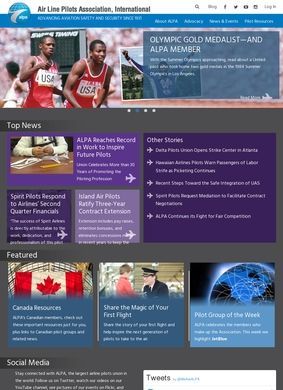
What does a pilot actually get for belonging to a union that predates most of the airlines still flying today? At ALPA, the answer is collective weight. It negotiates on behalf of more than 80,000 pilots at 42 carriers across the United States and Canada, and ALPA is the largest airline pilot union in the world. It has represented flight crews since 1931.
That longevity is worth pausing on. The aviation industry those first members knew has been remade several times over, through deregulation, waves of bankruptcy, and a run of mergers that swallowed famous names whole, and the union has come through every version of it still bargaining. Very few labor organizations of any kind can point to that span, and fewer still that have kept the same core purpose intact across it.
The live website would not load during this review, returning server errors on repeated attempts, so the assessment here rests on the association's well-documented record instead of a walk through its own pages. That record is substantial enough to stand on. What it does is well established. It bargains airline contracts and carries a large safety brief, and it lobbies on the laws that touch both.
Collective bargaining at industrial scale
Contract negotiation sits at the center of what ALPA does. When pilots at a particular airline settle their terms on pay, scheduling, retirement, and job security, ALPA is the organization on the other side of the table, drafting the language that will govern their working lives for years at a stretch. This is slow, technical work, closer to law and accounting than to anything glamorous about flying, and it is where the membership fee turns into something concrete.
The union does not impose those terms. ALPA bargains them and then puts the result to a member vote, which keeps the leadership answerable to the pilots it represents. That accountability shows up in the numbers: one contract can reset pay scales and career expectations for thousands of people at a stroke, and a body negotiating on that scale needs a mandate its members granted directly.
Recent contracts at FedEx and Delta
Two recent cases show the range of the work. FedEx pilots ratified a contract through ALPA, closing out a long negotiation that touched thousands of cargo crews and the freight operation they fly for. At Delta, ALPA has been working through a pilots' contract of a very different shape, one built around a passenger network with its own economics and its own pressures.
The mechanism underneath is the same in both places: the union carries the negotiation, and the membership votes the outcome up or down. What is striking is the breadth. Cargo and passenger flying run on different economics and different schedules, and an organization that can bargain credibly across both is doing something a single-airline group would struggle to match.
Pay, benefits, and working conditions
Past any single contract, ALPA presses on the wider terms of the profession. Benefits, fatigue and rest limits, and the daily conditions that decide whether flying stays a career worth keeping all fall inside its remit. For a pilot weighing one airline's offer against another's, the strength and track record of ALPA representation is a genuine factor in the decision, sometimes as important as the pay figure itself.
This is the quiet, continuous half of the work. It rarely makes headlines, and it shapes what the job feels like from one month to the next far more than any single ratified contract does. Scheduling rules alone can be the difference between a pilot who is home for dinner most nights and one who is not, and those rules are won or lost in the same negotiations.
The safety brief the public never sees
Aviation safety is the second pillar, and it is the one passengers benefit from without ever learning the union exists. ALPA calls itself the largest non-governmental aviation safety organization in the world, and the claim holds up against what the organization does day to day. Pilots meet the failure modes and near-misses that regulators and manufacturers often see only after the fact, from the cockpit, in real conditions.
It routes that firsthand knowledge into safety analysis and accident investigation, and its representatives sit in on the technical work that follows serious incidents. Little of that work is visible to the flying public, which is exactly why an independent account of it has value.
There is a reason a union, and not an outside body, runs this work. Labor and safety are joined at the root. A rested, fairly scheduled crew is a safer crew, so a fatigue rule is a bargaining issue and a safety issue in the same breath, and the organization that negotiates the roster is well placed to argue about the risk built into it. That overlap gives ALPA a standing on safety questions that a pure lobbying group would find hard to earn.
Lobbying on the 1,500-hour rule and the ALERT Act
A good deal of that effort ends up in legislation. ALPA has taken positions on the 1,500-hour rule, the minimum flight-experience threshold for airline first officers, and on measures such as the ALERT Act. A reader need not agree with the union on any given bill to recognize the pattern: it lobbies on the rules that decide who may occupy a cockpit seat and under what conditions they fly.
Few outside voices carry comparable standing on those questions, for the simple reason that few can claim to speak for tens of thousands of the people actually doing the flying. When ALPA testifies on a flight-experience rule, legislators know the position comes from the working end of the profession.
Backed by the AFL-CIO and the global IFALPA
ALPA does not stand alone. It is an affiliate of the AFL-CIO, which ties it into the broader American labor movement and the political weight that comes with it, and it is a member of the International Federation of Air Line Pilot Associations, the global body that links pilot unions across many countries. Those affiliations extend its reach well past its own membership rolls.
Through the AFL-CIO it shares in coordinated labor action and lobbying; through IFALPA it connects North American pilots to counterparts abroad who fly the same aircraft and wrestle with many of the same safety questions.
Whether it is worth consulting
For anyone trying to understand how airline pilots in North America are organized, ALPA is the primary source rather than a secondary account of one. It is the entity that negotiates the contracts and files the safety positions, so its own material sits closer to the ground than secondhand reporting about it. Nine decades of history sharpen that further. A union that has bargained through deregulation, bankruptcy filings, and a long series of mergers has institutional memory that no recent arrival can match, and that memory shows up in how it frames a contract fight or a safety argument.
The site being unreachable is a real limitation on any close read of it, and worth stating plainly. Even so, the substance is not in doubt. The organization's scale and its record are corroborated well beyond its own pages. A reader who lands on this listing gets a resource whose importance is easy to verify from independent sources, and the union's own reporting can be read alongside that outside coverage without much risk of spin going unchecked.
The natural comparison is IFALPA, the international federation ALPA belongs to. IFALPA spans far more of the globe, but it is a federation of associations, not a bargaining agent, and it does not sit across the table from Delta or FedEx. For a pilot in the United States or Canada, or for anyone studying labor inside the region's airlines, ALPA is the more direct and more consequential of the two. IFALPA is the wider lens; ALPA is where the contracts actually get signed.