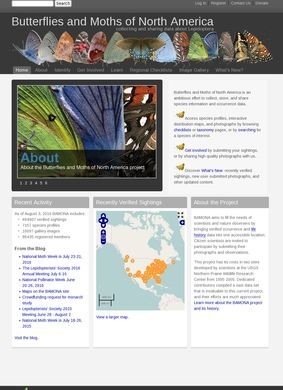
Type a region into the species checklist tool, pick butterfly or moth, and you get back a tailored list of what flies in that corner of the continent. That single feature gives a good sense of what Butterflies and Moths of North America is built to do: turn scattered Lepidoptera records into something a curious person can actually query. The project, run by the Butterfly and Moth Information Network, tracks species from Panama up through Canada, and the database is the heart of it.
Species profiles with host plant data
The numbers behind it are not trivial. More than 7,000 species profiles sit in the collection, each one carrying life history notes, identification tips, caterpillar host plant data, and distribution maps. That host plant detail in particular is the sort of thing a gardener planting for pollinators or a naturalist trying to confirm a caterpillar will keep coming back for. Profiles are written to help someone figure out what they are looking at, avoiding walls of taxonomy with no practical exit.
Photo identification by regional coordinators
What lifts the whole thing above a static reference is the identification service. A visitor can upload a photo of a butterfly, moth, or caterpillar and have it reviewed by collaborating lepidopterist coordinators, real people with regional knowledge who confirm or correct the guess. Submissions that check out feed the dynamic occurrence maps, so the photo someone took in their backyard becomes a verified dot on a distribution map that the next person consults. It is a loop where contribution and reference reinforce each other, and it explains why the maps feel current instead of frozen.
Public data shared with research networks
Butterflies and Moths of North America does not keep its records walled off. The verified occurrence data is quality controlled and then made publicly accessible, shared with GBIF, the Global Biodiversity Information Facility, as well as USGS and ScienceBase. A sighting logged here enters the wider pool of biodiversity data that researchers and agencies draw on, which is a meaningful step up from a hobby site that collects photos and stops there.
From museum collections to citizen submissions
The inputs are broader than citizen submissions alone. Records also come from museum and personal collections and from published literature, which gives the database a backbone of vetted historical data underneath the live, crowd-sourced layer. The combination is sensible. Casual observers supply volume and recency, while the institutional sources supply depth and confirmation. A naturalist deciding whether a species has genuinely shifted its range gets the benefit of both.
Recognition from the wider community backs this up. SciStarter, iNaturalist, informalscience.org, thebutterflynetwork.org, and a USGS-NBII fact sheet all point to the project approvingly. When the citizen-science world and a federal science fact sheet both treat a resource as a reference, that tells you more than any badge on the homepage could.
Funding works the way it does for a lot of volunteer-driven science projects. Butterflies and Moths of North America runs on donations, both one-time gifts and recurring support through fundraisers, and it leans on that money to keep operating. There is also a BAMONA Shop selling branded merchandise, and a portion of the proceeds from its Earth Day edition goes to Pollinator Partnership. None of this is dressed up as a revenue engine. It reads as a small operation keeping the lights on so the database stays free to use.
If there is a limitation worth naming, it is that the value depends on participation. A regional checklist or an occurrence map is only as complete as the records people have bothered to submit and the coordinators have had time to verify. In well-covered areas the maps will feel rich; in poorly observed regions a species may be present but barely represented. That is the honest trade-off of any crowd-sourced dataset, and Butterflies and Moths of North America is upfront enough about its sources that a careful user can read the gaps for what they are.
Set against comparable tools, the mix here is unusually practical. The photo identification by named coordinators, the host plant data, the regional checklist generator, and the pipeline into GBIF together make Butterflies and Moths of North America useful to several kinds of visitor at once: the backyard observer who wants a name, the teacher building a lesson, the gardener choosing plants, and the researcher pulling occurrence data. Few free resources cover all four without asking for a subscription.
Butterflies and Moths of North America is the rare free resource that holds together across multiple use cases without demanding a login or a payment. The evidence on the page, from the GBIF feed to the named coordinator network, is concrete enough to act on.