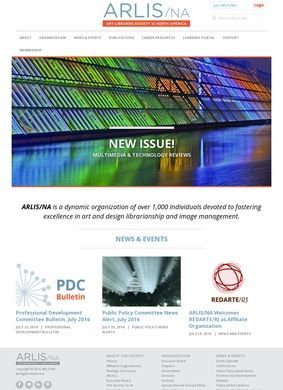
Art librarians occupy a peculiar corner of information science: they need depth in cataloguing and metadata practice, but also fluency in art history, visual culture, and the peculiarities of image rights. That combination is too narrow for general library associations to address well, and it is the exact gap the Art Libraries Society Of North America was built to fill.
Founded as a 501(c)(3) professional association, the Art Libraries Society Of North America brings together more than a thousand art and design information specialists across the continent, including librarians, visual resources professionals, curators, educators, and students. The breadth is intentional. Having the person who acquires the books in the same organization as the person who manages the image database, and both of them alongside the student who will do one or both jobs in a few years, makes for a more complete professional community than a narrower membership would allow.
Publishing for art and design information specialists
The publishing program is one of the most concrete things the Art Libraries Society Of North America does. Art Documentation, the society's peer-reviewed journal, gives the field a scholarly venue specific to art and design librarianship, instead of relying on general library science titles. For a specialty this focused, having dedicated editorial infrastructure is not a small thing. Beyond Art Documentation, the Art Libraries Society Of North America publishes specialized review publications covering areas like digital art history and graphic novels. That second area is worth pausing on. Graphic novels in an art library context sit at the intersection of artists' books, sequential art studies, and popular visual culture, and treating them as deserving their own critical coverage says something about how the Art Libraries Society Of North America reads what the field collects and studies.
Connecting isolated practitioners across the continent
Membership comes with access to a professional directory, and in a specialty where many practitioners are the only art librarian at their institution, that directory is genuinely useful. The nearest colleague who understands your specific cataloguing dilemmas or knows how to handle a particular image rights question might be several states away. The Art Libraries Society Of North America turns that isolation into something more workable by giving members a way to find each other. The programming calendar extends that connective function across multiple formats. An annual conference is the major gathering, but the Art Libraries Society Of North America also runs regional study tours that put members inside specific collections, webinars for continuing education that do not require travel, lunchtime networking sessions, and mentoring programs for people earlier in their careers.
Job listings and mentoring for early-career librarians
Those mentoring programs and the job and internship listings are worth noting specifically for students and early-career librarians. Art librarianship openings are specialized enough that watching general library boards can mean missing postings that would have been a strong fit. Having listings aggregated by the Art Libraries Society Of North America, alongside mentoring from people already working in the field, shortens a path that can otherwise feel long and opaque. A person finishing graduate work in art history or library science can find job leads, connect with a mentor, and build peer relationships through a single association, without assembling those things from scratch across multiple channels.
Building community infrastructure between annual events
The society also maintains a Commons platform for member collaboration and archived media. That platform is easy to underestimate from the outside. A great deal of what makes a professional community durable is its between-event life: the working groups that continue a conversation started at the conference, the recordings of webinars that remain available after the live session ends, the informal exchanges among members working on related problems. The Art Libraries Society Of North America's Commons is designed to hold that ongoing activity, so it does not evaporate between annual gatherings. Archived media in particular is something many organizations handle poorly; keeping recordings accessible gives the community a cumulative resource in place of a series of one-time events.
Why image management matters in art libraries?
Image management comes up in the organization's stated priorities, and it is accurate to flag it. Digital collections at art institutions have grown faster than most libraries can comfortably handle, and the metadata and rights questions that come with large image archives are genuinely distinct from those attached to text collections. An association that names image management alongside traditional librarianship as a core concern is reading its members' actual daily work. The Art Libraries Society Of North America is not a general library group with art titles shelved in one section; the whole structure of the organization, its publications, its events, its programming, is oriented around the specific problems people in this field face.
One thing worth being direct about: the value of membership here is participation-dependent. The directory, the Commons, the mentoring, the study tours, and the webinars all reward members who engage with them. Someone who joins, glances at the journal once, and lets the membership lapse will get little from it. That is not a critique specific to the Art Libraries Society Of North America; it applies to nearly every professional society, but it is worth naming. The Art Libraries Society Of North America provides a substantial amount of infrastructure for a working professional, and most of it requires the member to use it.
The cross-disciplinary membership structure also deserves attention as a design choice. Curators and educators sit alongside cataloguers and visual resources staff within the Art Libraries Society Of North America. An art librarian's work regularly touches teaching, exhibition planning, and scholarship, so an association that includes the people doing those adjacent jobs reflects how the work functions in practice. The exchange between a curator's concerns and a cataloguer's is the kind of conversation a single-institution position rarely produces on its own.
Taken whole, the Art Libraries Society Of North America reads as a working association, not a ceremonial one. The peer-reviewed journal gives it scholarly grounding. The conference, study tours, and webinars address continuing education at different levels of commitment. The job listings and mentoring programs address professional development for people entering the field. The Commons gives the membership a place where its collective work accumulates over time. The review publications on digital art history and graphic novels indicate an organization paying attention to where the field is going as much as where it has been. For anyone whose professional life centers on art and design information, the Art Libraries Society Of North America is the central body in North America for that work, and what it offers is concrete.