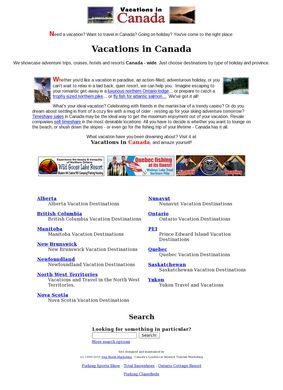
Almost nowhere else will you find a walleye fishing trip and a stop at the Chateau Frontenac sold from the same page, yet Vacation in Canada puts them side by side. The site covers all thirteen Canadian provinces and territories, from Alberta and British Columbia out to Nunavut and the Northwest Territories, and its idea of a vacation stretches from a black-bear hunt in the bush to a photograph of Anne of Green Gables House on Prince Edward Island.
That range is the first thing that strikes you, and it sets the tone for a site that refuses to pick a lane.
Vacation in Canada works as a travel resource, not a single tour operator. It gathers destinations, lodges, and experiences and organizes them by region and by activity, pointing a visitor toward specific places to fish, hunt, hike, or sightsee across the country. It reads closer to a business directory of lodges and outfitters than a company that books any of them itself, which shapes what you can and cannot expect from it.
Provinces, lodges, and the outdoors
The heart of the site is its regional coverage. Every province and territory gets a place, which is more than a lot of Canadian travel sites bother with, since the far north tends to get dropped for want of easy attractions. National parks show up throughout, Gros Morne in Newfoundland, Sirmilik up in Nunavut, and Cameron Falls among them, and the cultural side runs to Quebec City, the Chateau Frontenac, and that green-gabled farmhouse on the island. Whoever built Vacation in Canada clearly wanted breadth, and on breadth alone it delivers.
What pulls the whole thing together is the roster of named partner lodges. Vacation in Canada lists specific properties, Northern Walleye Lodge, Ogascanan, Wild Goose Lake, Big North Lodge, and Auld Reekie Lodge among them, which is more concrete than the vague "top destinations" filler that pads most travel pages.
A reader gets actual names to look up, and a named lodge is something you can research on your own, cross-check, and phone directly, which is worth more than a glossy photo with no address behind it. That habit of naming specific lodges is the most useful thing Vacation in Canada does, because it hands a traveler the one thing a broad search often will not surface on its own: a concrete place to start calling.
Fishing, hunting, and lodge stays
The outdoors coverage is where Vacation in Canada is most detailed, and where it seems most at home. Fishing runs to walleye, pike, and salmon, called out by species instead of lumped under a generic banner, and there is a black-bear hunting section for the traveler after big game.
ATV adventures and straightforward lodge stays round it out, the sort of trip where the lodge itself is the destination and the fishing or the quiet is the point. For someone whose ideal week in Canada means a boat at dawn and a cabin at night, this is the part of the site that will hold attention. The cultural attractions, by contrast, read more like a thin list of the obvious landmarks than a genuine guide to them, and the museums and towns deserve the same care lavished on the walleye.
For the angler and the hunter, though, Vacation in Canada is pitched squarely at them, and that clarity about who it is really for counts as a strength worth crediting.
Who stands behind the site
Here the account gets harder to write with confidence, because the site tells you almost nothing about who runs it. There is no phone number, no email, and no mailing address on the homepage. Nothing clickable leads to a person or an office. For a resource pointing travelers toward lodges and hunting trips, that silence is a genuine mark against it.
If a booking goes sideways or a listed lodge has closed, there is no obvious way to raise a hand and ask, and no visible party who takes responsibility for what the page recommends. A traveler about to wire a deposit to a remote fishing camp wants to know a real person sits somewhere behind the recommendation, someone who will pick up when a plan falls through. This site does not offer that reassurance anywhere on the page.
The footer offers the only real clue to the machinery underneath. It credits partners named Due North Marketing, Ontario Fishing Resorts and Lodges, and More Fascinating Places, which points to an affiliate or referral arrangement more than a single company standing behind every recommendation. That is not disqualifying on its own; plenty of useful travel resources run on partner referrals and are upfront about it. But it does change how you should read the enthusiasm on the page, because a recommendation and a paid placement can look identical from the outside.
No contact trail, no reviews
Outside opinion is no help either. A search for reviews of Vacation in Canada turns up nothing that actually assesses this site; the results are the homepage itself and a crowd of unrelated travel companies with similar names, the big packaged-tour operators and airline vacation arms that have nothing to do with it. So there is no third-party score to lean on, no cluster of customer reports, no reputation trail at all beyond what the site says about itself.
That leaves a visitor judging Vacation in Canada purely on the content in front of them, with no independent voice to confirm that a listed lodge is still open or that a partner delivers what the page promises.
That is the doubt I cannot resolve on the available evidence. Vacation in Canada is genuinely useful as a starting map, a way to learn that Northern Walleye Lodge exists or that Sirmilik National Park is out there waiting, and its province-by-province reach is substantial. But a travel site with no contact route, no named owner, no reviews, and a footer full of marketing partners sits in an uncomfortable place, somewhere between a good-faith guide to Canadian trips and a referral shopfront dressed as one.
Nothing on the page settles which it is, and until a traveler can verify a listing directly with the lodge itself, every recommendation here is better treated as a lead to check than a booking to trust on sight.