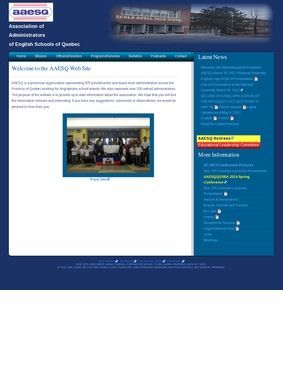
AAESQ is the Association of Administrators of English Schools of Quebec, a professional membership body for the people who run Quebec's English-language schools: principals, vice-principals, and other school management staff. That single sentence covers a surprisingly large slice of who keeps a school working day to day, and the AAESQ site is built squarely around their needs and not around parents, students, or the general public. Anyone outside school administration will find little reason to linger here, and that focus is the point.
The membership AAESQ serves sits at a particular pressure point in education. A principal answers to a board, a ministry, a union, parents, and staff at the same time, often with no peer network and little time to compare notes with colleagues facing the identical squeeze. AAESQ exists to give those administrators a shared place to land. The content on the AAESQ site reflects that brief closely, and it makes no pretense of being a public-facing resource about schooling in general.
Professional development for school leaders
Professional development is the spine of what AAESQ puts forward. There are leadership webinars and workshops in formats suited to people who cannot easily leave a building during the day, and an events calendar that keeps the schedule visible. Networking events and annual retreats round this out, with recent retreat sessions built around negotiation, a topic that lands naturally for managers who spend real chunks of their year at the table with unions and authorities. None of this is flashy. It reads like programming designed by people who know exactly what their members can and cannot fit into a term, which is a harder thing to get right than it sounds when the audience is this stretched.
Publishing on management working conditions
Alongside the live events, AAESQ publishes. Newsletters and briefs cover education trends and the working conditions tied to school management, and that second strand is worth pausing on. Working conditions for administrators are a quieter subject than teacher contracts or classroom funding, and they rarely get sustained coverage anywhere else. By keeping a Varia section devoted to management working conditions resources and educational briefs, AAESQ fills a gap that few others bother with. A vice-principal trying to understand where their role sits in the wider system has somewhere concrete to look, and the briefs give that person a reference point that does not exist in many other places.
From legal support to employment listings
The practical side of AAESQ membership goes past learning and networking. The association points members toward legal assistance resources and toward information on pension and insurance, the kind of support most needed precisely when an administrator is dealing with a dispute or a career decision and has no time to research it from scratch. These are not headline features, but they are the reasons a working principal keeps a membership current year after year. When the pension question or the disciplinary letter lands, having a body that already holds the relevant information is worth a great deal more than any webinar.
Recognition programs and peer acknowledgment
Recognition is part of the picture too. AAESQ runs awards programs and recognition initiatives for school administrators. School leaders are visible when something goes wrong and largely invisible when things go right, so a structured way for peers to acknowledge good work fills a real absence. It also says something about how AAESQ understands itself: as a community with its own standards, not simply a service vendor renting out webinars.
Employment is the last piece on the member-services side. The site carries employment opportunities listings, which makes sense for a sector where the pool of qualified administrators is narrow and movement between boards is common. A member weighing a new posting, or a board hunting for someone to fill one, has a sector-specific place to look instead of a generic job board that knows nothing about the Quebec English-school context. A listings page tuned to this field is genuinely useful, and it is the sort of quiet utility that keeps an association relevant between conferences.
Structurally, the site lays out who is behind all this. There are sections for executive members, the board of directors, and partner organizations, plus a leadership committee that steers the work. AAESQ states that it partners with other education-sector bodies across Quebec, and that web of partnerships is consistent with how a membership association this size tends to operate: it borrows reach and credibility from the institutions around it rather than trying to be everything on its own. Anyone trying to understand the governance will find the information there and laid out plainly.
The clearest strength in the way the offering hangs together is the absence of mission creep. AAESQ could have padded itself out with general commentary on Quebec education, opinion pieces, or material aimed at the public. It does not. Everything points back to the administrator: their development, their working conditions, their legal and financial protections, their recognition, and their next job. That discipline makes the site easy to read for the audience it wants and easy to ignore for everyone else, which is an honest way for a niche body to present itself.
There are limits worth naming. Much of what is on offer here is organizational scaffolding: a calendar, a set of programs, briefs, listings, and committee rosters. The real value of an association like this lives in things a website cannot fully convey, namely the quality of the workshops, the usefulness of the legal and pension guidance, and whether the negotiation-focused retreats genuinely change how members handle their own tables. The site tells you that these exist and how they are organized. It cannot tell you how good they are, and a prospective member would need to attend something before forming a real view.
The English-language qualifier also bounds the reach. Quebec's English schools are a minority system inside a French-majority province, and the administrators who run them face a specific regulatory and political environment. AAESQ is built for exactly that population, which is its strength and its ceiling at once. A French-sector administrator, or a school leader anywhere outside Quebec, will find the structure recognizable but the substance only partly transferable. This is a regional, language-specific body and it does not overstate itself on either count.
A search for independent commentary on AAESQ turns up very little outside the organization's own channels. That is not unusual for a small professional association operating within a defined institutional network, and it does not raise a flag. The membership model means the people best placed to assess AAESQ are current members, not external reviewers, and the absence of public comment reflects that structure rather than any apparent problem.
The listing does its job. The category placement under Quebec is accurate, the description of who AAESQ serves and what it provides matches the kind of focused, members-first professional association the name promises, and there is no visible gap between the claim and the apparent substance. The spread of services, from development through legal support to recognition and employment, points to a body with established programming and real institutional depth. An English-sector school administrator in the province has clear reason to look further; most others do not, and AAESQ is upfront about that.