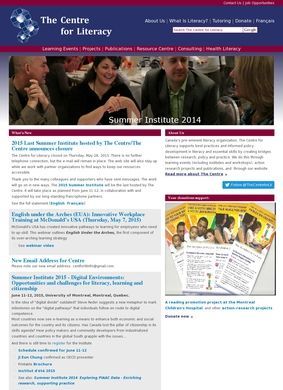
Someone trying to understand why an adult learner stalls at a workbook page, or why a patient cannot follow discharge instructions, runs into the same wall fast: literacy is treated as a yes-or-no skill when it behaves like a spectrum tied to health, work, and daily decisions. That gap between how literacy actually functions and how programs are funded and measured is the problem The Centre for Literacy spent decades working on. The site that survives it is an archive, and reading it that way changes what you take from a visit.
A bilingual organization based in Montreal
Based in Montreal, the organization built its reputation as Canada's leading body on literacy and essential skills, and the material it left behind reflects that scope. The Centre for Literacy worked across English and French, a practical necessity in Quebec, and that bilingual reach extended its output into both linguistic communities. The closure in 2015 ended the live programming, but partner organizations kept the publications and resources reachable, so what you are looking at is a preserved record of a particular way of thinking about literacy: not as remedial schooling, but as something woven into health systems, workplaces, and community life.
Publications catalogue and resource centre
The strongest part of the surviving site is its publications catalogue and resource centre. This is the substance. The Centre for Literacy produced and gathered research, policy analysis, and accounts of community practice, and the collection is broad enough to serve people coming at literacy from very different angles. A researcher can find studies and reports. A policymaker can find the kind of synthesis that connects evidence to program design. Community practitioners, the people running actual tutoring and adult education sessions, can find material grounded in what happens on the ground and not confined to theory alone. That mix of audiences was deliberate, and it shows in how the catalogue is organized around real questions instead of academic silos.
Summer institutes and workshops for practitioners
Beyond the documents, the record covers the events that gave the organization its character. The Centre for Literacy ran annual summer institutes as a recurring fixture, bringing together educators and others working in the field for sustained sessions instead of one-off talks. There were workshops too, focused on literacy, adult education, and essential skills. Reading the descriptions of these now, after the fact, you get a clear sense of an organization that valued bringing practitioners into the same room over publishing at them from a distance. The summer institute format in particular points to a belief that this work improves through exchange, which is a harder thing to manufacture than a webinar series.
Value for policy historians
The honest answer depends on who is asking. For anyone studying the history of literacy policy in Canada, the value is direct: The Centre for Literacy was a central player, and its preserved output documents how thinking evolved at the meeting point of research, policy, and practice. That positioning is the reason the archive holds together as a coherent body of work and not a scattering of unrelated papers.
Action research in community health literacy
There is also concrete work recorded here beyond writing. The Centre for Literacy ran action-research projects, including initiatives in community health literacy, which is one of the more practical and underserved corners of the field. Health literacy sits at a costly junction, where people misunderstand medication, miss appointments, or cannot navigate a form, and the projects pursued by The Centre for Literacy treated it as a problem to be studied and acted on together. Anyone working on patient communication or community health programs today can still mine that material for approaches that were tested in practice.
Services that are no longer active
The services The Centre for Literacy once offered, consulting, tutoring programs, and bilingual programming, are no longer live, and it would be dishonest to pretend otherwise. A visitor hoping to enroll in a workshop or hire the team will find a record, not a service. That is the central limitation, and it is worth stating plainly before anyone arrives expecting an active provider. What remains is reference value, and on that measure the archive holds up well.
French-language resources for Quebec practitioners
The bilingual dimension deserves a second mention because it is rare and useful. Much of the available literacy research leans heavily English, and The Centre for Literacy, by working seriously in both languages, produced material that a French-speaking practitioner or researcher can use without translation. For Quebec specifically, and for francophone communities elsewhere in Canada, The Centre for Literacy filled a need that few national bodies covered with the same commitment. The French-language resources in the catalogue are a practical asset, not a cosmetic addition.
Reading through the resource centre, the consistent thread is a refusal to treat literacy as separable from the rest of life. The framing of essential skills, the attention to workplace contexts, the health initiatives, the policy work: all of it points toward literacy as a capacity that shapes whether someone can hold a job, manage a condition, or take part in civic life. That is a more demanding and more useful way to look at the subject than tallying reading levels, and it is the through-line that makes the archive worth more than the sum of its individual documents. The Centre for Literacy held that framing consistently, and the collection is stronger for it.
How does the archive compare to ABC Life Literacy Canada?
The natural point of comparison for a researcher or educator is ABC Life Literacy Canada, which remains an active national organization with current programs and campaigns. ABC Life Literacy is the place to go for live initiatives and present-day resources. What The Centre for Literacy offers instead is depth of recorded research and a documented history at the research-policy-practice intersection that an advocacy-focused active body does not try to replicate.
A search for third-party reviews turns up no significant volume, which is unsurprising for an academic and policy organization that closed in 2015 and whose audience was researchers and practitioners rather than the general public. The two organizations serve different needs: one for what is happening, one for understanding how the field got here and what was learned along the way. For work that benefits from that second kind of grounding, The Centre for Literacy remains a serious resource, even closed, and its preserved catalogue is the reason it still merits a visit.