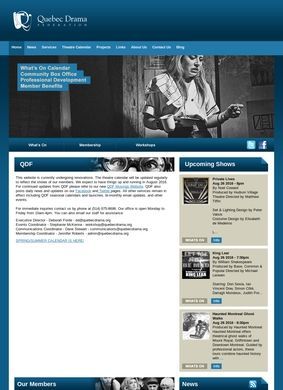
An actor in Montreal finishes a contract and wants to know what auditions are coming up, whether there is a grant that fits a new project, and who else is staging English-language work this season. Those three needs rarely sit in one place. The Quebec Drama Federation pulls them together as a service organization for English-language theatre across the province, and the site is built around exactly that scattered set of questions a working artist arrives with. It positions itself as the place a member checks first, and the layout reflects that intent.
Calendar and weekly audition bulletin
Start with the calendar. There is a digital listing of members' upcoming productions, which means someone can see at a glance what is being staged and when. Sitting alongside it is the weekly "What's On Wednesday" bulletin, carrying event listings, audition notices, and designer portfolios. That weekly cadence is the difference between a listing that is technically accurate and one that reflects what is happening in the rooms right now. For a freelance performer or a designer chasing the next gig, a bulletin that lands every week is more useful than a static page updated whenever someone remembers to. The Quebec Drama Federation has clearly decided that timeliness is part of the value it provides, and the regular bulletin is the mechanism that delivers it.
Member directory for theatre artists
Membership is the spine of all of it. The Quebec Drama Federation enrolls individual theatre artists, companies, and organizations, and it publishes a member directory so those people and groups can be found. The audience here is specific. This is not aimed at the general public looking for a night out so much as at the people who make the work and need to locate collaborators, peers, and producers. A directory only pulls its weight if it is current and reasonably complete, and that is the one thing a visitor cannot fully judge from the outside. Membership in the Quebec Drama Federation also functions as a kind of credential within the sector, a marker that an artist or company is part of the recognized community, and that intangible matters in a field where reputation travels by word of mouth.
Practical resources for companies and artists
The resources section is where the organization moves from listings into genuine support. It gathers funding opportunities, venue listings, legal guidance, and information on labour associations. Each of these answers a concrete problem. A small company trying to find a room to perform in, an independent artist working out which grant deadlines apply, a creator who needs to understand a contract before putting pen to it: these are the practical walls people hit, and having them addressed in one hub saves a lot of separate searching.
Supporting mental health among artists
The inclusion of mental health support for artists is the detail worth returning to, because it points to an organization paying attention to the people behind the productions and not simply to the productions themselves. Theatre work is precarious and irregular by nature, and an arts body that treats wellbeing as part of its remit is taking the realities of the profession seriously. It is a small line on a resources page that says something larger about how the Quebec Drama Federation understands its members. Most arts bodies stop at money and rooms; extending that same shelf to wellbeing widens the definition of what support means.
The overture publishes reviews and criticism
There is also "The Overture," a publication carrying theatre reviews and articles. This gives the organization an editorial voice beyond logistics, a place where the community's work gets written about and discussed. A federation that only schedules and lists is a noticeboard; one that also publishes criticism and commentary is closer to a cultural anchor for its field. How lively and frequent that publication is would shape how much weight it pulls, and that is harder to gauge without spending real time inside it.
Advocacy for english-language theatre in Quebec
Advocacy is the other half of the mandate. The Quebec Drama Federation lobbies and advocates on behalf of the English-language theatre community in Quebec, which puts it in the role of representing a linguistic minority within the province's arts sector. That is a meaningful and somewhat delicate position. English-language theatre in Quebec operates in a particular cultural and political context, and having a body whose job is to speak for it collectively matters to companies that would have little voice acting alone. The site frames this clearly enough that a prospective member can see what they are joining and why representation might be the reason to do so.
Spotlighting MTL Launch and fringe productions
Beyond the standing services, the Quebec Drama Federation spotlights particular initiatives, naming MTL Launch and Fringe productions among them. These give the work a face: rather than describing programs in the abstract, the organization points to specific moments where its support shows up in actual productions. For someone weighing whether to engage, concrete initiatives are easier to assess than a mission statement, and they hint at where the energy of the organization is currently going. Naming MTL Launch and Fringe also tells a newcomer which corners of the scene the federation is closest to, which is the sort of orientation a person new to Montreal theatre would otherwise spend months piecing together.
How the pieces fit together
Taken as a whole, the offering is coherent. Calendar, bulletin, directory, resources, publication, and advocacy fit together around a single community rather than feeling like a grab bag of features. Each piece serves the same set of users, and the through-line is clear: support the people who make English-language theatre in Quebec and help them find work, money, rooms, and each other. The Quebec Drama Federation has assembled the right components for that job.
Testing the framework before joining
What a visitor cannot resolve from the homepage is how alive these components are in practice. A member directory, a calendar, and a weekly bulletin are only as valuable as their upkeep, and the same goes for the depth of "The Overture" and the reach of the advocacy work. The structure promises a well-served community. Whether the listings are densely populated, whether the funding information is kept current, and whether the publication runs often enough to feel like a real voice are questions that only show up after joining, and that gap between a strong framework and its day-to-day vitality is the thing worth testing before taking the scope on trust.