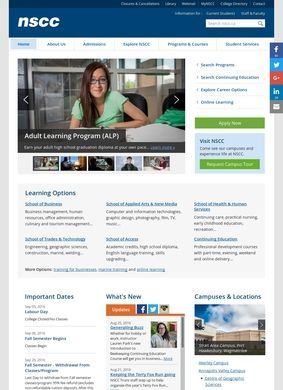
Nova Scotia Community College exists to answer a practical need: learning something useful without leaving the province or taking on the debt a four-year university implies. With more than 130 full-time programs, the breadth is the first thing worth taking seriously. This is a public post-secondary institution built around the things people actually get hired to do, from welding and electrical work to nursing support, software, accounting, and graphic design.
Programs spanning trades and technology
The program catalogue runs across trades, technology, business, health and community services, arts and design, and applied arts. These are not vague faculty labels. Each feeds into credentials that mean something to an employer reading a resume: certificates, diplomas, and applied degrees. A student aiming to be a power engineer takes a different path than one heading into early childhood education or digital animation, and Nova Scotia Community College keeps those paths distinct, avoiding the generic first-year funnel. That distinction is real for a sixteen-year-old who already knows what they want, and equally real for a forty-year-old who cannot afford to wander.
Delivery options across the province
Delivery is handled three ways: on campus, fully online, and a blended mix of the two. For a province as geographically stretched as Nova Scotia, that flexibility is not a luxury. A learner in a rural county may not be able to relocate, and the online and blended options keep a real credential within reach. There are 13 campuses spread across the province, a deliberate piece of design rather than an accident of growth. It means Nova Scotia Community College sits physically close to most of the population it serves, and a student in the Annapolis Valley is not expected to commute to Halifax to finish a diploma.
Inside workplace learning solutions
What sets Nova Scotia Community College apart from a standard teaching college is its Workplace Learning Solutions division. This arm builds customized training for employers, which is a different operation from running scheduled diploma intakes. A manufacturer rolling out new equipment, or a health authority that needs a cohort of staff upskilled on a specific system, can commission training shaped to that need. I find this the most telling part of the offering, because it positions Nova Scotia Community College as an active participant in the regional economy, a genuine participant in the regional economy, not a pipeline for graduates.
Apprenticeship training for skilled trades
Apprenticeship training in the skilled trades sits alongside that workforce work, which closes a loop that many institutions leave open. A young electrician or carpenter can complete the in-school technical blocks at Nova Scotia Community College while logging hours on the job, and the credential at the end is the recognized provincial standard. Apprenticeship is unglamorous and essential, and the fact that it is named as a core part of what the college does, rather than buried as an afterthought, says something about its priorities.
Applied research is part of the picture too, framed as work carried out in partnership with industry. That is the honest version of what a community college does on the research front: problem-solving tied to a company or sector that needs an answer, with students, particularly in technology and trades programs, getting exposure to real projects, not simulated textbook exercises. Nova Scotia Community College does not try to position this as academic research, which is the right call.
Student support services available
The student-support layer is fuller than a casual visitor might expect. Advising, financial aid, accessibility services, and career development are all listed as part of what enrolled learners can draw on. These services are the difference between a student who stalls in the second term and one who finishes. Accessibility services are especially important for a public institution with a mandate to serve the whole province, including learners who need accommodations to get through a program. Career development at the back end connects a diploma to an actual job, which is the point for most people who enrol at Nova Scotia Community College in the first place.
The college also serves audiences who do not fit the full-time mould. Part-time learners, people topping up skills through continuing education, and those pursuing micro-credential options all have a route in. Micro-credentials are short, targeted, and increasingly how working adults add a verifiable skill without signing up for a multi-year program. Their presence at Nova Scotia Community College suggests the institution is paying attention to how learning demand has shifted over the past decade, where a focused twelve-week certificate can satisfy an employer just as well as a longer credential once did.
Serving part-time and international learners
International students are accepted, which broadens both the classroom dynamic and the college's reach. For a smaller province, drawing learners from outside Canada is one of the few reliable ways to sustain program enrolment and bring different perspectives into trades and technology cohorts that might otherwise be entirely local. International tuition is a serious investment, and students paying it will judge the same programs against higher expectations than a local resident might, which is a useful pressure on quality.
Google Reviews show a modest number of ratings across the individual Nova Scotia Community College campus listings, with averages sitting in the mid-to-upper range without being exceptional. That pattern is consistent with what you see at most public colleges: strong satisfaction among students who found the right program, frustration among those who hit administrative snags. The absence of reviews on third-party consumer platforms is unremarkable for an institution of this type.
Comparing program quality across campuses
If there is a reservation worth naming, it is the one that comes with breadth itself. More than 130 programs across six broad fields, spread over 13 campuses, with online, blended, apprenticeship, continuing education, and micro-credential streams layered on top, is a large surface area. The promise of a public college is that quality holds steady whether you are in a flagship Halifax-area program or a smaller campus offering with a single intake a year.
What Nova Scotia Community College presents tells you the range of what is possible, but a prospective applicant choosing between a specific program at a specific campus is left to investigate whether the welding program in one county matches the depth of the same program two campuses over, or whether support services are staffed fully enough to reach a part-time student at a satellite location. The catalogue is confident; closing that gap requires a conversation with current students in the specific program, something the website cannot do.