An emerging painter in Halifax finishes her first real body of work and runs straight into the question with no obvious answer: now what? How to price it, show it, fund the next one, and find someone further along the road who will tell the truth about it?
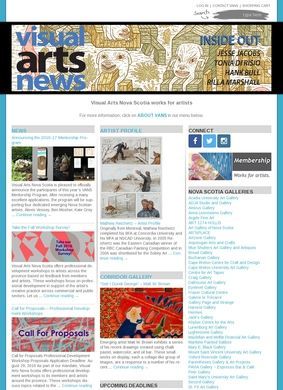
Visual Arts Nova Scotia exists to stand in that gap. It is a provincial, member-based arts service organization whose stated mission is the advancement and rights of visual artists and the visual arts in Nova Scotia, and most of what it does maps directly onto the practical problems a working artist actually has.
The membership is broad on purpose. Visual Arts Nova Scotia serves emerging and established artists alike, and it counts galleries and artist groups among the people it works for, which puts the organization somewhere between a professional body and a support network. That dual footing shapes almost everything underneath it.
The programs behind the mission
Strip away the mission statement and what remains is a concrete set of programs, each pointed at a different stage of an artist's working life. Some are about learning the craft of a career. Some are about money. One is about mental health, and a couple are about the plain business of getting work in front of people.
Visual Arts Nova Scotia runs them as a bundle that membership opens up, which is a more honest structure than a menu of one-off services, because it assumes an artist needs several kinds of help at once. A painter rarely has just one problem. She needs a mentor and a wall and a grant and, some months, the rent, and the organization is built around that plain reality.
Not all of it is running at full strength. The PAINTS Program, one of the offerings Visual Arts Nova Scotia lists, is currently suspended indefinitely, a gap worth knowing about before anyone joins for that single reason.
The Mentorship Program and workshops
The Mentorship Program is the clearest answer to that early-career question. It pairs emerging artists with experienced mentors, which is the sort of one-to-one guidance that is almost impossible to buy and easy to underrate until an artist has had it. A mentor who has already navigated grants, galleries, and lean years can save an artist a season of wrong turns. Alongside it, the organization runs professional-development workshops and webinars, the group version of the same instinct.
Between the two, a member can get both the private counsel of one mentor and the broader footing that comes from a room, or a screen, full of peers working through the same problems. Workshops and webinars also scale in a way a mentorship cannot, reaching artists in parts of the province that are nowhere near a major gallery, which for an organization covering all of Nova Scotia is no small thing.
VANS in Residence and the Corridor Gallery space
Two programs handle exposure. VANS in Residence offers artist-residency opportunities, the concentrated time and space that lets an artist make something ambitious instead of squeezing work around a day job. The Corridor Gallery gives them somewhere to hang it, a dedicated exhibition space run by the organization itself. A residency that feeds into a gallery show is a tidy pipeline, and it means Visual Arts Nova Scotia can carry an artist from the studio to the wall without handing them off to an outside venue.
For an artist trying to build a record of exhibitions, a show at the Corridor Gallery is a real line on a resume and a real opening on a calendar, both of which are hard to secure any other way early on.
For an artist without gallery representation, that second door is one of the more concrete things Visual Arts Nova Scotia provides. Wall space is scarce, and a member has a route to some.
Peer review groups and the Artist Emergency Fund
Grant applications are where a great deal of good work quietly stalls, and the Peer Application Review Groups aim straight at that. They give members feedback on grant applications from people who have sweated through their own, which tends to be worth more than any template or checklist.
The Artist Emergency Fund covers a different kind of trouble entirely: direct financial support when an artist hits a wall that has nothing to do with talent. Put together, they show Visual Arts Nova Scotia treating money as a real obstacle rather than an awkward subject, both the money an artist is trying to win and the money that has suddenly run out.
Peer review of grant applications is the kind of unglamorous, high-value help that quietly raises a member's odds with the funders who actually cut the cheques, and an emergency fund is the sort of backstop most artists discover they needed only after the emergency has already arrived.
Artists in Mind, and what membership carries
Artists in Mind is the least expected item on the list, a mental-health support program built specifically for artists, whose working lives run on isolation, rejection, and unstable income. Naming that plainly and building a program around it is a genuine choice, and not a common one among organizations of this kind. Membership itself carries the rest, and this is where Visual Arts Nova Scotia does its quiet structural work: access to the programs above, the Visual Arts News magazine, and the community networks that come with belonging to something province-wide.
Artist Pages, an online portfolio gallery for members, gives each one a public page to point curators, buyers, and collaborators toward. For an artist without the money or the skills to build a proper website, that hosted page is a genuine asset, a working portfolio at an address someone else keeps online. The Visual Arts News magazine, meanwhile, keeps members inside the conversation about what is being shown and argued over in the province.
Read as a whole, the offering is coherent in a way that arts organizations often are not. Learning, exposure, funding, emergency help, mental health, and a portfolio, each stage of a working practice has a corresponding program, and Visual Arts Nova Scotia has clearly thought about how one stage leads into the next. The pieces talk to one another.
For an artist working anywhere in the province, the case for at least looking closely is straightforward. This is not an entry that would mean much pulled from a business directory; it is the organization that consolidates mentorship, exhibition, grant help, and a financial backstop into a single membership, and none of those is easy to assemble alone, one arrangement at a time.
Visual Arts Nova Scotia turns a scattered set of needs into one address. An artist could, in theory, chase each of these separately, a workshop here, a residency application there, a gallery cold-call somewhere else, but almost nobody has the time, and the point of a service organization is to spare them the running around.
The doubt sits with that suspended program. When one of the named offerings has gone dark indefinitely, a prospective member is left guessing whether it is a temporary belt-tightening or the first thread to come loose, and the site does not say which. An organization promising a full ladder of support is only ever as convincing as the rung currently missing from it.