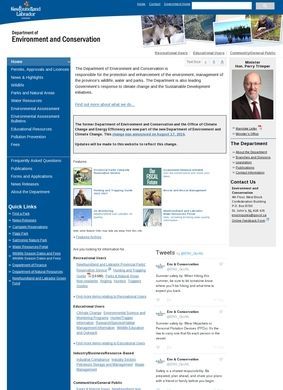
A Climate Change Adaptation Cost-Benefit Analysis Tool is one of the more unusual things published by The Department of Environment and Conservation, the provincial body in Newfoundland and Labrador responsible for environmental protection, water, and climate policy. It lets a community weigh the cost of preparing for climate impacts against the cost of doing nothing, which is the sort of practical instrument that turns policy language into a decision a town council can act on. A calculator is a strange thing to find on a government environment page, and a welcome one.
The work divides cleanly into a handful of areas, and the Environment Division carries most of the day to day regulatory load.
The regulatory backbone
Most of what The Department of Environment and Conservation does under this division is unglamorous and necessary. Water Resources Management covers drinking water, groundwater, community water and wastewater systems, flooding, and dam safety. These are the files that decide whether the tap in a small outport is safe and whether a spring melt turns into a disaster.
Water resources management
Drinking water oversight is the piece that touches every resident whether they think about it or not. The division also handles groundwater and the community systems that treat and move wastewater, and it takes on flooding and dam safety, two areas where a lapse has consequences measured in property and lives. A failed dam or an unmanaged floodplain is the kind of low-probability, high-cost risk that only a standing authority tends to watch.
Grouping these under one office gives the province a single place responsible for the whole path water takes, from source to tap to discharge. For scattered coastal communities without large municipal utilities, having the province hold this responsibility centrally counts for more than it would in a dense city with its own engineers on staff.
Environmental assessment and pollution prevention
Environmental Assessment is where proposed projects get reviewed and where public notices are posted, so a resident can see what is being weighed before a shovel goes in the ground. Pollution Prevention sits beside it and handles industrial compliance, waste management, pesticide control, petroleum storage, and impacted sites. Each of those is its own headache: a leaking fuel tank, a contaminated lot, a misused pesticide, all need rules and someone to enforce them.
The permits, approvals, and licenses that run through The Department of Environment and Conservation are the mechanism that makes this enforceable instead of aspirational. A rule with no permit behind it is only a suggestion. The public notices matter here too, because a project review that no resident can see is not truly public.
Climate work and protected land
The Climate Change Division is where the forward-looking programs of The Department of Environment and Conservation live. The Climate Action Plan sets the direction; the Climate Change Challenge Fund and the Greenhouse Gas Reduction Fund put money behind it; the Oil to Electric Incentive Program gives a household a concrete reason to swap a furnace. There is energy efficiency support and greenhouse gas monitoring as well, so the division both funds the transition and measures whether it is working.
Data and dollars in the same place is how a plan avoids becoming a press release. The Climate Action Plan is the anchor document, and the two funds give it teeth by attaching real money to specific projects instead of general aspirations.
Net-zero programs and incentives
The funding programs are the part a reader is most likely to use directly. A homeowner heating with oil can look into the Oil to Electric Incentive Program; a community or organization with an idea can approach the Climate Change Challenge Fund or the Greenhouse Gas Reduction Fund.
The energy efficiency support rounds this out for people who want to cut a bill rather than replace a whole system. By pairing adaptation planning with the net-zero emissions push, The Department of Environment and Conservation covers both sides of the problem: it cuts emissions now and braces for the changes already locked in.
Natural areas and heritage rivers
The Natural Areas work is quieter and easy to overlook. It handles protected areas planning, wilderness and ecological reserves, and the management of heritage rivers. For a province defined by its coastline and interior barrens, this is the arm of The Department of Environment and Conservation that decides which places stay undeveloped and which rivers keep their protected standing. The Drinking Water Safety Action Plan ties back to the water files, a reminder that these divisions overlap more than an org chart suggests: a protected watershed is also a drinking water source.
The material speaks to employers, employees, unions, communities, and ordinary residents at once, and the site's value depends on which of them a visitor happens to be. An employer facing a compliance question, a union weighing a workplace concern, and a homeowner chasing an incentive are all sent to the same set of divisions. A municipal planner will get more out of The Department of Environment and Conservation than a casual reader will, because the depth is in the regulatory and program detail rather than in general explainer content.
The breadth is the honest selling point. Few single sources pull together drinking water rules, project assessments, pollution enforcement, climate funding, and reserve planning for one province in one place. The Department of Environment and Conservation is that source for Newfoundland and Labrador, and the practical tools, the cost-benefit calculator, the incentive programs, the action plan, are what lift it above a static list of mandates. That combination, regulation plus funding plus land protection under one provincial roof, is genuinely hard to assemble anywhere else for Newfoundland and Labrador.
There is a caveat worth stating. A site this broad can be hard to navigate, and a resident arriving with one narrow question, say whether a particular pond is protected or how to claim the oil-to-electric incentive, may need patience to reach the exact page. Depth and ease of use pull against each other, and The Department of Environment and Conservation clearly prioritizes the former.
That tension sums up the site. Someone who wants to understand how Newfoundland and Labrador governs its water, air, and land will find comprehensive divisions and named programs to work through, while someone chasing one quick answer has more digging to do first.