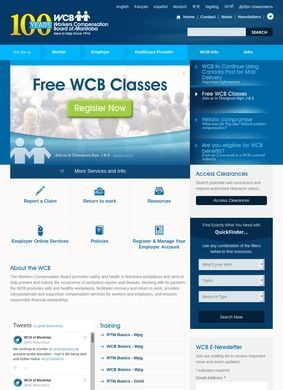
Clearance certificates are where you start to understand what the Workers Compensation Board of Manitoba is for. A general contractor in Winnipeg can look up whether a subcontractor is in good standing before work begins, and that one lookup prevents the kind of liability dispute that can follow a worksite injury for years. Found through a business directory search, the Workers Compensation Board of Manitoba site is not a public-relations front. It is the operating interface through which workplace injury compensation across the province gets administered, and the design reflects that without apology.
Clearance certificates for contractor verification
The statutory mandate shapes everything. Under The Workers Compensation Act of Manitoba, the Workers Compensation Board of Manitoba has to speak to three distinct groups at once: workers who have been hurt, employers who fund the system through premiums, and health-care providers who treat claimants and send clinical information back into the file. The site keeps those audiences separated. A worker filing a claim is not wading through payroll reporting rules. An employer registering an account is not reading rehabilitation guidance written for an injured person. That separation is the single clearest sign of an agency that understands its own complexity.
Worker claims and wage-loss benefits
For injured workers, the main path runs through injury reporting and claims filing, then into wage-loss benefits and return-to-work support, with medical aid and rehabilitation coverage alongside. The Workers Compensation Board of Manitoba organizes its worker-facing content around those practical questions, and the downloadable forms and guides give people something concrete to act on. A claimant in the weeks after an injury is rarely thinking about actuarial models; they want to know whether their wages are covered and whether their treatment will be paid for. The structure answers those questions without asking the reader to hunt.
Employer premiums and account administration
The employer side carries more ongoing administrative weight. Account registration, premium assessment, and payroll reporting are recurring obligations, not one-time setup tasks, and the site treats them accordingly. This connects to how the agency is funded. The Workers Compensation Board of Manitoba runs entirely on employer premiums rather than provincial tax revenue, which changes the relationship between the agency and the businesses it covers. Employers are both regulated parties and the funding base, and the assessment tools reflect a body that has to keep that base accurate year over year. The clearance certificate system fits into this same ecosystem: one business verifying another's standing before a project starts.
From myWCB portal to appeal pathways
Tying the two sides together is myWCB, the online portal. It lets both workers and employers manage claims, submit documents, and check file status without a phone call for every update. A claim moves over weeks and months, and being able to upload a document or see where a file stands during the stressful period right after an injury is worth more than the same feature at a quieter moment. Workers Compensation Board of Manitoba built document submission and status tracking into the portal, which addresses the friction points most common in claims administration. How well the system holds up during peak filing periods is harder to judge from the outside, but the architecture suggests an agency that mapped the user journey before building.
Safety and prevention content sits alongside the administrative functions. Educational materials and training resources are here because preventing injuries is cheaper than compensating them, and a body funded entirely by employer premiums has a direct financial stake in fewer claims. The Workers Compensation Board of Manitoba also publishes research and statistical reporting on workplace injury trends across Manitoba, which turns the raw data flowing in from claims into something employers, safety officers, and policymakers can study. That reporting doubles as an accountability record, showing what is happening to workers province-wide year over year.
The appeal structure is where a compensation system proves itself or does not. Decisions about benefits affect income and recovery, and not every decision goes the claimant's way. The Workers Compensation Board of Manitoba provides an internal review process and, beyond that, access to the independent Appeal Commission. An internal-only appeal can feel circular, so routing contested decisions to an external body gives the process credibility it would otherwise lack. Whether the appeal pathways are explained clearly enough for an unrepresented worker to follow without legal help is harder to judge from structure alone, and that is a real gap worth noting.
A news and updates section covers policy changes, rate adjustments, and reporting deadlines, which any statutory body needs given how frequently those shift. Independent searches for the Workers Compensation Board of Manitoba turn up claimant forums and news coverage rather than rated profiles on consumer platforms, and no aggregate rating count appears on the main review sites. That is typical for a statutory compensation body, so the absence is not a gap in the site's own presentation.
The overall picture is of an agency doing a serious operational job. Forms, portals, certificates, and assessment tools dominate the design because those are what people come to the Workers Compensation Board of Manitoba to use. The features are all present and reasonably organized. The harder question is whether an injured Manitoban, mid-recovery and out of a paycheque, finds the portal and the appeal process as workable as the published structure promises. The site can describe what it offers; only the experience of an actual claim tells you whether the Workers Compensation Board of Manitoba delivers on it.