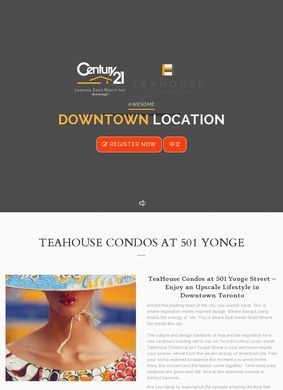
Teahouse Condo is the marketing site for a 52-storey tower rising at 501 Yonge Street in downtown Toronto, 589 suites stacked above the Church Street corridor and built by Lanterra Developments. That is the pitch in one line, and the website exists to sell it: floor plans, renderings, and the amenity list that pre-construction buyers scroll through long before they ever see a physical unit, because there is no physical unit yet.
The site sells a building that does not exist at street level, which is normal for pre-construction and worth keeping in mind going in. A buyer looking at Teahouse Condo is committing to drawings and a completion date, not a suite they can walk through, so the marketing page does more of the work than it would for a finished building where the proof is in the hallway.
The tower at 501 Yonge
The address does a lot of the selling. 501 Yonge Street sits in the Church Street corridor, a short walk from the University of Toronto and the downtown campus formerly known as Ryerson, which is why the listings lean on the location so hard.
This is student, faculty, and young-professional territory, dense and transit-fed, and a 52-storey tower here, the one Teahouse Condo is selling, is aimed squarely at renters and investors who want a downtown address that walks to almost everything. Lanterra also has a sister building, Teahouse 2 Condos at 18 Maitland Terrace, so the project is really a two-tower play on the same block.
Floor plans and suite mix
The floor plans are the heart of any pre-construction pitch, and Teahouse Condo puts them front and centre, with a dedicated plans page cached under the project name. Third-party real-estate sites such as Condos.ca, CondoNow and TalkCondo carry the same layouts, which is useful, because a buyer can cross-check the developer's own rendering against a neutral listing before trusting either. With 589 units in a single tower, the suite mix runs from compact investor-grade studios up through larger family layouts, the standard spread for a building of this height and this location.
The plans are the one part of the pitch a buyer can study closely, and having them mirrored on outside portals is a small point in the project's favour. Renderings flatter, of course, and a layout on a screen tells a buyer nothing about ceiling height or how the afternoon light actually falls, so the floor plans are a starting point for questions and not a substitute for a hard hat and a finished suite.
Amenities and the indoor pool
The amenity package is where a tower like this competes. Listings for Teahouse Condo describe a fitness facility, dedicated personal-training rooms, a yoga studio, and an indoor pool, a fuller wellness offering than many downtown pre-construction buildings bother to include.
An indoor pool in particular is a real cost to build and to maintain over decades, so putting one in signals a building positioned a notch above the bare minimum. Whether the finished amenities match the renderings is the perennial pre-construction gamble for Teahouse Condo, and no marketing page can settle it years ahead of occupancy.
Walk and transit scores
Location scores back the pitch, and here the numbers are hard to argue with. Third-party sites put the walk and transit scores at 99 to 100 out of 100, about as high as those measures go, and for once the marketing and the map agree.
From 501 Yonge, a resident reaches groceries, transit, and two university campuses on foot. For a Teahouse Condo investor buying to rent, those scores translate fairly directly into tenant demand, which is the number that actually matters to that buyer more than the colour of the lobby tile. Toronto's downtown core rewards an address like this one, and vacancy within walking distance of two campuses tends to stay low even in a soft market.
What the listings and reviews say
Here the picture gets thinner. The site was difficult to read directly, and none of the usual contact details, a phone number, an email, a sales-office address, surfaced in the process. Most business directory entries carry that information as a matter of course; this one did not.
For a pre-construction project, where the entire transaction runs through a sales team, a contact route that is this hard to find is a genuine mark against the site, and a serious buyer would end up working through a third-party agent or one of the listing portals instead of the developer's own page. That is a workaround, and it should not have to be the default.
Outside opinion on Teahouse Condo is scarce and mixed. CondoEssentials carries a single review for the project, and its one substantive note is a worry that the developer's past buildings have a reputation for poor condo management, with the reviewer hoping this one improves on that record. A thread on Reddit's r/TorontoRealEstate mentions unspecified bad reviews circulating about the building, though with no detail attached it is hard to weigh.
CondoAdvisory has a review page for the address with no rating shown. None of this is damning, and none of it reassures either. For a purchase this size, a near-empty review trail is itself a caution, because it leaves a buyer with almost no independent signal to weigh against the sales pitch.
The management question
The management concern is the one worth taking seriously, because it points at what happens long after the sale closes. Pre-construction buyers are purchasing years of condo-board governance and maintenance along with the concrete, and a developer with a shaky management history is a fair thing to probe before any deposit changes hands. A single online review does not amount to much on its own, and one anonymous person's hope for improvement is not a verdict.
Still, a prospective Teahouse Condo buyer would be right to ask pointed questions about how Lanterra's completed towers are actually run day to day, and to talk to owners in those buildings before putting money down. This is homework the marketing site will never do for a buyer.
One point needs clearing up, because it is easy to be misled by it. A Booking.com listing called "The Teahouse Condos by GLOBALSTAY" carries a rating of 8.7 from recent guests, but that is a short-term rental operation run by a separate management company, not the condo development and not this website. Anyone tempted to read that 8.7 as a score for Teahouse Condo should set it aside, since it measures a different product entirely, run by different people.
So where does this leave a buyer? Teahouse Condo, the website, does the basic job of a pre-construction marketing page: it names the address, the developer, the unit count, and the amenities, and the third-party portals fill in the floor plans and the strong location scores. What it does not do is make itself easy to contact, or answer the one real doubt hanging over the project, which is management.
The location is excellent and the amenity list runs above average; the developer's management reputation and the awkward contact path are the reasons to slow down before getting swept up in the renderings. For a downtown investor who trusts the numbers at 501 Yonge and will do their own digging on Lanterra, this entry is a reasonable place to start. For anyone counting on the site itself to answer their questions, it falls short.