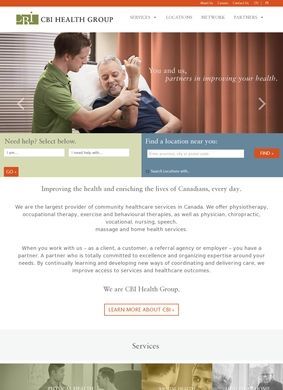
A car crash leaves someone with a wrenched neck, a recovery that will not move, and an insurer already asking when they can be back at a desk. That knot, the medical, the practical and the paperwork all tangled at once, is roughly the situation CBI Health Group is built around. The company calls itself Canada's leading community healthcare provider, and its work sits at the meeting point of rehabilitation and everyday community care, spread across the country.
Care under one banner
The service list is long and mostly clinical. Physiotherapy sits at the centre, joined by occupational therapy, massage therapy, chiropractic care, kinesiology, and acupuncture or IMS. Around that core CBI Health Group runs mental health services, concussion management, custom orthotics, bracing and splinting, ergonomics, and driving assessments, the last a genuinely useful thing to find under one roof for anyone recovering the confidence to get back behind the wheel.
The breadth is the whole point. A single provider covering physical therapy, psychology, and the administrative side of a claim means an injured client is not stitching together three separate relationships while hurt and stressed. Disability management, return-to-work planning, and home health or home care extend that reach past the clinic door and into the parts of recovery that happen at a job site or a kitchen table.
Not everything on the list is rehabilitation in the narrow sense. Ergonomics assessments, driving evaluations and the disability-management work push CBI Health Group toward the workplace and the insurer as much as the treatment room, which fits a company that describes its reach as community healthcare, not pure physiotherapy. A worker recovering from a back injury might see a physiotherapist for the body itself, a kinesiologist to build the return-to-work plan, and an occupational therapist to sort out the desk and the daily tasks, all of it coordinated from a single file instead of three unconnected ones.
Home health and home-care options extend the same idea to people who cannot easily travel, bringing part of the service to the client instead of asking the client to come in. Whether that coordination happens as smoothly in practice as it reads on the page depends entirely on the local team, but the pieces needed to do it well are all present.
Rehabilitation after an accident
Motor-vehicle-accident rehabilitation is called out as its own stream, and it is where the pieces connect. Someone hurt in a collision can move through physiotherapy, occupational therapy and concussion management, then on into return-to-work planning and disability management, without ever leaving CBI Health Group.
For an injury that touches body, livelihood and mood at the same time, keeping those threads inside one organisation is a real convenience, always assuming the individual clinic handling the case turns out to be a good one.
Clinics and virtual visits
The physical CBI Health Group network is large. Clinic names surface across the country, Calgary Central and Calgary South, Brantford West, Burlington, Cambridge, Niagara, Toronto Eglinton, and many more besides, and a Locations page works as a finder built around the plain prompt to locate a rehabilitation clinic nearby.
Virtual and remote options sit alongside the in-person sites, useful for follow-ups, home-exercise check-ins, or clients who live too far from a branch or are too immobilised to travel to one.
How the record reads
Reputation is where CBI Health Group gets complicated, because there is no single score to point at. The employee side is middling. Glassdoor carries 594 reviews at 3.0 out of 5, with a Toronto subset of 127 sitting a shade higher at 3.1, and Indeed shows somewhere between roughly 500 and 650 employee reviews depending on the filter applied. Those numbers describe what it is like to work there, which a prospective patient should read as background, not a verdict on the care.
Patient-facing ratings tell a scattered story. On Birdeye the clinic in London, Ontario sits at 4.9 out of 5 across 135 reviews; the Mississauga clinic sits at 2 out of 5 from 24; a Victoria, British Columbia location under the CBI Health Group name lands at 4.3 from 16 reviews. That spread is the honest headline. There is no company-wide client rating anywhere, only individual branches that range from excellent to poor.
What the spread means for a patient
The lesson buried in those numbers is a local one. Because the ratings attach to specific clinics rather than the parent company, the CBI Health Group brand on the door tells a prospective patient less than the reviews of the exact location they would actually visit.
A strong national name does not guarantee the branch down the road is one of the good ones, and the Mississauga figure is proof enough that the floor can drop low.
Finding a phone number
Contact runs through the CBI Health Group clinics too. The site pushes visitors toward the Locations finder and per-branch contact prompts on its service pages, which means a caller reaches a specific clinic rather than a central switchboard. No single head-office phone number or email stood out during the check. For a network this size that is a defensible design, since most enquiries are local anyway, though someone who just wants a general answer before choosing a clinic has a slightly longer path to a live person.
So the verdict lands lukewarm by design. CBI Health Group offers real breadth, a genuinely national footprint, and a sensible way to keep an accident claim under one roof, and none of that is in doubt. What is in doubt is consistency. A prospective patient cannot trust the CBI Health Group name alone to predict the visit, and has to go and read the reviews of the specific clinic, where the distance between a 4.9 and a 2.0 is the entire story.