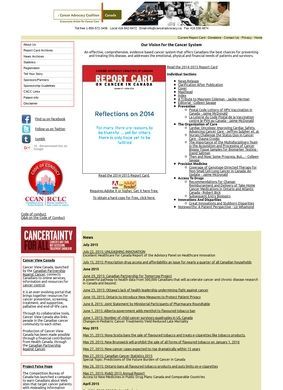
Low-cost, confidential counseling for cancer patients and the people who love them sits near the center of what Cancer Advocacy Coalition puts in front of a visitor, and that choice says a good deal about who the group means to reach. It describes itself as a Canadian, community-based organization run by working people and volunteers, holding a goal as large as the elimination of cancer next to a smaller, more immediate one: improving quality of life for anyone living with the disease.
The ambition is huge. The presentation is plain, and that plainness works in its favor.
Cancer Advocacy Coalition organizes its material around things a person can actually use. The section names tell you what is inside before you click: Cancer Info for education and prevention, a separate Prevention & Screening area, support services, online community forums, volunteer programs, and a resource on financial assistance for treatment. The audience is broad by design, taking in patients still in active treatment, survivors managing life after it, and the families standing beside both. A newly diagnosed patient, or a partner trying to work out what happens next, can find a way in without much digging.
Contact runs through a contact page with a form, meant for both general inquiries and people who want to get involved with Cancer Advocacy Coalition. The homepage stops there. No phone number and no street address appear on it, though a separate directory listing elsewhere records a Toronto address, phone, fax, and an email for the coalition.
That split is worth flagging honestly: the coordinates exist, but they live on someone else's page, not on the organization's own front door. On its own front page you get the form and little else in the way of direct contact, a drawback for anyone who would sooner pick up a phone than type into a box and wait.
As for outside reputation, there is not much to report. A search for reviews or ratings of Cancer Advocacy Coalition mostly turns up other groups with similar names, the alphabet soup of alliances and coalitions that cancer nonprofits tend to share, so this one has no visible body of third-party feedback to lean on. That is not a mark against the work; it simply means a newcomer cannot check it against a public score the way you might vet a restaurant.
One Canadian directory confirms the organization exists and lists its details, which at least anchors it as real. Beyond that, the site stands on what it offers rather than on a wall of testimonials.
Where the support and community pieces come in
The support offering is the emotional core. Cancer Advocacy Coalition frames its counseling as low-cost and confidential, open to patients and to the loved ones who shoulder much of the strain without being the ones in treatment. That second audience is easy to overlook, and I was glad to see it named plainly instead of tacked on at the end of a list. Cost and confidentiality are the two barriers that keep people away from this kind of help, and naming both up front tells you the group understands who it is talking to.
A caregiver quietly falling apart in a hospital corridor is exactly the person a line like that is meant to reach.
Next to the counseling sits an online community and peer-support platform, with discussion forums. The reasoning is simple. People who have lived through a diagnosis often help each other in ways no pamphlet manages, and a forum gives them a place to do it on their own schedule, at two in the morning if that is when the fear shows up.
There is a limit to what the outside pages reveal, though. Whether the community is active, how many people post, how quickly a new question gets an answer: none of that is visible until you are inside, and a quiet forum can be lonelier than no forum at all. A visitor has to take the platform on faith and try it.
Cancer info and the prevention side
The educational half leans on the Cancer Info and Prevention & Screening sections, supported by a blog that covers prevention, the cost of treatment, and broader health topics. Prevention and screening guidance is practical ground for a group like Cancer Advocacy Coalition, since catching disease early changes both outcomes and costs, and it fits an audience that stretches to people who are not sick but are worried. A mother reading up on screening after a scare in the family is served by the same pages as someone already in chemo, and keeping both in mind is harder than it looks.
The blog widens the reach a little. Treatment cost is a subject many patient sites avoid, and putting it beside prevention advice suggests Cancer Advocacy Coalition is thinking about the whole experience, money and all, well beyond the medical chart. It reads like content written by people who have watched the bills pile up, not by a marketing team filling a calendar.
Financial support and getting involved
For many families the cruelest part of cancer is the bill, and Cancer Advocacy Coalition meets that directly with information on financial assistance for treatment. A nonprofit built by volunteers is never going to write large cheques, so the value here is orientation: pointing people toward programs and help they might not know exist. Set beside the low-cost counseling, it builds a steady message about affordability that runs through the whole site, and that consistency is the strongest thing the coalition has going for it.
The volunteer programs close the loop. Cancer Advocacy Coalition presents itself as made of working people giving their time, and it asks visitors to join that effort, which is also how a community-based group of this kind keeps its doors open. There is an honesty to that model. A coalition that depends on volunteers is telling you, without saying so, that it lives or dies on whether ordinary people show up.
What a visitor ends up with is a compact set of doors: counseling, forums, prevention material, a treatment-cost blog, a financial-help resource, and a form to reach someone. The phone number and the address live on an outside listing, and the size of the community stays behind the login.