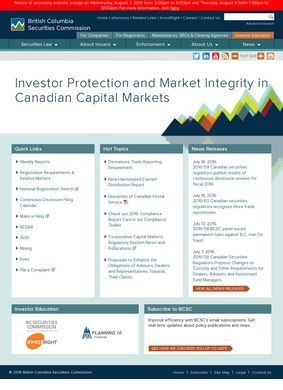
Provincial securities regulators do not usually make for compelling reading online, but the British Columbia Securities Commision manages something most government sites never pull off: it gives a cautious investor practical tools to act on, warnings paired with instruments for checking. The site covers the full spectrum of who might land there, from someone who has never bought a stock and just got a suspicious phone call, to a compliance officer at a public company filing continuous-disclosure documents.
Investright education for investors
Start with the part built for ordinary people putting money somewhere. InvestRight is the education arm, and it reads like it was written for a person who is nervous about investing and wants plain answers. There are explainers on how markets work, walkthroughs of how common frauds operate, and a running stream of scam alerts naming specific tactics in circulation. Someone who received a cold call about a can't-miss opportunity could land on InvestRight and recognise the pattern being run on them within a few minutes.
That is not a trivial thing for a public agency to get right, and the British Columbia Securities Commision has clearly put real effort into the design of that section. A lot of consumer-protection material stops at the warning and leaves the reader with nothing to do next. The British Columbia Securities Commision pairs the warning with an action, which changes the experience entirely.
Check registration before investing
The action in question is the registration check. Before handing money to an adviser or firm, a visitor can look up whether that person or company is actually registered to sell investments or give advice in the province. It answers a single concrete question with a yes or a no, and that question is exactly the one an unregistered promoter hopes the investor never thinks to ask. Alongside the registration lookup sits a public enforcement database, listing individuals and firms that have been disciplined. A name that raises doubts can be run against a record of past sanctions in about thirty seconds. The British Columbia Securities Commision publishes these tools prominently, where a newcomer will find them.
Serving both investors and registrants
Retail investors get the education portal, the alerts, and the lookup tools. Registrants and issuers get a separate body of material: forms, filing guidance, the rules and regulations, notices, and consultation documents open for comment while policy is being shaped. The British Columbia Securities Commision is trying to serve the small saver and the compliance officer from the same site, and the two streams mostly stay out of each other's way.
Rules for public companies
For the professional side, the depth is genuine. There is guidance on exempt market offerings and on prospectus requirements, specifics a company has to get right before raising money from the public. Oversight of continuous disclosure by public companies is covered as well, which is the ongoing obligation that keeps shareholders informed after an initial capital raise. None of it is light reading, but it is the operational substance a regulated firm needs, and having it published openly, without locking it behind a registrant portal, is the right approach.
The news and decisions material ties the two audiences together. Enforcement actions, policy updates, and formal decisions are published as releases, so an investor can see consequences being handed down while a practitioner tracks where the rules are heading. It also makes the enforcement database feel less like a static list and more like the visible end of an active process. The British Columbia Securities Commision refreshes this material regularly enough that it functions as a working reference, not a static archive.
Place within the Canadian regulatory system
One feature worth noting is how the British Columbia Securities Commision positions itself within the larger Canadian picture. It administers the BC Securities Act locally, but it also participates in the Canadian Securities Administrators framework, the umbrella that coordinates the provincial and territorial regulators across the country. For a reader trying to understand whether a rule is purely a British Columbia matter or part of a national approach, that context prevents a lot of confusion. Securities regulation in Canada is provincial by design, and a site that explains its own place in that structure is doing the reader a real service.
The investor alerts deserve more than a passing mention because of how they function in practice. Warnings about unregistered or fraudulent activity are not posted and forgotten; they build into a body of named tactics and named bad actors that a visitor can search. Combined with the registration tool and the discipline database, a determined person has three separate ways to check an offer before any money changes hands. That redundancy is deliberate. The British Columbia Securities Commision has structured the site so that the tools reinforce each other, which is the strongest argument for treating it as a routine stop and not a place you visit only after something has already gone wrong.
Investor alerts and enforcement tools
The material is dense in places, and a first-time investor who clicks past InvestRight into the rules section will hit language written for lawyers and compliance staff. The British Columbia Securities Commision separates the audiences reasonably well, but the line between plain-language guidance and statutory text is not always obvious from where you are standing. It is possible to wander from one into the other without noticing the reading level has jumped. That is largely a feature of the subject matter, not a flaw in the design, though a clearer signpost between the two sections would reduce the friction.
A search for third-party reviews of the British Columbia Securities Commision turns up almost nothing in the usual consumer-review channels. That is normal for a regulatory body and does not reflect anything meaningful about the quality of what it does. The work of a securities commission shows up in enforcement records and policy outcomes, and those are public here.
Reading level in regulatory documents
Set against the density issue, the breadth of actionable resources is hard to argue with. Registration checks, an enforcement record, fraud alerts kept current, investor education that assumes no prior knowledge, plus the full regulatory apparatus for the people who need it. The British Columbia Securities Commision covers the range from someone protecting their first few thousand dollars to a firm filing a prospectus, and it treats both as legitimate visitors rather than making one group feel like an afterthought. Few regulatory sites manage that without the less-served audience having to dig.
The practical case for the British Columbia Securities Commision is straightforward: the tools are there, they are free, and they answer the questions most likely to prevent a costly mistake. A cautious investor who uses the registration check and the enforcement database before moving forward has done more due diligence in five minutes than many people manage in days, at no cost. The British Columbia Securities Commision has put the instruments within reach; the gap that remains is getting more people to use them before a problem arises rather than after.