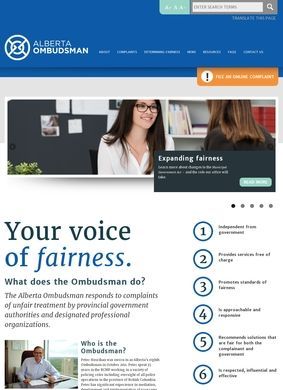
An investigation is free, the recommendations are non-binding, and the office cannot reverse a single decision it disagrees with. That combination sits at the centre of how the Alberta Ombudsman works, and understanding it explains both the value and the limits of what a complainant gets here. This is an independent provincial office that looks into claims of unfair treatment by public-sector bodies in Alberta, and it does that work without charging the people who bring the complaints.
Who the office investigates
The reach of the Alberta Ombudsman is wider than many residents probably assume. It takes complaints against provincial government authorities, against municipalities, and against Alberta Health Services where a patient concern is involved. It also covers self-regulated health professions and a range of other designated professional organizations. So a person who feels a licensing body treated them unfairly, or who hit a wall with a municipal department, lands in the same place as someone disputing how a provincial authority handled their file. The site lays out who is and is not within scope, which is the first thing anybody filing actually needs to know.
Administrative fairness as the standard
What the Alberta Ombudsman investigates is administrative fairness, meaning the process by which a public body reached a decision, and whether that process was conducted properly. This is a narrower question than whether the decision was correct, and the distinction shapes everything downstream. The office runs formal fairness investigations and, when it finds a problem, issues recommendations to the body involved.
What the Alberta Ombudsman cannot do
Those recommendations are backed by reputation and persistence, not by force. The Alberta Ombudsman does not award damages, and it does not overturn the decision a complainant is unhappy about. For a resident hoping the office will simply make a bad outcome go away, that is a hard ceiling, and the site is upfront about it. The honest reading is that the Alberta Ombudsman is a check on how public bodies behave procedurally, and a person who walks in expecting it to act like an appeal court will come away disappointed. The clarity about what it cannot do is, in its own way, the most useful thing on the page.
Kevin Brezinski leads the office
Kevin Brezinski holds the role, bringing three decades of law enforcement and investigative work to it. That background fits an office whose core function is fact-finding into how decisions were made, and the public naming of the person in charge adds a degree of accountability that an anonymous complaints desk would lack.
Complaint Checker tool for eligibility
Before anyone files, the site offers a Complaint Checker, a tool meant to help a person judge whether their situation is eligible at all. Given how often complaints fall outside an ombudsman's mandate, this is a sensible piece of design. It spares the complainant the effort of preparing a submission that was never going to be accepted, and it spares the office a queue of files it has to turn away. A pre-filing eligibility step is practical; it shows the Alberta Ombudsman has thought about the experience from the complainant's side rather than solely from its own intake perspective.
How to file and access services
Filing itself can be done online, so a resident does not have to print, mail, or appear in person to start the process. The Alberta Ombudsman pairs that intake route with community outreach and educational programming built around administrative fairness principles. That education side does more than it first appears to: a population that understands what fair process looks like is better equipped to recognise when it has been denied, and to use the office well when it has.
Two physical offices back all of this, one in Edmonton and one in Calgary, covering the province's two largest population centres. The combination of online intake, a pre-filing eligibility check, and staffed locations in both major cities means the Alberta Ombudsman is reachable through whatever channel suits the person.
No public review platform (Google, Yelp, or otherwise) carries ratings for the Alberta Ombudsman, which is typical for a government oversight body. The office is evaluated by the complaints it resolves and the annual reports it publishes, not by star ratings, and those formal accountability mechanisms are what an oversight office should be judged on.
It is worth being plain about who benefits most from the Alberta Ombudsman. The strongest fit is a resident who has already gone through a public body's own process, who believes that process was handled unfairly, and who wants an independent party to examine it. Someone in that position gets a free, structured review by an office with real investigative experience behind it. Someone who instead wants compensation, or wants a ruling thrown out, is in the wrong building, and the sooner they learn that the better, and the Complaint Checker is there to tell them exactly that.
The educational programming deserves a second mention because it changes how the Alberta Ombudsman fits into the broader system. An ombudsman that only processed complaints would be purely reactive. By teaching administrative fairness to communities and, presumably, to the bodies it oversees, the office tries to reduce the number of complaints that need to exist at all. Whether that effort moves the needle is not something the site can prove, but the intent is coherent.
What the Alberta Ombudsman publishes is an office that knows precisely what it is for and does not oversell. It investigates process, recommends, educates, and does all of that for free across two cities and an online channel. The recommendations are not orders, and the office says so. A resident weighing whether to bring a complaint here can find, in a few minutes on the site, both the door in through the Complaint Checker and an honest account of how far that door leads. The remedy is procedural review, the cost is nothing, and the scope ends where damages and reversals begin.