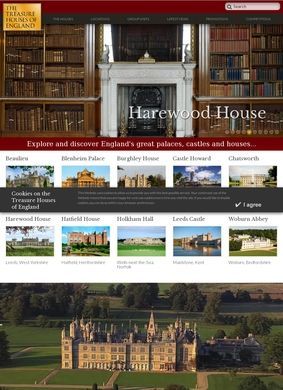
Where do you go when you want to see England's greatest private palaces in one place before deciding which one gets your day out? Treasure Houses of England answers that by gathering ten of the country's foremost stately homes under a single banner and giving each one a page to make its case. Beaulieu, Blenheim Palace, Burghley House, Castle Howard, Chatsworth, Harewood House, Hatfield House, Holkham Hall, Leeds Castle, Raby Castle and Woburn Abbey all sit side by side here, which is a lineup most heritage lovers would recognise instantly.
The premise is simple and it holds up. Treasure Houses of England is a marketing consortium, not a ticket seller, and the site behaves accordingly.
What the consortium puts in front of a visitor
The spine of the site is the section called The Houses. Every estate gets its own dedicated page carrying historical background and the practical visitor information a traveller needs before turning up at the gates. That is the useful part. Instead of eleven separate tabs open across a browser, someone planning a heritage trip can read short, comparable profiles in one sitting and work out which properties fit the route and the mood of the trip.
An About Us section explains where Treasure Houses of England came from. According to Wikipedia, Treasure Houses of England traces back to the early 1970s, when nine of England's leading stately homes joined forces, and the roster has shifted over the decades to the current group. That history matters here because it tells you the endorsement is not casual. These are privately owned houses that chose to stand together, and the shared standard is the whole point of the collaboration.
The roster itself is worth pausing on, because it reads like a shortlist a heritage specialist might draw up. Blenheim Palace, the birthplace of Winston Churchill, sits alongside Chatsworth in the Peak District and Castle Howard in Yorkshire. Beaulieu brings its motoring associations, Leeds Castle its moated setting in Kent, Holkham Hall its stretch of Norfolk coast. None of these are obscure names padded out to fill a page; each is a first-rank attraction in its own county, and putting them side by side says something about how a great house is expected to present itself to the public.
What you will not find is a shop, a booking engine, or a ticketing tool anywhere on the homepage. The site does not try to sell you a timed entry slot or a gift membership.
That reticence is refreshing in a corner of the web where every other visitor attraction wants your card details before you have finished reading. Here the reading comes first.
The houses section as a planning tool
Used the way it is built to be used, the property directory earns its keep. A family weighing Chatsworth against Castle Howard, or wondering whether Leeds Castle suits younger children better than Burghley House, can read each estate's own summary and then follow the link out to that estate's full website for opening times, prices and events. The Treasure Houses of England page is the shortlist; the individual estate handles the transaction. For a first pass at trip planning, that division of labour works cleanly.
The comparison value grows once geography enters the picture. Anyone touring the north can see at a glance that Castle Howard, Chatsworth and Harewood House sit within reach of one another, while a southern trip might pair Beaulieu with Leeds Castle. The site does not draw those routes for you, but laying the houses out together makes the connections easy to spot.
Where the model shows its limits
The flip side of a pure promotional portal is that it stops short exactly when some visitors want more. There is no unified calendar showing which house has a flower show or a Christmas light trail on a given weekend, and no way to compare admission across the group. Everything that touches money or dates lives one click away on eleven different sites.
That is a deliberate choice and a defensible one, though a traveller expecting a one-stop hub for bookings will need to adjust their expectations. The site informs; it does not transact. A group calendar and a side-by-side price view would lift it from a useful signpost to a genuine planning hub, and their absence is the clearest thing holding it back.
Finding your way to the estates and to the group itself
Contact is the softer spot. The homepage carries no phone number, no email, and no postal address for the consortium. The footer offers a Privacy Policy, Terms and Conditions, and a site-credit link to the studio that built it, and that is the extent of it. Someone who wants to reach the organisation behind Treasure Houses of England directly has very little to work with on the page.
In fairness, the design pushes you toward the individual estates for anything concrete, and each property page links out to a house that carries its own full contact details, opening hours and booking routes. So a visitor is rarely stranded; they just have to travel through a property page to get where they are going. For a body whose job is to funnel interest toward member houses, routing all contact through those houses is internally consistent even if it leaves the consortium itself feeling faceless.
Still, if you had a question for the group rather than for one house, the site would leave you guessing.
What the search turned up on reputation
Looking for outside opinion on Treasure Houses of England as an organisation is where things go quiet. A search does not surface third-party reviews or ratings of the website or the consortium as a business. What comes back instead is a set of near-namesakes: a book titled The Treasure Houses of Britain, a DVD collection, and a streaming series that borrow the phrase without reviewing this group at all.
That absence is not a mark against the operation. A promotional alliance of stately homes is not the sort of entity that collects Google star ratings the way a hotel or a restaurant does, and its standing rests on the reputations of the member estates Treasure Houses of England represents, which are considerable and well documented in their own right. The lack of consumer reviews reflects what this is, an industry consortium, more than how well it performs.
Anyone treating the roster as a shortlist is really trusting Blenheim, Chatsworth and the rest, all of which carry their own long public records. Judged as a curated introduction to that group, Treasure Houses of England does the introduction honestly and without inflation.
The Wikipedia entry, at least, confirms the group is a genuine long-running body and not a marketing shell thrown up yesterday. A fifty-year-old alliance of privately owned houses is a different proposition from a page anyone could assemble in an afternoon, and that history is doing a lot of the trust-building the site itself does not spell out.
Whether the site is worth your time
For what Treasure Houses of England actually sets out to do, this holds together well. A heritage tourist mapping out which English palaces and castles to visit gets eleven credible options, real historical context on each, and a clean path outward to the estates that handle the details. There is no hard sell and no clutter, and Treasure Houses of England does not pretend to be something it is not. It knows it is a signpost, and it plays that role with restraint.
The weaknesses are worth naming plainly. Direct contact with the consortium is close to nonexistent on the page, there is no cross-property booking or events overview, and someone hoping to plan a visit start to finish in one place will be sent elsewhere quickly.
None of that undoes the core value. What is published here is a trustworthy, well-organised gateway to some of the finest houses open to the public in England, and it does that one job with care rather than trying to be a booking service it was never built to be.