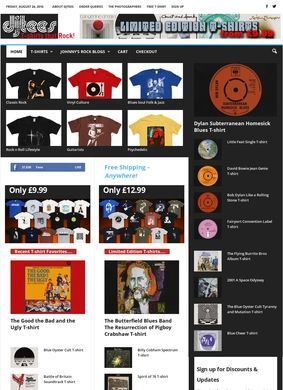
You want a t-shirt with a specific blues guitarist on it, or a vinyl-record motif that isn't the same five bands every other shop prints, and most general apparel sites leave you stranded. DJTees starts from the opposite end. The whole catalogue is built around music and the people who care about it deeply, from classic rock acts on both sides of the Atlantic to jazz, folk, soul, funk, and country, with a corner reserved for classical composers and even a philosophy and football line that suggests someone behind the curtain has wide tastes.
Collections and curation by genre
The sorting is what makes it usable. Instead of dumping everything into one grid, DJTees groups designs into named collections like "Bestsellers," "Great Singers," and "Gigs and Posters," so a fan of a particular era or sound can follow a thread rather than wade through hundreds of unrelated graphics. A "Great Singers" section sits beside guitarist-focused designs for blues, jazz and folk players, which tells you the curation is by genre and by role, not by whatever sells fastest. That kind of structure rewards browsing. You go in looking for one artist and surface three more you half-forgot you liked.
Discounts and loyalty rewards
On the commercial side, DJTees runs a "3 for 2" promotional code, free shipping once an order passes the hundred-pound mark, and a loyalty scheme branded as Rewards. None of those are unusual on their own, but stacked together they point at a shop that expects repeat buyers and people kitting out a small collection in one go, which fits the buy-three logic of the discount. The products read as custom-printed graphic apparel, and there is a women's clothing line alongside the unisex-feeling band tees, so it is not purely aimed at one demographic.
Blog and community presence
There is also a blog, "Johnny's Rock Blogs," which gives the operation a voice beyond the product pages. A retailer that writes about the music it prints is usually run by people who know the catalogue they are selling, and that shows up in the breadth of the designs: someone has to know who the obscure folk guitarists are to commission art of them. It lends the whole thing a personality that a generic print-on-demand storefront tends to lack.
Review ratings across platforms
Outside opinion is where the picture gets more textured, and a buyer should weigh it carefully. DJTees carries Trustpilot reviews, around twenty-five of them, with positive quotes on display, though the headline score was not clearly readable. Knoji lists it at 3.7 out of five across five reviews, Smart.reviews puts it near 3.9, and Tenereteam shows 4.2 from nine reviews. Review Centre has user feedback too, without a firm count. The numbers cluster in respectable-but-not-glowing territory, and the volume is modest, so a few orders can swing the average noticeably.
The figure that stands out, and not in a comforting way, comes from AskmeOffers, where the DJTees distribution splits roughly thirty-nine percent "Terrible" against sixty-one percent "Excellent" with nothing in between. A polarised spread like that, no middle ground at all, usually means people either got exactly what they hoped for or hit a real problem with an order. It is the sort of pattern that warrants reading the actual complaints before placing a large order, because an average smooths over a split that a shopper would want to see plainly.
There is a more organic signal worth noting. A thread on theFretBoard, a guitar forum, references specific DJTees product links, which means real musicians have found the shop and passed it around among themselves. That kind of word-of-mouth among an enthusiast community is something no star rating can buy, and it squares with the genre-deep catalogue. The audience the shop is built for has noticed it. What is absent is telling in its own way: no meaningful presence turned up on BBB, Google, or Yelp, so the reputation is documented almost entirely on smaller specialist review sites rather than the big aggregators most shoppers check first.
Contact information gaps
That gap in visibility extends to how DJTees presents itself for contact. The homepage shows no phone number, no email, no postal address, and no obvious link to a contact page. For a clothing order that arrives and fits, this may never matter. For one that turns up wrong, late, or damaged, the absence of a visible route to a human is a genuine drawback, and it sits awkwardly next to that polarised review split. A shop asking customers to spend over a hundred pounds for free postage is asking for a degree of trust, and an easy way to reach someone is part of how a retailer earns that trust back when an order goes sideways.
None of this cancels what the catalogue does well. For a fan of classic rock, blues, vinyl culture or the less-printed corners of music history, the range and the genre-aware curation are a real draw, and the blog plus the forum chatter indicate the people running it are part of the same world as the buyers. The promotions and loyalty programme make sense for anyone planning more than a one-off purchase. DJTees is clearly aimed at a specific person, and it serves that person with more depth than a broad apparel site would bother with.
What the published evidence cannot answer is whether the after-sale side matches the front-of-shop appeal. The catalogue depth and the forum chatter are genuine. The missing contact route and the all-or-nothing review split are genuine too, and they are the piece a buyer cannot test until something goes wrong. DJTees is worth exploring for anyone deep in a niche the mainstream ignores; going in with a modest first order makes more sense than staking a large one on an unresolved track record.