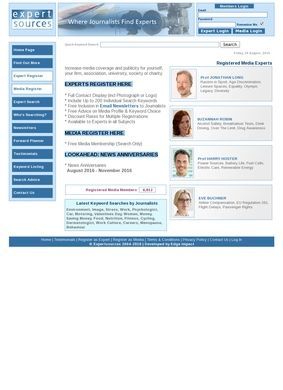
Expert Sources is a UK media matchmaking service run from Reading, Berkshire, that connects journalists and PRs with subject-matter specialists by topic. The model is two-sided and the structure is plain enough to assess from the published details. Experts pay to register; journalists and media professionals join free and search the database. On the published facts the proposition is coherent and the contact accountability is unusually open. The catch is that almost everything a paying expert would weigh comes from the platform's own description, with no outside corroboration to check it against. That makes this a tool worth examining closely on its mechanics, and a harder one to commit money to on faith.
How the expert registration works
The expert side is the revenue side, so the specifics deserve scrutiny. Registration is paid, with tiered discounts depending on the package. In return an expert gets a profile carrying a photo or company logo and up to 200 searchable keywords. Those keywords do the actual work here, because the database is searched by subject area; the more precisely an expert tags their fields, the better the odds a reporter chasing a niche angle surfaces them. Registered experts are also folded, at no extra cost, into email newsletters sent directly to journalists. So the listing is not a page that sits and waits. It pushes the expert toward the people writing stories.
Pricing structure without published figures
That is a reasonable design. What the published material does not give is a price. "Tiered discounts" describes the shape of the pricing without naming a single figure, and for a service that asks specialists to pay before they see a result, the absence of a number is a fair thing to hold against it.
Free access for journalists
The deal for journalists is more generous and easier to recommend, because it costs nothing. Free membership opens the searchable expert database, a favourites or shortlist system for holding useful contacts, and regular curated email digests built around topics in the news. The favourites feature is the quietly practical one. A reporter who found a good economist last month does not want to rerun the same search under deadline pressure, and being able to park a name and return to it is the difference between a tool used once and one kept open in a tab. None of this requires payment or a leap of faith from the media side, which is exactly why the free half of the model reads as the stronger half.
Forward planner for news calendars
One feature stands apart from basic search-and-match, and it is the part that shows someone understood how newsrooms plan. Expert Sources keeps a forward planner listing upcoming news anniversaries and awareness dates. Editors build calendars around these markers, the anniversary of a major event, a national awareness week, a recurring fixture in the political or cultural year, and they line up commentary well before the date arrives.
Keeping the planner current
A journalist looking ahead can spot a date worth covering and, in the same place, start hunting for the relevant expert to comment on it. That folds planning and sourcing into one workflow. For experts, the corollary is just as useful: anyone whose specialism maps onto a known upcoming date has a clear reason to keep their keywords sharp, since demand for their field becomes predictable instead of random. The concept is genuinely clever, and it is the most distinctive thing Expert Sources offers. The caveat is upkeep. A forward planner is only worth anything if it stays current, and the published listing gives no way to confirm that it does; that only shows through use over time.
UK media focus as a boundary
The geographic focus shapes who should bother. Expert Sources operates from Reading, Berkshire, oriented toward UK media and PR. For a British broadcast researcher or trade-press reporter that orientation is a strength. For anyone sourcing experts for a primarily American or international outlet it narrows the pool considerably, and the site makes no pretence otherwise. This is not a flaw so much as a boundary, and it is stated honestly. An expert outside the UK media ecosystem, or one hoping to be found by it, should read the Reading address as a hard limit, not a minor detail.
Contact details and accountability
On accountability the service is direct in a way many competitors are not. There is a phone number, a working editorial email address, and a full postal address in Caversham, Reading, alongside a contact page. For an outfit whose entire business is brokering trust between strangers, that openness counts. A platform asking experts to pay for visibility and asking journalists to lean on its database has to be reachable, and the contact details here are present, specific, and easy to find. This is the single strongest point on the page, and it does most of the reassuring.
Missing independent verification
It is also doing more reassuring than one page should have to, because outside corroboration is missing. A search for independent reviews of Expert Sources returned nothing usable; the results pointed at unrelated companies sharing a similar name, which are not this business. The blank is not proof the service is poor. Plenty of solid niche B2B tools never accumulate public reviews, because their users are professionals who judge by results, not star ratings. The consequence for a prospective expert is plain enough: the paid registration is being weighed almost entirely on the platform's own account of itself, with the credibility of its setup standing in for the verdict of anyone who has used Expert Sources in practice.
Weigh it honestly. The two-sided model is sound, the keyword search and shortlist features match how the work actually gets done, and the forward planner is a smart addition. The free media side asks nothing and gives a usable tool, so a UK journalist has little reason not to register and try the database.
What to ask before paying
The paid expert side is the genuine decision, and there the case Expert Sources makes is incomplete: no published price, an unverifiable claim about planner upkeep, and no third-party feedback of any kind. A UK specialist in academia, consultancy, law or science will find the mechanics well-matched enough to justify a direct call to the editorial team, to pin down tiered pricing and how the newsletter distribution is targeted. Until those numbers exist on paper, treat the spend as a measured bet, not a settled one, and get the figures out of Expert Sources before any money changes hands.