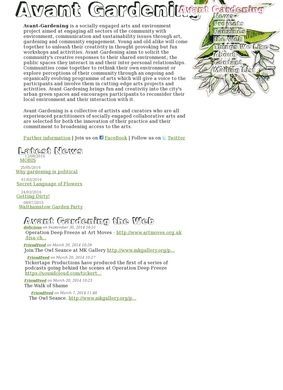
Can something built around gardening really end up inside the Barbican and Tate Britain? That is the pitch Avant Gardening makes on its home page, and the portfolio behind it holds up. This is a London arts and environment project that treats planting, growing and time spent with nature as a working medium for community art, not a hobby page or a garden-supply shop. The commissions run from workshops on housing estates to full gallery exhibitions. Artwork is credited to Polly Brannan, and the site itself was built by The Useful Arts Organisation.
How the art and the gardening fit together
The idea takes a moment to settle, because the two words in the name pull in different directions. One brings to mind soil and allotments. The other brings to mind conceptual art in a white room. Avant Gardening lives in the overlap, running nature-based activities that double as socially engaged art practice, aimed at "young and old alike" across urban communities that the contemporary art world does not usually court.
What keeps this from reading like a grant application is the specificity of where the work has happened. A practice that can point to named venues and dated projects is describing things it has done, and the site leans on that evidence more than on mission statements. That is the right instinct for a project whose premise sounds abstract until you see the receipts.
From estate workshops to gallery rooms
The range is the interesting part. On one end sit hands-on sessions run on housing estates, the kind of small-group local work that rarely gets documented anywhere public. On the other end sit happenings and interventions at the Barbican, the Serpentine Gallery, MK Gallery and Tate Britain.
Most arts organisations pick a lane and stay in it. Avant Gardening moves between the community end and the institutional end, and the gardening theme is the thread that carries across both, which is a harder thing to pull off than it looks on the page.
The projects portfolio and the news feed
Two sections carry the proof. Projects is the portfolio, a walk through past commissions. News is where individual pieces get written up, and it rewards a click: one entry covers a project Avant Gardening called Songbook, staged at The Albany in Deptford, alongside a mention of past award recognition tied to the work. The News section is more persuasive than the About page, because a running log of things that were made and staged is harder to wave away than a paragraph of intent.
Neither section is enormous. But there is enough there to see a genuine body of work behind the name, not a single event stretched to resemble a career.
The venues that give it weight
The list of hosts reads like a tour of the UK art establishment: Barbican, Serpentine, Tate Britain, MK Gallery, and City of London festivals. For Avant Gardening, rooted in gardening and community engagement, that is a serious set of doors to have walked through, and it is the strongest single argument the project makes for itself.
A caution belongs here, though. The site does not always spell out the scale of each involvement, so a happening at a major gallery could be anything from a headline commission to a modest slot inside someone else's programme. Anyone can look up the names and confirm the venues exist. The exact weight of each is left a little vague, and a reader is trusted to take the association at something close to face value.
Fanzines and the printed side
Fanzines is the section that pushes back against expectation, a run of the project's own cheap, self-produced publications. It fits the ethos closely. A fanzine is made to be handed around, which sits naturally with work built on estates and in community rooms and sold through no gallery shop at all. It also signals that Avant Gardening thinks about how the work survives on paper after the event has packed up, a step most project sites skip entirely.
A workshop ends when everyone goes home; a printed zine keeps circulating, and it doubles as a record for the estates and community groups that took part, who might otherwise see nothing lasting come out of the visit.
Getting in touch, and the questions left open
Contact is straightforward enough. There is a dedicated page with a working email form and a listed address for someone named Paul, plus links out to Instagram, Facebook and Twitter under the avant.gardening and London handles. For a small arts project, that is a reasonable spread of routes, and the form connects to a real person rather than a black hole.
What is absent is a phone number and any physical street address, nowhere on the site. For an outfit that works across specific London venues and estates, that gap is easy to explain, but it does mean anyone hoping to reach a human quickly is funnelled through a form and a few social feeds.
The larger silence sits outside the site. A search for outside opinion on Avant Gardening turns up nothing about this particular organisation. The names that surface belong to other businesses entirely: a landscaping firm in Wisconsin, a nursery in Massachusetts, a New York restaurant. None of them is this project, so there is no independent audience verdict to set against the site's own telling.
The contact route and who stands behind it
Two names anchor Avant Gardening: Polly Brannan on the artwork, and Paul handling the correspondence. That points to a small operation, which the fanzine format and the estate sessions already implied. The transparency is fine as far as it reaches, and the email route does land with an actual person on the other side.
And that is where the doubt settles. The venues are impressive and the projects are documented, yet every line of assessment here rests on what the project says about itself. I kept waiting for one outside voice and never found it. Nothing from a reviewer, a past participant, or an arts writer confirms how these workshops actually land for the people sitting in the room, and for a practice whose whole reason for being is community impact, that missing testimony is the gap no list of gallery names manages to close.