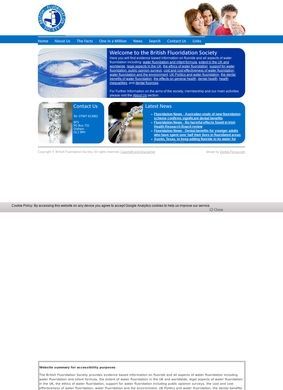
The British Fluoridation Society is a not-for-profit company registered in England and Wales whose single purpose is to promote water fluoridation as a way to cut tooth decay. That aim is stated plainly and pursued narrowly: securing an optimum fluoride level of one part per million in public water supplies, and pulling together the medical, dental, educational, and administrative effort that adding it to the mains actually requires. The organisation has been at this for more than half a century, which gives the campaign a long institutional memory to draw on.
Registered under company number 00953937, the British Fluoridation Society sits somewhere between a professional body and an advocacy group. It distributes dental health information to the public while coordinating the people whose decisions determine whether a given region fluoridates its water at all.
What the society sets out to do
The mission is single-minded, and the site does not pretend otherwise. Water fluoridation is the subject, the argument, and the reason the British Fluoridation Society exists. Every section circles back to it.
That focus is a strength and a limit at the same time. A visitor looking for general dental advice, brushing technique or diet, will find the material here pointed somewhere more specific: the public health case for adjusting fluoride in the water supply, the safety questions that surround it, and the evidence that decades of research have produced. If the intended reader is a professional weighing that policy, the concentration pays off.
Fluoridation resources and the evidence base
The Fluoridation Resources section is the heart of the site. It gathers educational materials on the safety and benefits of fluoridation, video content, webinars, professional forums, podcasts, and eBooks, alongside links out to a research and evidence base. That is a wide spread of formats for one topic, and the mix matters: a dental professional building a case for a local scheme needs the underlying studies, while a councillor or an interested member of the public may get further with a recorded lecture or a podcast.
Pulling the evidence and the plain-language explainers into one place is the practical service the British Fluoridation Society provides. The evidence base is the part worth opening first, since almost every claim elsewhere on the site leans on it.
Membership and career development
Beyond the reading material, the British Fluoridation Society runs a membership programme and offers career development support. Membership is the mechanism that turns a set of web pages into a working network, connecting the dentists, doctors, and public health officials who share the aim. The career development angle points the offering at people earlier in their working lives, which is a sensible way for an advocacy body to keep its argument alive across generations of practitioners rather than letting it age with its founders.
What the site does not do is hide its position. This is an organisation that wants water fluoridated, and it argues that case with its resources. A reader should weigh the material knowing that, the same way they would read any campaigning body, and the British Fluoridation Society is at least transparent about where it stands.
Who it is built for
The audience splits three ways, and the British Fluoridation Society speaks to each of them differently. There are the professionals who deliver or influence dental care, the officials who set public health policy, and the general public who drink the water in question. One site is trying to serve all three, and the range of formats is how it manages the stretch.
The About and Blog sections carry the connective tissue: who the British Fluoridation Society is, what it has been arguing, and where the current debates sit. A separate Media Contacts section gives journalists and officials a direct route to the organisation, and the society keeps a Facebook presence that pushes the same message out to a wider audience than the site alone would reach. The blog in particular is where a body like this either stays current or goes quiet, and an active one is a good sign that the campaign is being tended instead of left to sit.
Dental and medical professionals
For dentists, doctors, and other clinicians, the British Fluoridation Society functions as a clearing house. The forums, webinars, and evidence links give a practitioner the material to answer a patient's fluoride question or to brief a local authority, and the monograph and newsletter content keeps that audience abreast of where the science and the policy stand. This is the reader the British Fluoridation Society is built around, and the depth of the resources reflects it.
The general public and the blog
A member of the public arrives with simpler questions, is fluoride in the water safe, does it work, and the British Fluoridation Society answers them through the accessible end of its content: the videos, podcasts, and eBooks rather than the raw studies. Whether that lands depends on how a given reader feels about the source, since the answers all come from a body that openly favours fluoridation. The material is there to be read critically, which is the honest way to use it.
Taken as a whole, the British Fluoridation Society is a focused, long-running resource that does one job thoroughly and makes no secret of its stance. It will reward a public health officer or a dental practitioner building a case for a local water scheme more than it will a casual browser after quick tips. A reader in that first group should head straight into the Fluoridation Resources section, work through the recorded lectures and the linked evidence base, and treat the membership programme as the next step if the topic sits at the centre of their work.