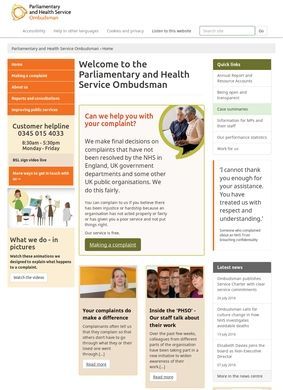
At some point, almost everyone who has fought a long and fruitless complaint against a government department or an NHS body arrives at the same question: who do you go to when the organisation you are complaining about has already given you its final answer? In England, that answer is the Parliamentary and Health Service Ombudsman, an independent public body that picks up cases only after the internal complaints route has been exhausted. The site does not try to be a general guide to public grievances. It is built for a specific moment, and it knows it.
Check my complaint tool
The most practically useful feature is the "Check my complaint" tool, a short online questionnaire that tells you whether a situation falls within this office's scope before you spend time assembling a formal case. That ordering is sensible. A lot of the frustration in the complaints world comes from people doing the hard work of documenting everything, submitting, and only then learning that the issue was never eligible. The eligibility check sits at the front of the journey, which respects the visitor's time. If the tool says yes, an online portal is there for the formal complaint. If it says no, the site points toward the appropriate route and explains why.
Guidance on eligibility
The pre-complaint guidance does the same job in a quieter way. The remit of the Parliamentary and Health Service Ombudsman is narrow on purpose: it is the last stage, not a general-purpose complaints body, and a significant share of people who arrive will be in the wrong place. Some will be too early in the process. Others will hold grievances that belong with a different watchdog altogether. The guidance explains which is which and where to turn. A body that openly tells you when it cannot help is more trustworthy than one that tries to absorb every query, and the Parliamentary and Health Service Ombudsman takes the former approach consistently.
Support for representation
There is also information on advocacy and representation, covering how a complainant can be supported or spoken for during an investigation. The people most likely to need a final-tier ombudsman are often the same people least equipped to fight a long bureaucratic process alone: someone worn down by months of NHS correspondence, a relative acting on behalf of a patient who cannot speak for themselves, a person who finds official language impenetrable. Pointing toward help in that context is a practical act, not decoration.
Searchable database of rulings
One feature that sets the Parliamentary and Health Service Ombudsman apart from a standard complaints page is the searchable database of past rulings. Anyone can browse case outcomes, which addresses two different audiences at once. A prospective complainant can read comparable cases and form a realistic picture of what tends to be upheld and what does not, before they invest emotional energy in a submission. Researchers, journalists, and people studying how public bodies fail get a public record they can work from. Publishing the reasoning behind past rulings is an invitation to scrutiny, and the Parliamentary and Health Service Ombudsman extends it openly.
Improving complaint handling across the sector
The second strand of work on the site faces public-sector organisations, not complainants. There is complaint standards guidance and leadership support aimed at helping hospitals, departments, and other bodies handle grievances better at source. Every dispute resolved properly by an NHS trust or a government department is one that never has to climb to this final stage. The Parliamentary and Health Service Ombudsman publishes annual complaints data as well, turning the volume and pattern of grievances into a public record that policymakers and researchers can examine, where previously the figures would have remained buried inside individual institutions. The strategic logic is that improving complaint-handling across the sector reduces the flow of cases reaching the final tier, which is a more durable fix than processing a growing queue.
Waiting times and service costs
The site states current waiting times plainly: up to six months for NHS complaints, up to seven months for complaints about UK government departments. Those are long stretches for anyone already worn down by an unresolved dispute. It would have been easy to soften the figures or bury them in smaller print. Stating them up front lets a person decide whether to commit to the process with a clear sense of the timeline. The Parliamentary and Health Service Ombudsman chooses the uncomfortable version of that disclosure, and it is the right call.
Two structural facts ground the whole proposition. The service is free to complainants, and it operates independently of the government departments it scrutinises. Removing cost as a barrier means access does not turn on what someone can afford. Independence is what gives any finding genuine weight; an ombudsman that answered to the very departments under review would be procedural theatre. The Parliamentary and Health Service Ombudsman is constitutionally separate from those bodies, and that separation is the reason a decision here carries force when a department has otherwise stonewalled.
Outside reputation is limited: public search returns no substantial body of third-party user reviews for the Parliamentary and Health Service Ombudsman as an institution. That is expected; the Parliamentary and Health Service Ombudsman is a statutory body rather than a commercial service, and people do not rate it the way they rate a shop. What is available is the published casework record itself, the annual data, and the rulings database, all of which can be read and assessed directly.
There is one constraint worth naming, and it is built into the role rather than the website. A meaningful share of visitors will arrive to discover they are not yet eligible, that they must return to the organisation they are unhappy with and complete its own process first. The site handles that reality about as well as any design could, through the eligibility tool and the guidance pages, but no amount of clear layout changes the fact that many people will leave to do more groundwork before they qualify. Reading the material with that in mind sets the right expectation: the Parliamentary and Health Service Ombudsman is a structured, deliberate channel with real waits attached, not a shortcut to redress.
Taken together, the Parliamentary and Health Service Ombudsman presents itself with unusual clarity for a public institution. It defines its scope tightly, screens people before they commit to a formal submission, explains what to do when it cannot help, supports people who need representation, opens its decisions to public view, works to raise complaint-handling standards across the sector, and tells you upfront how long you will wait and that the process costs nothing. The picture that emerges from the published material is of an institution that treats correct use as the priority, not volume.