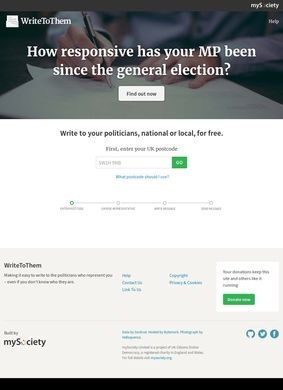
You have a problem with a planning decision, a benefits delay, or a road that floods every winter, and you know the person responsible for it sits in some council chamber or in Parliament. The hard part is never having an opinion. The hard part is finding out who that person is and how to reach them without composing a letter, hunting for an address, and second-guessing whether you are even writing to the right office. WriteToThem exists to collapse that whole search into a single field: type your postcode, and it tells you who represents you.
Finding your elected representatives
The tool is run by mySociety, a UK registered charity (number 1076346), and it costs nothing to use. From the postcode lookup WriteToThem identifies the full set of people who answer to you, which is a longer list than residents usually realise. Members of Parliament at Westminster sit alongside MSPs in the Scottish Parliament, Members of the Senedd in Wales, and Members of the Northern Ireland Assembly. London residents also see their London Assembly Members. Local councillors appear too, across the multiple tiers that overlap in much of the country, so a single household can be matched to a county councillor, a district councillor, and a parish representative at once. The historical MEP data is there as well, a reminder of how long the project has been running and tracking these mandates.
How the postcode lookup works
What makes WriteToThem usable is that it never asks you to understand the structure of UK government before you start. You enter a postcode, you pick the representative who fits your issue, you choose what kind of message you are sending, you write it, and you submit. Five steps, in plain order, with the heavy lifting (matching boundaries to people, finding current contact routes) done quietly in the background.
Simple steps to contact elected officials
The people who most need to contact a representative are often the people least sure of how to do it. Someone writing for the first time about a school place or a housing repair does not have to know whether their concern belongs to the council or to their MP. The selection step lays out the options and lets the issue find its own destination. It is a small piece of design that removes a real barrier.
Removing barriers for first-time users
The representative data behind all this is sourced from GovEval, and the infrastructure runs on Mythic Beasts. Those are not details most visitors will ever notice, but they speak to a service that is maintained rather than left to rot, which is a genuine risk for any civic tool that depends on constantly changing officeholders.
Open source code and data sources
One thing that sets WriteToThem apart from a typical contact form is that its source code is published openly on GitHub. Anyone can inspect how the matching works, how messages are handled, and how the site behaves. For a tool whose entire value rests on routing your words to the correct elected official, that transparency is worth more than any reassurance the site could write about itself.
Beyond the core flow, WriteToThem also includes a Help section for people who get stuck, donation options for those who want the charity to keep the lights on, and a facility that lets other websites link directly into the writing flow. That last feature is quietly useful: a campaign group or a local news site can drop a reader straight into the postcode lookup instead of explaining the whole process again.
The tool sits within a family of mySociety projects that share the same civic purpose. TheyWorkForYou tracks what representatives say and how they vote, FixMyStreet handles reporting potholes and broken streetlights to councils, and MapIt deals with the boundary data underneath it all. Knowing that the service belongs to that group tells you something about its priorities. It is built to put pressure points back in the hands of ordinary people, and it has the company of tools that do the same job from different angles.
What WriteToThem does and does not do
There are limits worth being honest about. WriteToThem handles the contacting, not the answering, and whether a representative replies is entirely outside its control. It is a delivery mechanism, a clean and well-aimed one, but the conversation it starts depends on the person at the other end. WriteToThem also focuses on email contact, so anyone who prefers a phone call or a face-to-face surgery will use it as a first step and not the whole journey.
Still, for what it sets out to do, it does the job with very little friction. The whole experience is built around getting a message from a citizen to the right official in a few minutes, and it has been doing exactly that for years without charging for it or burying the function under advertising. The free, charity-backed model means there is no upsell waiting at the end, no premium tier that unlocks the part you actually wanted.
WriteToThem does not have a wide trail of third-party reviews on ratings platforms; a search turns up very little beyond press mentions and civic tech forums. That absence is partly a function of what it is: a free public tool people use once or twice a year, not a subscription service they rate. The mySociety charity behind it has a longer track record and has been covered by mainstream UK outlets over the years, which gives some external grounding. The honest verdict is that WriteToThem does a narrow job cleanly, the code is open for anyone to check, and the charity model removes the obvious commercial incentives to cut corners.