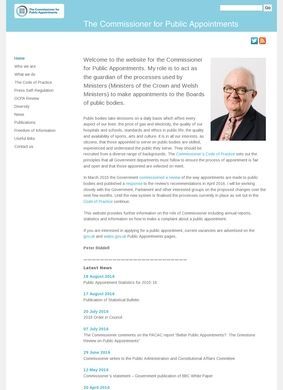
Running the process by which ministers fill seats on UK public body boards is not especially glamorous work, but it matters enormously once you try to find out whether a particular appointment was competitive or simply handed to someone. That is the gap The Commissioner for Public Appointments fills. An independent Crown appointee, the office exists to assure that ministerial appointments to public bodies comply with the Government's Governance Code on Public Appointments, the framework that replaced the older Code of Practice when it came into force in January 2017. The site is the public-facing record of that assurance work, and it rewards patient reading more than it rewards a quick visit.
How the Commissioner ensures appointment compliance
The Governance Code sets out what a compliant appointment looks like: open competition as the default, merit as the deciding criterion, and independent oversight where the stakes are high. The Commissioner for Public Appointments provides that oversight for significant appointments, Orders in Council appointments, and cases where a post is filled outside open competition. That last category deserves attention.
Appointments made without competition are exactly where public accountability is weakest, so placing them squarely in the remit is a meaningful design choice. A 2026 update to the list of significant appointments subject to oversight shows the scope is not static; the catalogue of which roles fall under scrutiny gets revised as government itself evolves. That kind of administrative upkeep is easy to discount, but it is the difference between a regulator that keeps pace with how boards get staffed in practice and one policing a frozen snapshot from years prior.
Investigating non-competitive appointment processes
Investigations are where the office has real teeth. When a candidate, public body, or other party believes an appointments process fell short of required standards, they can submit a formal complaint to The Commissioner for Public Appointments. The complaints channel is described as a defined procedure rather than a vague invitation, which is a useful distinction for anyone deciding whether a grievance is worth formalising. Once an investigation concludes, The Commissioner for Public Appointments publishes formal decision notices setting out what happened and why the process did or did not comply. Those notices are what separate a regulatory office from a policy document: they name flawed processes, put the reasoning on record, and do so publicly. A regulator that only restates principles is easy to ignore. One that publishes findings is harder to dismiss.
The Commissioner for Public Appointments also handles Freedom of Information requests, with instructions for how to submit them directly to the office. For a body whose entire credibility depends on transparency, building FOI directly into the office is a consistent design choice. The publications shelf rounds out the accountability layer: annual reports, management information statistics, and guidance on appointment procedures sit here for anyone who wants to look. The statistics are arguably the most useful material of all, since aggregate figures on appointment routes, competition rates, and bypass frequency are the raw evidence anyone needs to judge whether the system is working or merely declared to be working.
Finding vacancies and advisory functions
Two further strands complete the picture. The Commissioner for Public Appointments signposts vacancies through links to the HM Government Public Appointments portal and Welsh Government equivalents, so a citizen curious about serving on a public board has somewhere concrete to go for live openings. There is also an advisory function, where The Commissioner for Public Appointments works alongside the Cabinet Office and Welsh Government on appointment policy. That advisory role sits in some tension with the regulatory one, given that the same office both helps shape the rules and then polices compliance with them, though the independence baked into a Crown appointment is presumably what is intended to hold those functions apart.
It helps to remember which appointments are in scope. The remit of The Commissioner for Public Appointments reaches boards of public bodies that touch healthcare, utilities, education, and cultural services: institutions that run large parts of daily life across Britain. The word "institutions" is doing real work there: when a hospital trust board or a regulator of a public utility gains or loses a member, The Commissioner for Public Appointments is the office meant to confirm whether the process behind that change was fair, and the site is where the evidence for or against that fairness lives. The Code requires appointees to demonstrate relevant skills and diverse backgrounds, with the public interest given as the reason both requirements exist. Most people will never apply for a board seat, but many people depend on the bodies those seats govern.
For the audiences the office most directly serves, the material is genuinely practical. A would-be board member can read the Code in full, understand what a compliant process looks like, find current vacancies through the linked portals, and know there is a formal complaints route if something goes wrong. A journalist or researcher can pull the annual reports and statistics The Commissioner for Public Appointments publishes to probe claims about diversity, competition frequency, and how often appointments skip open process. A public body running its own appointment can check guidance against its practice before The Commissioner for Public Appointments does. The tone throughout is dense and official rather than approachable, but the substance is there for each of those readers in a different way.
Checking what the Commissioner regulates
The Commissioner for Public Appointments is also clear about where its authority ends. The office regulates and assures; it does not make appointments, which remain with ministers, and it does not run competitions. That boundary is sensibly drawn and openly stated. But it is also where the limits become visible. The Commissioner for Public Appointments can investigate, publish a decision notice finding non-compliance, and advise on policy, yet ministers retain the final power to act within the Code or not. The site documents standards and documents breaches.
What the publications cannot answer is whether decision notices change ministerial behaviour in the appointments that follow, or whether a finding of non-compliance lands as a serious consequence or as an uncomfortable footnote. The oversight record is public and the process is open to inspection. How much force that record carries in practice is a question each reader is left to weigh from the evidence on the page.