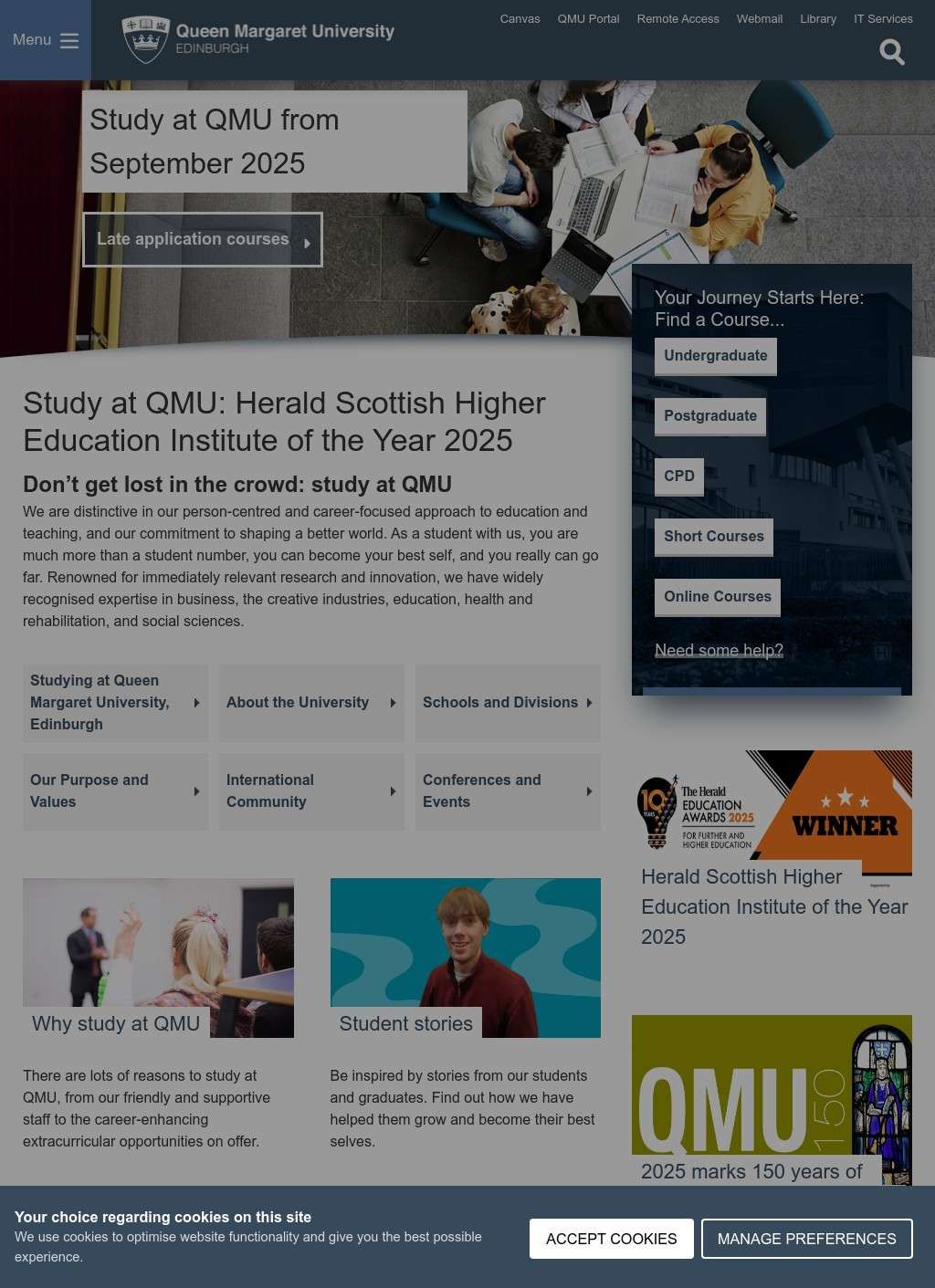
Most people who picture Queen Margaret University picture Edinburgh, but the campus that houses it is in Musselburgh, East Lothian, and it only opened in 2007. That single detail tells you a good deal about the institution. This is a Scottish university that put real money into building a coherent, modern home for itself, and the website carries the same sense of a place organised around a few specific strengths instead of trying to cover every field at once. As a registered Scottish charity, it sits in the established public-education landscape, yet the impression it gives is of a comparatively young institution still defining its edges.
Seven subject clusters define the university
The teaching spreads across seven broad subject clusters, and they are worth naming because they reveal where the university leans. Business sits alongside International Hospitality, Tourism and Events Management. Then there is Drama and Performing Arts; Education; Film, Communication and Design; Health Sciences; Nursing; and Psychology and Sociology. Read that list closely and the gravitational pull toward health and the human professions becomes obvious. Queen Margaret University clearly built much of its identity around clinical and rehabilitation training, and the postgraduate offering only confirms it. The undergraduate side covers the same ground, so a student moving from a bachelor's degree into a taught master's at Queen Margaret University is not stepping into a different institution halfway through. That continuity is part of what makes the smaller scale work in the university's favour.
Postgraduate health specialisms
That postgraduate menu is where things get genuinely specific. Dietetics, Occupational Therapy and Arts Therapies, Physiotherapy, Podiatry, Radiography, and Speech and Hearing Sciences are all present, joined by Cognitive Behavioural Therapy and a Global Health and Development strand.
These are not generic master's badges. They are the regulated, placement-heavy programmes that feed people into the NHS and allied health roles, and a university does not list that many of them unless it has the staff, the clinics, and the partnerships to back them up. Outside the health block, the site also covers Media and Public Relations along with an Arts, Culture and Creative Industries route, which keeps the creative cluster from feeling like an afterthought bolted onto a health school. Even so, the centre of gravity at Queen Margaret University is unmistakably the clinical side, and the site never pretends otherwise.
Research aligned with teaching areas
Research sits underneath the taught provision instead of off to one side. Queen Margaret University offers both MRes and PhD routes, and the institutional research focus tracks the same five areas the teaching does: health and rehabilitation, business, creative industries, education, and the social sciences. I find that kind of alignment reassuring, because it means the supervision and the lab or clinical resources genuinely exist where a research student would need them, instead of a doctoral page promising supervision in fields the university barely teaches. Coherence like that is harder to engineer than it looks, and Queen Margaret University seems to have managed it by keeping its ambitions narrow on purpose.
Professional development and online learning
There is also a professional-facing layer that is easy to overlook. The Advancing Professional Practice framework bundles continuing professional development and short courses for people already working, and the online master's programmes extend the reach beyond anyone who can physically reach Musselburgh. That matters for the allied health workforce in particular, where practitioners often want to upskill without leaving a post. Queen Margaret University rounds this out with business creation and entrepreneurship support and conference and events hire, the latter trading directly on that newer campus infrastructure. None of it feels like padding; each piece connects to a population the university plainly wants to serve.
International partnerships in academic offering
International partnerships get a mention too, spread across several countries. The site does not turn this into a parade of logos, which I appreciated; it reads as a working part of the academic offering instead of decoration. For a prospective postgraduate weighing where a degree from Queen Margaret University might travel, that international footprint is a real, if understated, point in its favour. The same restraint shows up throughout the site, and it gives the whole presentation a credibility that louder institutions sometimes lack. A reader can move through the pages without wading through marketing, which is rarer than it should be among universities of any size.
Student support services documented in detail
The student-support scaffolding is laid out plainly, and it is more thorough than many larger institutions bother to publish. On the practical side there is a Library and Learning Resource Centre, the Canvas virtual learning environment, the QMU Portal, and IT Services. On the welfare side, Queen Margaret University documents a Counselling Service, a Disability Service, a Careers and Employability Service, and an Effective Learning Service, alongside a Sports Centre, a Students' Union, and student accommodation. Taken together, this is the kind of concrete detail that helps an applicant picture the daily reality of being there, well beyond the polished prospectus version.
Distinct disability and learning support
A student deciding between two offers can compare that scaffolding line by line, which is exactly what it is for. The presence of a dedicated Disability Service and a separate Effective Learning Service, rather than one catch-all support desk, points to Queen Margaret University treating these as distinct needs with distinct staff behind them.
Does the focused scope match your needs?
If there is a criticism to make, it is about ambition instead of execution. Queen Margaret University is a smaller institution, and its strength is concentration: it does health, rehabilitation, and a handful of professional and creative fields well, and it does not pretend to span the full research-intensive spectrum of an ancient Scottish university. Someone hunting for a sprawling course catalogue or a particular niche outside those clusters may simply find the offering does not stretch that far.
That is a strength for the right student and a real limit for the wrong one. To the site's credit, the shape of the place is honest enough that the mismatch should be obvious well before anyone fills in an application. Nothing here oversells, and that restraint is itself a kind of reassurance about how Queen Margaret University handles the rest of the student relationship.
What the website does well is match its presentation to what the institution genuinely is. The structure mirrors the academic structure, the support services are documented in detail, and the postgraduate health specialisms are concrete enough to check against a career plan. Queen Margaret University comes across as a focused, professionally minded university that knows precisely which students it serves best, and the campus age underneath all of it explains a lot of the modern feel.
So where does that leave the verdict. In dietetics, physiotherapy, speech sciences, the wider allied health professions, or the creative and business strands the university teaches, Queen Margaret University looks like a serious, well-resourced option with a young campus and a clear sense of purpose, and its own site gives you enough substance to make an informed decision. Outside those clusters, the offering does not bend to fill the gap, and the site is honest enough that the mismatch is visible before an application is submitted. A strong recommendation within its lane and a guarded one outside it, which is more or less how a university this deliberate ought to be read.