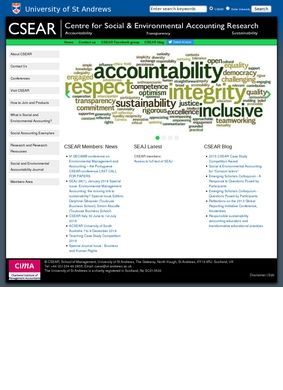
CSEAR is the Centre for Social and Environmental Accounting Research, an academic research centre housed within the University of St Andrews Business School. Its stated purpose is to mobilise accounting scholarship toward a more sustainable society, and everything on the site orbits that single idea. This is a scholarly hub, not a consultancy, and the material reads accordingly: dense in places, plainly written in others, aimed squarely at people who already work in or study sustainability accounting.
The audience is international and academic. Scholars, doctoral students, and practitioners who take environmental and social accounting seriously will recognise the territory CSEAR maps out quite quickly.
What the centre puts in front of researchers
The core of the site is a research programme dressed in fairly modest clothing. There is no attempt to look flashy. You find a membership scheme, a journal tied to that membership, a stream of blog posts and articles, educational resources, and a calendar of events. That is a coherent set of offerings for a field that lives on conversation between people who rarely sit in the same building.
Membership is the spine of it. Joining CSEAR opens access to the Social and Environmental Accountability Journal, which is the kind of specialist publication that gives a centre like this its weight. Anyone tracking developments in sustainability accounting will treat that journal as a working tool.
The membership and journal side
What makes the membership worth examining is that it bundles the intellectual output with the human one. The SEA Journal gives members the peer-reviewed record, while the wider programme keeps them connected to the community producing it. For an early-career academic trying to find footing in a narrow discipline, that combination carries real value. You get the literature and the people who write it in the same place.
It is a small field. A centre that concentrates the scholarship in one spot saves a lot of scattered searching, and CSEAR positions itself as exactly that concentrating point.
Blog, articles, and the running commentary
Alongside the formal journal sits a blog and a set of articles on sustainability accounting topics. This is the more accessible layer, and it does useful work. Peer-reviewed papers move slowly. A blog lets CSEAR respond to current debates, flag emerging questions, and give members something to read between the heavier publications.
The writing here is aimed at people who already speak the language of the discipline, so a general reader will find it fairly technical. That is the correct choice for the audience. CSEAR is not trying to explain accounting to the public; it is trying to advance a specialist conversation, and the informal writing keeps that conversation ticking over.
Learning, events, and the path for members
Education is treated as a genuine strand within CSEAR, not an afterthought. The centre lists educational resources and programmes, which fits an institution whose whole reason to exist is teaching a way of thinking about accounting. For anyone building a course or entering the field, having curated material from a recognised research centre is a practical shortcut.
Events sit next to the teaching. Sustainability accounting depends heavily on gatherings where researchers present work, argue it out, and build the networks that later turn into collaborations and citations. CSEAR putting events and networking front and centre reflects how this kind of scholarship really gets done.
Career development and mentoring
The mentoring and career development support is the detail I would flag to a younger academic. A great many research centres publish papers and host conferences. Fewer commit to walking members through the awkward early stages of an academic career, where the difference between staying and leaving often comes down to who answered your questions. Offering that support signals a centre thinking about the next generation of the discipline as much as its current output.
Whether the mentoring runs deep or stays light, the site does not fully say. But its presence as a named part of the CSEAR membership tells you something about the centre's priorities.
How the site holds together as a resource
Read as a whole, the CSEAR offering is unusually consistent. Research, publication, teaching, events, and career support all point at the same mission. Nothing feels bolted on to pad the page. A visitor gets a clear picture of a centre that does one thing and organises everything around it.
The plainness is worth naming as a strength. There is little marketing gloss, which suits a scholarly body. The value lands through the substance of what CSEAR puts on offer: a respected journal, a defined community, and a working programme of activity. A check for outside commentary on CSEAR, the kind of review or rating that tags a consumer-facing business, turned up nothing, which is unremarkable for a research centre judged by scholars through citations and membership rather than star ratings.
For its intended readers, this reads as a serious, focused resource. A practitioner curious about sustainability accounting would find an entry point; a committed researcher would find a home base. The narrowness that makes CSEAR less useful to a casual visitor is exactly what makes it valuable to the people it targets. The membership programme, the SEA Journal, the blog, the educational material, the events, and the mentoring add up to a centre doing careful work in a corner of accounting that has grown steadily more relevant, and the site presents that work without inflating it.