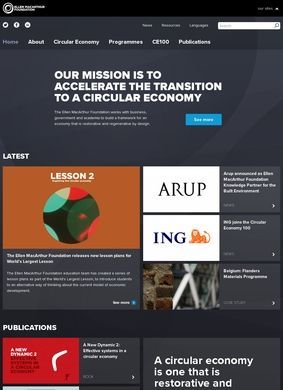
Stumbling across the Ellen MacArthur Foundation while browsing a business directory entry gave me a decent nudge to look at what it actually publishes, and it turns out there is quite a lot to look at. This is a UK-registered charity (Charity No. 1130306, Company No. 6897785) whose entire output organises around one idea: the circular economy, meaning the push to keep materials cycling through use and out of the waste stream after a single trip. That sounds like a tidy abstraction until you start moving through the site and see how many specific domains it reaches.
Plastics agenda for business
A good entry point is the 2030 Plastics Agenda for Business, a concrete commitment framework aimed at companies that make, sell, or depend on plastic packaging. The fact that the Ellen MacArthur Foundation works in dated, measurable targets, not vague aspirations tells you something about how the organisation operates. This is not a charity that publishes mission statements and waits. It sets out what companies are being asked to do and by when, and the documents are available for anyone to read.
Three thematic missions
Three thematic missions anchor most of the work: critical minerals, plastics, and fashion. These are domains where wasteful systems are obvious and the commercial stakes are large. Picking three and going deep makes more sense than spreading resources across every sector where circularity could theoretically apply, and the site reflects that discipline. Around those missions sits a wider range of topic areas: food, biodiversity, the built environment, cities, design, climate, education, finance. The breadth is genuine. A person could spend a long afternoon moving between how circular thinking touches farming and how it changes the way a building is designed to be taken apart at end of life.
Research reports and policy frameworks
Publishing is what backs a lot of this. The Ellen MacArthur Foundation produces research reports and policy frameworks and keeps a library of documents available for free download. That free-to-read decision has real practical consequences. A small council, a university seminar leader, or a startup founder can access the same material a multinational uses, and that is part of how ideas spread beyond the organisations that can afford subscription databases. One framework worth singling out connects circular economy principles to the Global Biodiversity Framework, treating waste reduction and the loss of living systems as parts of the same problem, not separate policy tracks.
The business collaboration side is where the abstract gets tested. The Ellen MacArthur Foundation runs programmes with companies and writes them up as case studies, so a visitor can see how a particular firm tried to redesign a product or a supply chain, and what happened. Case studies are easy to do badly; used well they answer the obvious sceptical question: has any of this been put into practice by people with budgets and shareholders? Alongside the corporate work there is a global network for circular economy practitioners, which gives the research and the programmes somewhere to land beyond the Foundation's own pages.
The educational material is easy to overlook next to the high-profile corporate work but it is worth attention. The Ellen MacArthur Foundation has built resources for schools and institutions that take a concept often buried in supply-chain jargon and make it teachable. That is a long game. A circular economy needs a generation that finds linear waste strange, not executives who only respond to a spreadsheet. Whether the school resources match the polish of the policy documents is something a teacher would have to judge for themselves, but the intent to reach that audience is clear and consistent across the site.
Design tools for product life cycles
Design tools point at the practical end of the same philosophy. The Ellen MacArthur Foundation's argument, repeated across its topic areas, is that most waste is decided long before anyone throws anything out: it is built in at the drawing-board stage. Tools that push designers to think about a product's whole life, including what happens when a user is finished with it, follow directly from that view. It is a more demanding ask than recycling programmes, and the materials do not soften that.
Public reviews of the Ellen MacArthur Foundation as an organisation are not plentiful. A search turns up limited ratings on the usual aggregator platforms, which is common for a charity operating primarily through research and corporate partnerships, with no consumer-facing services to generate ratings. The absence of a large review footprint does not say much either way about quality; organisations of this type are judged mostly by the uptake of their frameworks and the commitments their partners make.
For anyone following the field, the Ellen MacArthur Foundation's supporting infrastructure is well judged. A media centre handles press inquiries, and a newsletter subscription offers a low-effort way to track new reports without checking back constantly. None of it is flashy. The substance is in the documents and the programmes, and the rest of the site gets out of the way.
What no page on the site can settle is the gap between a well-argued framework and a changed industry. The Ellen MacArthur Foundation has assembled serious research, a significant roster of corporate partners, and a teaching pipeline that runs from boardrooms to classrooms. The 2030 Plastics Agenda will be measured by whether companies meet its targets, not by how clearly the document is written. On the published evidence, the Ellen MacArthur Foundation has earned a serious audience. The throwaway model is still dominant in most of the world, and the Foundation does not pretend the reports alone change that.
What the site does is give people working inside industries, governments, and schools the specific tools and arguments they need to push in a different direction. That is a realistic scope for a charity of this size, and the Ellen MacArthur Foundation pursues it with more discipline than the majority of organisations working on the same problem.