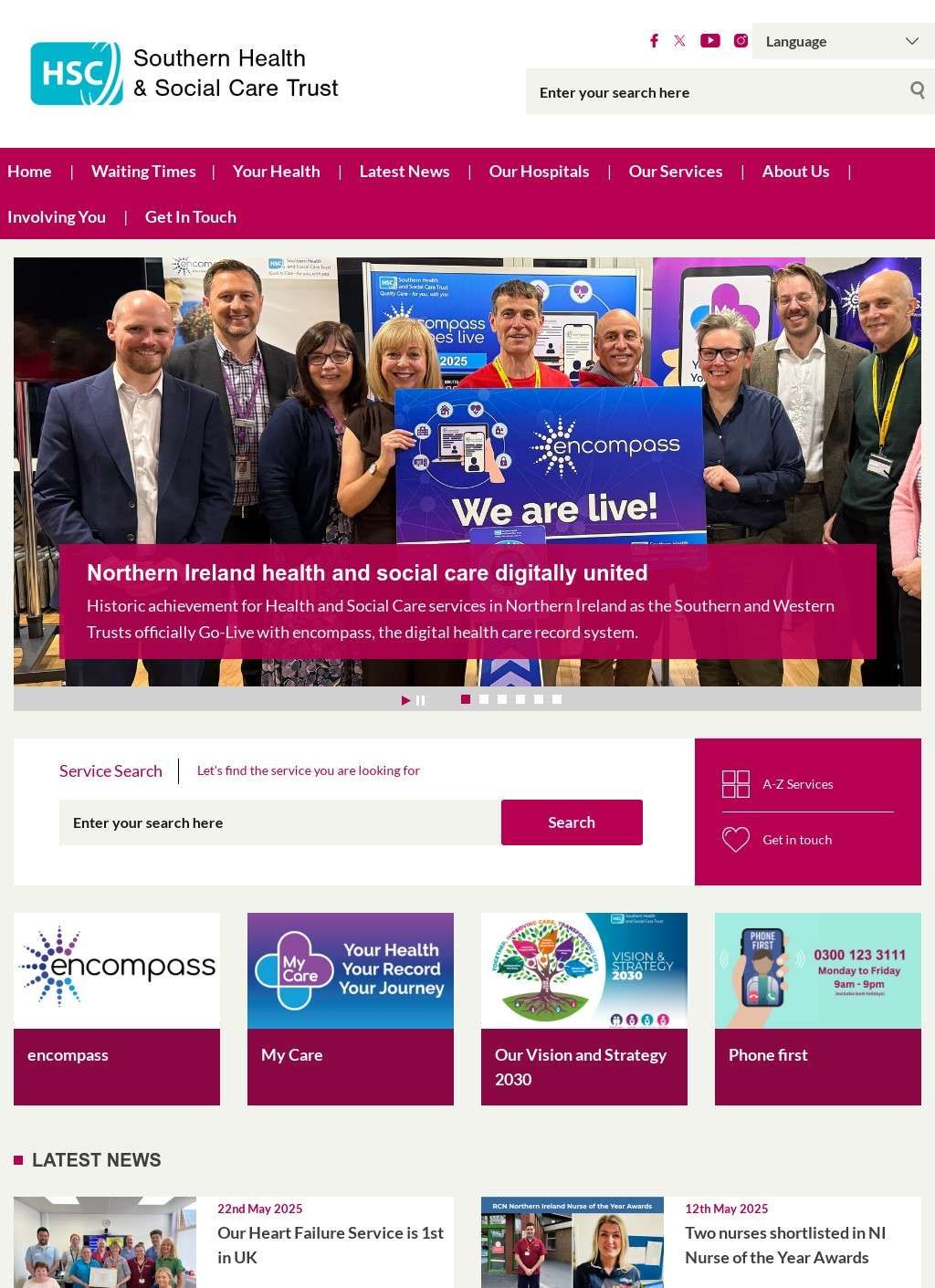
Craigavon Area Hospital and Daisy Hill Hospital in Newry are the two acute anchors of the Southern Health and Social Care Trust, and the site treats them as the spine of everything else it organises. Alongside those two, the Trust runs South Tyrone Hospital and Lurgan Hospital, and the way the services are laid out makes clear this is a statutory body covering a real geographic patch: Armagh City, Banbridge and Craigavon, Newry, Mourne and Down, and Mid Ulster. If you live in any of those council areas and need an NHS or HSC service, this is the organisation responsible for delivering it.
Hospital network across four council areas
What the Southern Health and Social Care Trust does well is refuse to pretend that health and social care are the same thing or that one of them matters more than the other. The organisation carries the full range of acute hospital medicine, but it gives just as much room to the community and social side, which is where a lot of public bodies go vague. Here the breadth is genuine. Maternity care is broken down into antenatal, intrapartum and postnatal stages, with midwifery-led units described separately and, notably, bereavement support for pregnancy loss given its own place. That last point is the sort of thing an organisation can quietly leave off a website, and the Southern Health and Social Care Trust does not.
Maternity care from pregnancy through postnatal support
The maternity strand is a good lens on how the whole thing is built. Rather than a single page that says "we have a maternity unit," the Trust splits the experience the way an expectant parent actually lives it, from the early checks through delivery and into the weeks afterward. Midwifery-led units appear as a separate route, which indicates real choice in how birth is managed, and the explicit naming of pregnancy loss support tells you the body has thought about its hardest days as much as its routine ones. Few things reveal an organisation's seriousness faster than how it treats the parts of its work nobody wants to need.
Naming services parents actually need
Children and young people's services are similarly granular. Within the Southern Health and Social Care Trust, health visiting, infant feeding support, paediatric speech and language therapy, child development, emotional health, and autism resources each get their own footing instead of being lumped under a single paediatrics banner. For a parent trying to work out which door to knock on, that separation is genuinely useful. It mirrors how families actually arrive at these services, one specific worry at a time, and it is much easier to navigate than a catch-all children's page with a phone number at the bottom.
That same instinct to name things precisely carries over into how the Southern Health and Social Care Trust presents its adult provision. A service user comes looking for a defined thing, and the structure of the site tries to meet them with a defined answer, which for a body responsible for hundreds of thousands of people across four council areas is a non-trivial editorial discipline to maintain.
Mental health and learning disability services
Mental health gets serious attention across both adult and child provision, and the Southern Health and Social Care Trust does not treat it as a single monolithic service either. There are dedicated learning disability specialist services and day centres, eating disorder services, and a Recovery College that runs courses tied to mental health and wellbeing. The Recovery College is an interesting inclusion, because it moves away from the purely clinical model toward something educational, where people learn to manage their own conditions. Plenty of trusts talk about that philosophy; fewer give it a named programme with actual courses behind it.
Day centres and community support
The day centres and the learning disability specialist services are easy to overlook on a quick scan, yet they speak to the social-care half of the Southern Health and Social Care Trust's remit: the part that does not generate headlines and rarely involves a hospital ward. Provision for people with learning disabilities is one of those areas where the gap between a polished mission statement and actual standing capacity tends to show. Naming day centres specifically, instead of gesturing at "community support," puts a concrete service on the table that a family can ask about by name.
Older people, palliative care, allied health
Older people and community care form another substantial block within the Southern Health and Social Care Trust: community nursing, palliative care, falls prevention, and brain injury services. The allied health professions sit nearby, with physiotherapy, podiatry and occupational therapy listed as distinct disciplines. Cancer support runs through Macmillan services, and there is sexual and reproductive health provision plus stop smoking programmes. The picture that builds up is of an organisation handling the dramatic acute moments and the slow, unglamorous, long-term work in roughly equal measure, which is what a health and social care trust is supposed to do but does not always make visible.
The audience is also clearly defined. The Southern Health and Social Care Trust serves individual patients and service users, and it works with partner agencies across the statutory, community and voluntary sectors. That dual purpose shows in how the material is pitched. Some of it speaks to a worried family member; some of it speaks to a community organisation that needs to know who to coordinate with. Both readerships are served without one drowning out the other.
It is worth being honest about what a site like this can and cannot tell you. Covering this many council areas and this many service lines, the Southern Health and Social Care Trust inevitably ends up with an enormous amount of information, and the genuine question for any visitor is whether they can find the one service they need quickly when they are stressed, unwell, or caring for someone who is. The breadth that reads as a strength when you survey the whole offering can become a maze when you are looking for a single answer at speed. Listing every service is one thing. Routing a frightened person to the right one in two clicks is harder, and it is the part that genuinely tests an organisation of this scale.
Taking the site as a whole, the Southern Health and Social Care Trust presents a comprehensive and structurally honest picture of what a large regional trust actually does. The Recovery College and the careful handling of maternity bereavement stand out as places where the organisation has gone further than the minimum. Whether that thoughtfulness reaches every corner of a service map this large is a question the published material cannot answer on its own, but the evidence on the page points to an organisation that at least tries to make its complexity navigable.