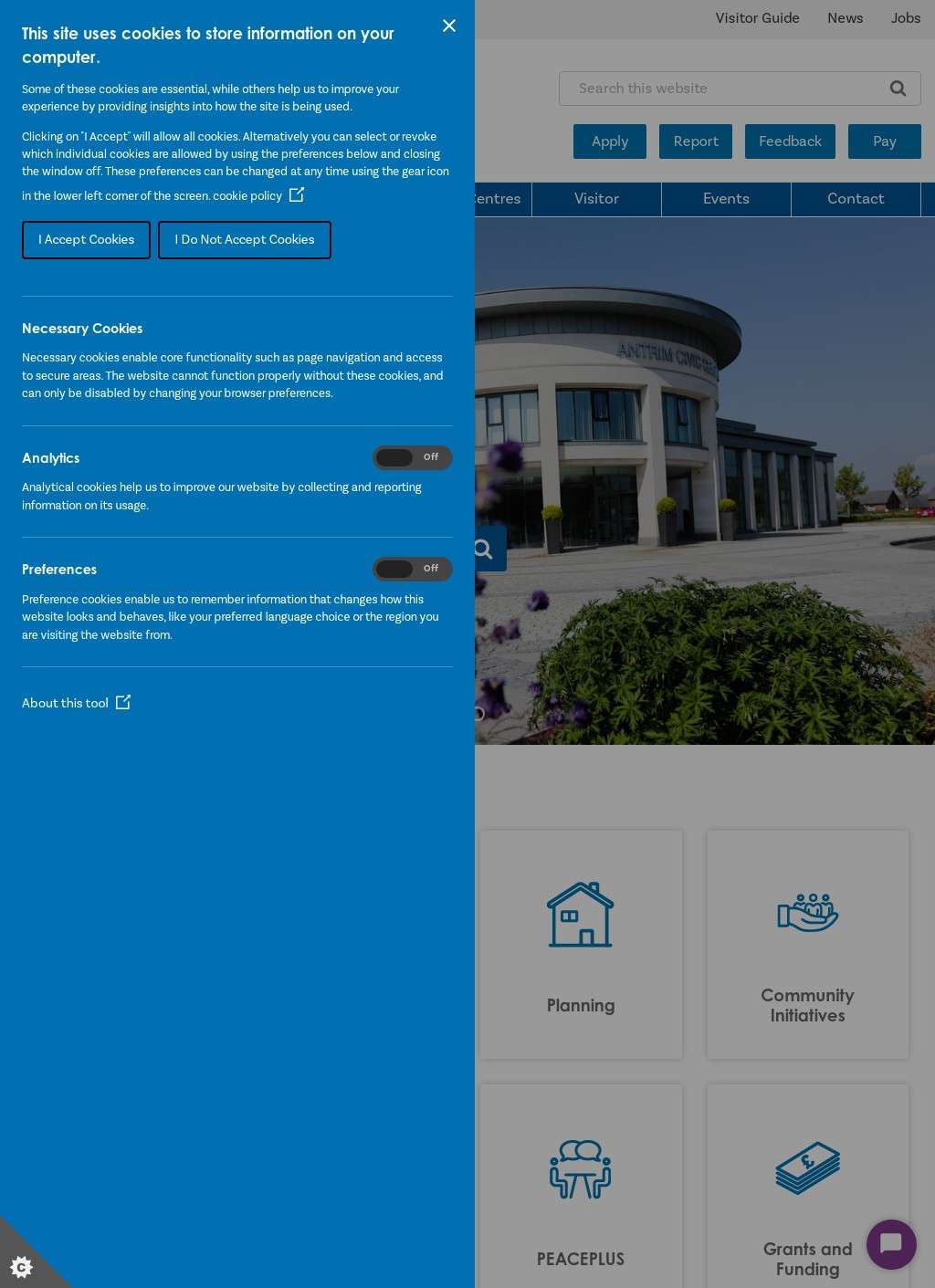
This is a council website that mostly does what a council website should, and the listing reflects that without overselling it.
Antrim and Newtownabbey Borough Council is the statutory local government body for the borough of the same name in Northern Ireland. The listing describes a site built around two things: the services the council is legally obliged to provide, and the everyday tasks residents, businesses, and visitors come looking for. So the question worth pressing is narrow. When someone arrives needing to actually do something, does the site let them do it, or does it just tell them about it?
Self-service core services
On the evidence here, mostly the former. The self-service core is wide. Dog licensing, civil registration, bin collection schedules, crematorium information, online payments, an interactive borough map, grants for community projects. Each of those connects to a form, an application route, or a payment portal instead of a number to call. That is the right design instinct for a local authority, and it is the part of the Antrim and Newtownabbey Borough Council listing that earns the most credit.
The strongest section is the one residents will hit most. Issues get reported through the site directly. Complaints and feedback run through their own system. The interactive borough map plots council facilities geographically, which is genuinely useful to someone who has just moved in and has no idea where the nearest leisure centre or civic office sits. Payments stay inside the council's own portal instead of bouncing the user somewhere else. None of this is flashy. It is the unglamorous plumbing that a council site lives or dies on, and Antrim and Newtownabbey Borough Council has clearly put the work in.
Civil registration for life events
Civil registration is where I would expect a council to be thorough, and here it is. Births, deaths, marriages, and civil partnerships are all covered. People reach these pages at moments that are already heavy, and a site that handles the paperwork cleanly takes one layer of friction off a hard day. All four functions are present, so there is no awkward gap where someone gets sent to a phone line at the worst possible time.
Crematorium information during bereavement
The crematorium information deserves a line of its own. It is tempting to file it next to the leisure centres as just another facility, but bereavement is one of the most time-pressured administrative situations a person ever deals with. Building it into the self-service structure shows Antrim and Newtownabbey Borough Council understands the state people are in when they land on that page.
Planning and building control
Planning and building control sit on both the resident and the business side, which is honest, because that is how those functions work in real life. A householder checking a neighbour's application and a developer weighing a change of use are pulling from the same database, so keeping building control alongside planning in one logical place is the correct call.
Leisure centre access separate from administration
Leisure centre access is split off from the administrative services, and that separation is sensible. Booking a swim and registering a birth are nothing alike, and the site does not shove both down the same entry point. There is a consistency dividend buried in all this too: a resident who figures out how to report a missed bin collection on the Antrim and Newtownabbey Borough Council site will meet the same structure six months later when they need to register a birth. The learning cost gets paid once. For a borough that spans more than one population centre, that kind of structural coherence is quietly valuable.
Grants for community projects
The grants and funding pages tie the administrative site to the community side. Residents and organisations running community projects can find out what Antrim and Newtownabbey Borough Council offers before they ever pick up a phone or walk into a civic office. The volunteer awards programme appears here, along with the initiative addressing violence against women and girls, both of which give the community section more substance than a flat list of services. These are programmes that need real council investment behind them, beyond a page somebody maintains.
Business section and action orientation
The business section is the smaller half, and that is fine. A borough council's commercial remit is narrower than its residential one, so a leaner business area is what you would expect, not a shortcoming. What is there covers the actual scope: planning and building control again, plus regulatory functions and support resources for people starting or growing a business in the borough. A listing of this kind helps because someone unfamiliar with the area can work out what the council does and does not handle before making contact, which saves a wasted call.
Check what the council handles before contact
One characteristic runs through resident, community, and business sections alike. Everything is oriented toward an action. Grant applications, planning queries, business support enquiries, community initiative contacts, all of them start from the same self-service logic. There is no section sitting there purely to describe the council's priorities while giving the reader nothing to do with that information. Antrim and Newtownabbey Borough Council has resisted the temptation to pad the site with brochure copy, and the result reads like infrastructure instead of a press release.
So the flat verdict at the top holds. The Antrim and Newtownabbey Borough Council site is competent and action-first, and the listing represents it fairly. I am not going to pretend it is more than that. It is a local authority doing local authority things well, which is praise enough and does not need inflating.
The honest limit is one the listing cannot resolve and probably should not pretend to. A directory entry can confirm that a function exists and that it is grouped sensibly. It cannot tell you whether the specific form you need works smoothly on the day, whether the payment portal accepts your card without a hitch, or whether the application route for your exact situation has a step that trips people up. The catalogue is broad and well organised, and the most common reasons anyone contacts a council, paying a bill, reporting a problem, registering a life event, all appear to be reachable online. Whether the one task you came for behaves the way you need it to is something the listing leaves open.