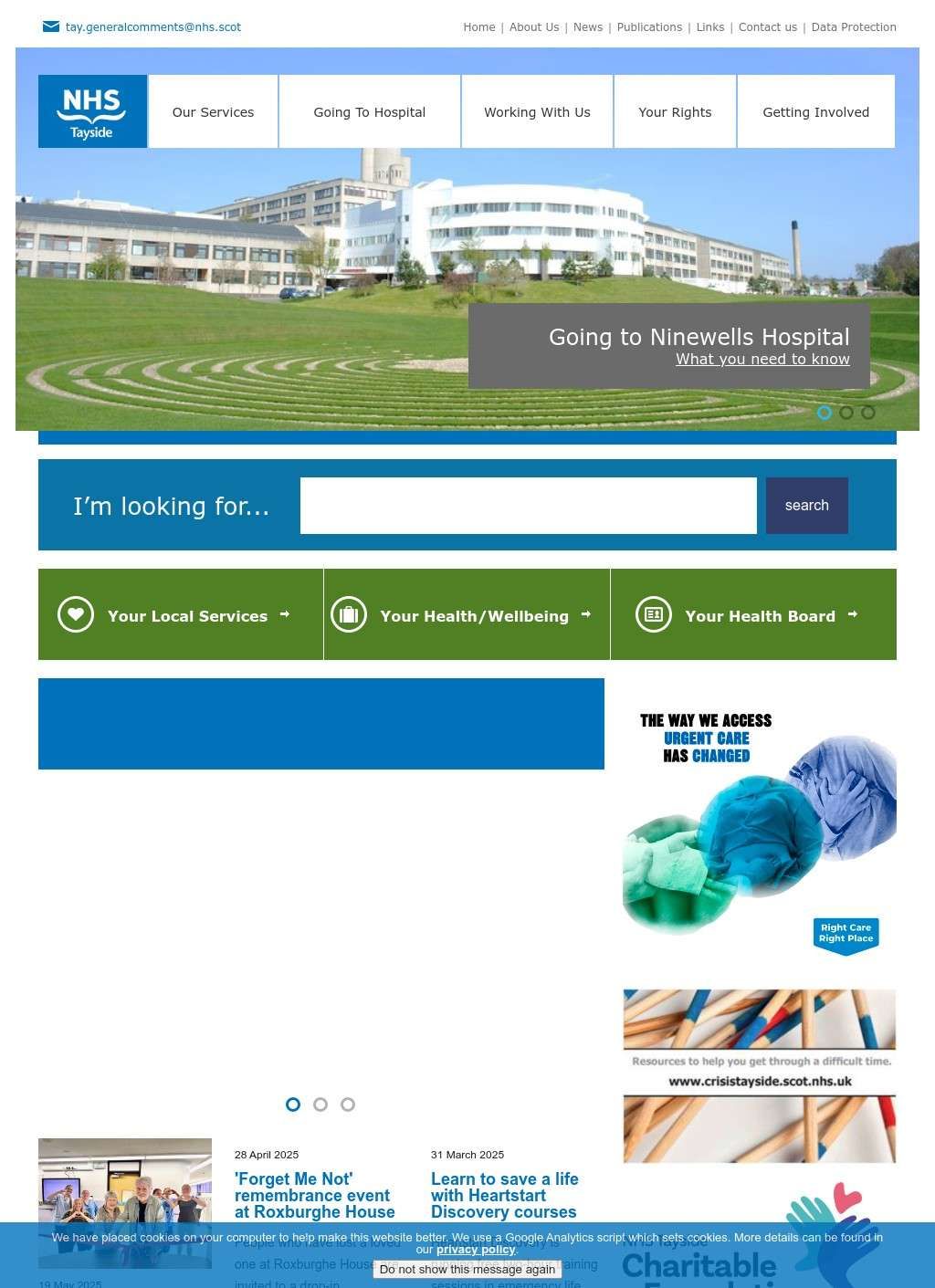
The Meadow Suite, a newly opened space for pregnancy loss support, sits on the front page of the NHS Tayside website, and that placement says something about how the site is run: a specific, human service given room right next to the usual administrative links. NHS Tayside is the official NHS health board portal for the Tayside region of Scotland, covering Dundee, Angus, and Perth and Kinross, three areas with very different needs, a compact city, a run of market towns, and a wide rural hinterland.
Care is delivered through three hospitals named across the site: Ninewells Hospital in Dundee, Perth Royal Infirmary, and Stracathro Hospital near Brechin. Between them those sites carry acute and general care for that mixed population, and the website is where a patient works out which service belongs to which building before they set off, which in a region this size is a real question and not a formality. A visitor in Forfar and a visitor in Perth are not asking the same thing, and a single regional site has to serve both without sending either to the wrong hospital.
The NHS Tayside site works on two levels at once. It is a directory of health services for a large and varied region, not a business directory of paid listings, and it is also a public-facing channel for a health board that wants residents involved in the decisions it makes about that care. Both jobs are visible straight from the homepage, which is more than a lot of public-sector sites manage without burying one under the other.
A resident can look up a clinic or comment on a proposal from the same starting screen, and the site does not force a choice between being useful and being open. That dual purpose is unusual to see stated so plainly on a public health site, where the two goals often pull against each other.
What the health board puts in front of residents
The homepage does real editorial work instead of dumping a full menu on the visitor and walking away. NHS Tayside pulls a handful of current services to the top, and the mix tells you what NHS Tayside is prioritizing at any given moment, whether that is a seasonal vaccination push, a mental health service, or a newly opened clinical space.
It is a small thing, but a health board that curates its own front page is signalling that it expects real people in difficult moments to land there first, and it arranges the page accordingly. That editorial instinct runs through the rest of the site as well. The front page reads as though someone decides each week what a patient most needs to see, and updates it to match.
Care that gets top billing
Vaccination programs lead, with COVID-19 and MenB both named, the latter aimed at protecting against meningococcal B, prevention work a health board is right to keep visible. Mental health has genuine prominence too, including the Carseview Centre, a service that is easy to bury on a cluttered NHS site but that stays visible here. NHS Tayside gives gynaecology services their own visible space, with the Meadow Suite for pregnancy loss support singled out by name, a quietly compassionate choice for a subject many organisations leave unmarked and unexplained.
Putting it on the front page, where a grieving parent does not have to go searching, is the sort of decision that tells you who the site is really for. That instinct, to name a sensitive service plainly and put it where it can be found, counts for more than any mission statement about compassion.
Two further highlights point to a board thinking hard about access rather than only about buildings. Near Me, the telehealth platform for video consultations, spares a patient in rural Angus or Perthshire a long drive to Ninewells for an appointment that could happen from a kitchen table, which in a region this spread out is a genuine saving of time, fuel, and a day off work.
Heartstart Discovery, emergency life support training, teaches ordinary members of the public what to do in the minutes before an ambulance arrives, which in a scattered rural area can be the minutes that decide an outcome.
Neither is a headline treatment, and that is the point: they are the quiet, preventive services a board can promote or leave buried, and NHS Tayside chooses to promote them. A board that leads with prevention and access is quietly telling residents what it values, and in a health service under constant pressure that choice of emphasis is worth respecting.
Finding services and having a say
Underneath the highlights sits the reference layer, the part of the site a resident actually uses when something is wrong. NHS Tayside provides an A-Z service directory, hospital information and guidance for each of its sites, patient rights and involvement pages, and local health services listings, so someone can move from a named condition to the place that treats it without a great deal of clicking around.
Employment opportunities sit here as well, a natural inclusion since NHS Tayside is one of the region's larger employers, and the patient rights pages give a resident a plain account of what they can expect and how to raise a concern when the care falls short. It is the unglamorous scaffolding a good public health site needs, and it is present and organised.
A resident who knows only their symptom can start at the A-Z and end at the right department, which is the whole job of a health board's front end.
The participation side is where NHS Tayside goes furthest past a standard information site. It actively invites the public to comment on healthcare proposals, a pending pharmacy application in Carnoustie among the live examples, through online feedback forms, so a resident can weigh in on a local decision before it is settled rather than after the fact.
That is a genuine channel, not a suggestion box. NHS Tayside also states sustainability commitments, promotes interpretation and translation services for people who do not use English as a first language, and flags its support for armed forces personnel and veterans, three groups a general health site can easily overlook. Taken together these are the touches that separate a board treating its website as an obligation from one treating it as an extension of the service itself, and NHS Tayside lands closer to the second.
None of this makes the site glamorous, and it does not try to be. What it does is keep the practical and the participatory side by side, so the same visitor who looks up a vaccination clinic can, on the next click, read a consultation document or a translated version of one. For a public body, that is a fair definition of doing the job well. The site will not win design awards, and it does not need to; it needs to get a frightened or unwell person to the right place quickly, and it is built for that.
For a general health question with no local angle, a resident might reasonably reach first for NHS Inform, the national NHS Scotland information service, and for symptom-checker basics and generic guidance that is often the right door to knock on. For anything tied to Ninewells, Perth Royal Infirmary, or Stracathro, though, or to a Tayside consultation, a local vaccination clinic, or a Near Me appointment, the national site cannot stand in for what NHS Tayside holds about its own hospitals, its own clinics, and its own corner of Scotland.