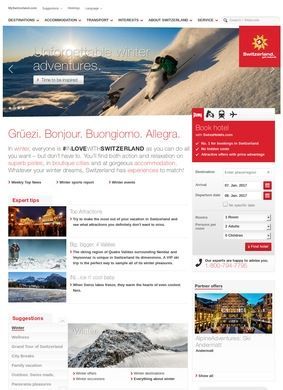
Where does a traveler start when the whole of Switzerland is on the table and the plan is still a blank page? This portal answers that by splitting the country into holiday regions first, so someone deciding between the lakes of the south and the peaks of the Bernese Oberland can see each region on its own terms before settling on a single itinerary.
How the trip takes shape
The organizing idea is destinations, experiences, accommodations, in that order, and it holds up well because that is roughly how a real trip forms in a person's head. You pick a place, you decide what to do there, then you find somewhere to sleep.
Destinations pulls together the holiday regions of Switzerland alongside individual attractions, nature reserves, and the UNESCO sites, which gives the browsing a spine. A reader who arrives knowing only that they want mountains can drill from a region down to a specific reserve without losing the thread. The material is dense in the way an official national resource tends to be, covering far more ground than any commercial operator would bother to catalogue. Because the portal is run by Switzerland Tourism, the breadth is the point, and the coverage is closer to a full inventory than a curated shortlist.
Experiences across the seasons
The experiences section is where the range shows. Hiking and skiing anchor it, as they should for a country whose reputation rests on both, but the listings also run through city tours, wine tastings, and cultural and seasonal events. That seasonal framing matters here more than it would elsewhere. A visit to the same valley in February and in July is essentially two different trips, and the site treats them that way instead of flattening the year into one generic pitch. Wine tastings sitting beside alpine skiing is a fair snapshot of how varied a trip through Switzerland can be.
There is an inspiration calendar that highlights 48 featured destinations, which is a genuinely useful device for the undecided. Rather than forcing a traveler to already know where they want to go, it works backward from timing and mood. Package deals and offers sit alongside the event listings, so someone who wants a bundled arrangement is not sent hunting elsewhere.
Where to stay, sorted by how people travel
Accommodations are grouped by traveler type instead of by star rating alone, and that choice is quietly sensible. Luxury and wellness hotels are listed, but so are family-friendly stays, apartments, hostels, camping, and alpine huts.
The huts in particular signal that this was built by people who understand how the country is actually walked. A family looking for a simple base and a solo hiker aiming for a high mountain refuge are both accounted for, and neither has to wade through the other's options to find their own.
The planning machinery underneath
Once the shape of a trip exists, Switzerland is a country that rewards planning down to the train connection, and the tools here lean into that. Transport information is front and center, which fits a place where the rail and postbus network is half the appeal. Weather forecasts, currency conversion, and sustainability guides round out the practical layer.
The sustainability material is worth singling out. It is not a token page. For a destination that markets its landscapes as the main draw, guidance on traveling responsibly through Switzerland reads as consistent with the product itself. Currency conversion and weather forecasts are the sort of small tools that a visitor would otherwise open in separate tabs, and folding them in keeps the planning in one window.
Booking without leaving the page
Booking is handled through integrated third-party search. Hotels, flights, train tickets, car rentals, and apartments all surface through partner platforms, so the research and the reservation happen in roughly the same place. This is the pragmatic approach for an official body that promotes the country without being the merchant of record. The site steers, the partners transact, and a visitor planning a full trip does not have to rebuild their search five times across five unrelated sites.
VR experiences are offered too, which is a lighter touch, more a taste of a place than a planning tool. For someone weighing whether a particular region is worth the journey, a short immersive look has its uses.
Reach and the traveler it is built for
The audience is plainly international, and the language support backs that up: 15 or more languages, which is a serious commitment and not the usual token handful. A traveler from almost anywhere can work through Switzerland in their own tongue, which lowers the friction that sinks a lot of otherwise good tourism sites. For a country with four national languages of its own, extending that courtesy to visitors fits the character of the place.
Beyond the consumer portal there are separate B2B and trade channels along with a media portal, kept apart from the traveler-facing pages. That separation is the right call. A holidaymaker never trips over industry material meant for tour operators, and the trade audience gets its own dedicated space rather than a diluted version of the public site.
Following along after the visit ends
The social footprint is broad, spanning Facebook, Instagram, TikTok, YouTube, LinkedIn, and Pinterest, and there is a newsletter for travel tips. TikTok and Pinterest sitting next to LinkedIn tells you the outreach is deliberately spread across very different audiences, from the casual scroller to the trade planner. A help center handles the practical questions that a static page cannot.
A search for independent reviews of the portal itself, separate from reviews of individual hotels or attractions booked through it, turns up nothing on the usual consumer review platforms; the only real gauge of standing here is the follower count on its own social channels, and that is not the same thing.
What ties it together is that the whole thing behaves like a working reference and not a billboard. Someone can plan an entire journey through Switzerland here, from the region down to the mountain hut and the train that reaches it, and step outside the portal only when it is time to pay.