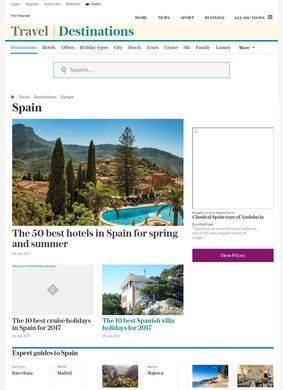
Where does a British traveler start when a fortnight in Spain could mean tapas bars in Madrid, a quiet cove on Majorca, or white villages in Andalusia? The Telegraph: Spain is built to answer exactly that, pulling expert-written guides to hotels, sights, beaches, restaurants, bars and shops across the country's main destinations into one corner of Telegraph Travel.
It is a curated hub, not a database, and that shapes both what it does well and where it falls short.
What the Spain hub covers
The spread of destinations is wide. The Telegraph: Spain runs guides to Madrid and Barcelona, the Balearic islands of Majorca and Ibiza, and the southern region of Andalusia, with regional pages for areas like the Costa Blanca sitting alongside the big-city coverage. A reader can move from a capital-city weekend to a coastal fortnight without leaving the section.
Each strand of The Telegraph: Spain is worth taking on its own terms.
The structure repeats across destinations, which is a quiet strength. The Telegraph: Spain tends to break a place into where to stay, the things to see and do, and where to eat, drink and shop, so a reader who learns the layout on the Barcelona pages can work the Andalusia ones without relearning it. That consistency is easy to underrate until you are weighing three destinations against each other in a single sitting, matching the hotels in one against the beaches in another.
Volume works in its favour as well. Spreading the coverage over several listing pages leaves more here than any single overview article could hold, and a planner willing to click deeper will turn up secondary spots beyond the postcard names.
City guides: Madrid, Barcelona and the islands
The city and island guides are the backbone. The Telegraph: Spain treats Madrid and Barcelona as full destinations, with the hotels, the things to see and do, and the places to eat and drink broken out so a visitor can assemble an itinerary from the parts.
Majorca and Ibiza get the same treatment within the hub, which helps, because the two islands pull very different crowds, and a guide that keeps them distinct saves a family from booking into a party resort by mistake.
Beaches, restaurants and the regional guides
Beyond the cities, the coverage gets granular. The Telegraph: Spain carries dedicated beach round-ups, restaurant and bar picks, and shopping suggestions, plus standalone regional guides to places such as the Costa Blanca and Andalusia.
This is where the section is most useful for a driving holiday, since a regional guide that names specific towns and stops is more use on the road than one best-of-the-country list. The Telegraph: Spain material is spread across several listing pages, so the depth is genuine, though the pagination does turn a browse into a scroll.
Round-ups like the 25 greatest holidays
The curated round-ups are the other half of the offer. A feature such as the 25 greatest holidays in Spain does the shortlisting for a reader who does not yet know where to go, turning a blank map into a ranked set of options. The Telegraph: Spain leans on this format heavily, and for someone at the daydreaming stage it is a fast way in.
The trade-off is built into the form: a ranked list reflects the editors' taste, so it steers you toward what they rate, and a traveler with fixed ideas may find the picks skew toward a particular kind of trip.
Reading it as a planning tool
The value of the section rests on who is writing it. The Telegraph: Spain publishes work by named Telegraph Travel specialists, among them a Spain specialist and hotel reviewer who covers the country's food scene and cities like Granada. Bylined expertise is the whole point of a newspaper travel desk, and it separates this from an anonymous aggregator: a reader can follow a specific writer whose taste they have learned to trust.
Depth of voice, then, is the draw. Breadth of coverage is the question mark.
The named specialists behind the bylines
That specialist coverage is the strongest reason to use The Telegraph: Spain over a crowd-sourced site. A single writer who has eaten their way across Granada and slept in the hotels can weigh a place in a way a thousand scattered one-line reviews cannot. The Telegraph: Spain guides read as considered rather than churned out, and the food and hotel writing in particular carries the detail of someone who was in the room. The catch is reach: a named-specialist model goes deep on the places those specialists visit and stays shallower on the ones they have not got to yet.
There is a practical wrinkle worth flagging plainly. The Telegraph: Spain sits behind The Telegraph's subscription and login system, so a reader without an account will meet a paywall across much of the content. The site runs separate UK and US editions, which helps with pricing and flight framing depending on where a reader sits, but the paywall is the thing to know before clicking in. For a subscriber it is a settled cost.
For a casual planner it is a gate, and a free listing on a business directory like this one can only point at what waits behind the login.
Taken together, the pieces cover a full planning arc. The round-ups suit the stage when a destination is still undecided, the regional and city guides suit the stage when dates are fixed and the details start to matter, and the hotel and restaurant reviews suit the final booking calls. A reader can ride The Telegraph: Spain from a vague craving for sun all the way to a booked table in Granada, which is more than a lone travel feature tends to manage.
Set against Lonely Planet's Spain pages, which are free and lean practical, The Telegraph: Spain trades open access for a firmer editorial voice: fewer, more opinionated guides written by people with names and a clear point of view. A backpacker counting every euro will get further on the free resource. The Telegraph: Spain pays off more for someone who already subscribes and wants a well-chosen hotel or a restaurant worth the detour, provided its specialists have actually covered the destination in mind.