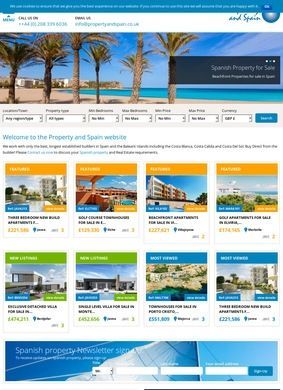
Property & Spain's homepage sorts its listings by coastline before anything else: Costa del Sol, Costa Blanca, Costa Brava, then out to the Balearics and the Canaries, with Barcelona and Madrid handled separately as city markets. That structure tells you who the site is built for. Someone who already knows they want a place near the Mediterranean, or in a specific Spanish city, and wants to browse by region instead of typing a postcode into a generic search box.
It is a sensible way to organise a country that foreign buyers tend to think about in terms of holiday geography rather than administrative provinces.
What sits behind those regional gateways is a mix of property listings and a fair amount of written guidance, and the guidance is where Property & Spain tries to separate itself from a plain listings feed. A catalogue of apartments is easy to assemble. The context around a purchase is the harder thing to get right, and it is the reason a browser might return.
Where the listings point and who they court
The regional spread on Property & Spain is genuinely broad. Costa del Sol and Costa Blanca are the obvious high-volume markets for British and northern European buyers, and their presence is no surprise. Including Costa Brava, the Balearic Islands, the Canary Islands, and then two distinct city markets in Barcelona and Madrid, suggests the catalogue is meant to cover most of the demand a foreign buyer would arrive with, whether that is a beach apartment or an urban flat. Few single sites bother stretching from island holiday markets all the way to central Madrid.
Property & Spain names its intended audiences directly, and the list is telling: families, retirees, remote workers, holiday seekers, and investors. Those are not the same buyer with different labels. A retiree relocating permanently wants very different things from a remote worker keeping one foot in another country, and an investor chasing rental yield is reading the market in a third way entirely. Property & Spain positioning itself across all five is ambitious, and it puts real weight on how well the guidance can speak to each of them without turning into generalities.
Investment framing and market trends
The investment guidance and market trend material on Property & Spain is the part I'd want to test hardest before trusting it. Market analysis for Spanish property is only as good as how current and how specific it is; a page that talks about trends in the abstract is close to useless to someone deciding between Malaga and Alicante this year.
The brief confirms the section exists but not how granular it gets or how recently it was last updated. An investor is the reader most likely to notice a shallow write-up fast, and least likely to forgive one.
Legal, tax and financing help for foreign buyers
Buying property in Spain as a non-resident carries real friction: the NIE number, non-resident tax treatment, notary and registration steps, and mortgage rules that differ for overseas applicants. Property & Spain offering legal and financial advisory content around mortgages, taxes, and the purchase process is aimed squarely at that friction, and it is the kind of material that earns a site repeat visits if it is accurate. The open question is whether this is original explanation or a light summary of things a buyer can read on any expat forum.
Advisory content of this sort is also where accuracy carries consequences, so a reader would be right to cross-check anything here against a solicitor before acting on it.
Neighbourhood and lifestyle detail
The neighbourhood and lifestyle insights are the softer end of what Property & Spain offers, and they are also where a property site can add the most human value. Knowing that one town empties out of season, that another has a year-round expat community, or that a third is a forty-minute drive from the nearest international school, changes a buying decision more than a photo gallery does.
Whether Property & Spain delivers that texture or settles for tourist-brochure summaries is something the homepage alone cannot confirm, but including the category at all is a point in its favour. The buyers most likely to relocate permanently, the retirees and the remote workers named earlier, care about exactly this kind of everyday detail, and a site that gets it right saves them a scouting trip or two.
The credibility questions the site leaves open
Here is where my confidence in Property & Spain drops. A physical address is shown, in Surbiton, Surrey, which is a real place and at least anchors the operation to a location a reader could look up. That is worth something.
But it is the only contact detail on the homepage. No phone number. No email. No visible link to a dedicated contact route or enquiry form. For a business that sells personalised buyer assistance as one of its core services, that is an odd and fairly serious gap. Personalised help implies a conversation, and a conversation implies a way to start one.
A buyer who reads through the guidance, warms to the idea, and then wants to ask about a property in Javea is left with an address in Surrey and no obvious next step. That mismatch was harder to explain away than sparse guidance would have been.
An address without a phone line or contact form does not make a site illegitimate. Plenty of small property operations run lean, and some route enquiries through channels that only appear once you click into an individual listing. If that is the case here, the design choice still costs Property & Spain something, because a first-time visitor judges reachability by what the homepage shows, not by what might be buried three clicks deeper. It raises the bar for everything else, because the cues a cautious buyer normally leans on are missing.
Searching for outside opinion on the Property & Spain site turns up nothing that refers to this particular business. The results that surface are other Spanish property firms with similar-sounding names, none of them connected to this site. So there are no third-party reviews, no star ratings, no aggregated customer feedback to weigh, positive or negative. The record is simply blank.
That blankness cuts both ways, and it is important to be fair to Property & Spain about it. No reviews is not the same as bad reviews. A newer or lower-profile site would look exactly like this, with no trail of feedback simply because not enough people have passed through it yet. But it also means a prospective buyer has no independent voice to fall back on, and combined with the missing contact channels, it leaves the credibility case resting almost entirely on the quality of the content itself.
For a purchase as large and cross-border as Spanish property, most people will want more reassurance than that before they engage. A buyer risking a five or six figure sum tends to want at least one stranger's word for it.
Personalised assistance with no way in
Taken together, Property & Spain reads as a resource with a sensible structure and a well-chosen subject: the regional listings are logically laid out, and the guidance around legal, financial, and lifestyle questions targets exactly the problems a foreign buyer runs into. If the written material is genuinely current and specific, this could be a useful early-stage browsing tool for someone mapping out where in Spain to look. As a first stop for orientation, Property & Spain has a reasonable shape to it, and the topic coverage is wider than many single-region sites bother with.
The doubt that cannot be resolved from the outside is whether the depth matches the ambition, and whether a real person answers when a buyer reaches out. Property & Spain promises personalised assistance while showing no way to reach it, which is the wrong gap to leave open. Until it closes, this is a browsing aid with a reasonable shape, and treating it as anything more is a leap of faith the site itself has not earned yet.