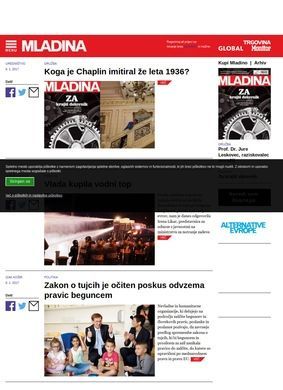
Mladina is the Slovenian weekly behind this listing, and Slovenia Magazines points to something with a genuine publishing operation behind it rather than a placeholder site dressed up as journalism. Open the page and there is actual reporting: investigative pieces, political commentary, the long-running interview slot called "Intervju," and opinion columns where the magazine's own writers take clear positions. The editorial line is not hedged, and the site reflects that directly. The coverage leans progressive, the political analysis is pointed, and nothing about the presentation pretends to be wire-neutral. That clarity of character is worth noting at the start because it frames everything else about what the site is and who it is for.
Progressive reporting with clear editorial voice
Cultural coverage runs alongside the political work without feeling like a secondary shelf. Book reviews, film criticism, music writing, and commentary on the arts all have real space, and there is a consumer section called "Konzum" plus broader entertainment coverage. The mix tells you who Slovenia Magazines is built for: a Slovenian-speaking reader who follows national politics and wants the week's culture covered in the same publication. It is a general-interest weekly with a fixed editorial temperament, not a niche title stretching to look broader than it is.
Arts coverage alongside political analysis
The practical reading infrastructure is solid. Slovenia Magazines carries a complete archive of past issues going back decades, which changes what the subscription actually is. A weekly without back issues is essentially a perishable product: read once and gone. With the full run available, the magazine becomes a standing reference for Slovenian political and cultural history as the magazine recorded it in real time. A researcher, a student, or a long-time reader chasing an old interview or a piece of reporting from years back can go and find it. There is a digital subscription path labelled "Naroci se," a mobile application, an online shop ("Trgovina"), and standard registration and login. None of that is unusual for a magazine of this size, but all of it is present and functional, which is not guaranteed when legacy print titles move online.
Complete archive as historical reference
The archive is the strongest argument for paying rather than skimming free fragments. A subscription to Slovenia Magazines with full back-issue access is qualitatively different from a subscription that only unlocks current content. Decades of reporting on Slovenian domestic politics, on European integration as it affected Slovenia, on cultural figures who are now historical, on economic upheavals as they happened: that is a different category of resource from a magazine that resets each week. The institutional value of that depth is also what the Library of Congress apparently recognises. The library holds a current subscription to Mladina and catalogues it as a weekly. That is a real indicator of durability: a national library on another continent paying to keep a publication on its shelves places Slovenia Magazines in the company of titles that reference institutions treat as worth preserving indefinitely.
Institutional recognition from major libraries
Press directories and reference lists of key Slovenian periodicals also include Mladina, which reinforces the same picture. Slovenia Magazines is not trying to establish credibility through consumer ratings; it has the kind of institutional record that tends to outlast trend-driven attention. Searches do not return ratings on the standard consumer platforms, no star counts from Google or Trustpilot or anything comparable. For a long-established national weekly that is unsurprising: readers tend to rate restaurants and gadgets, not political weeklies they have subscribed to for years. The absence of that layer is not a problem with the publication so much as a feature of its market position.
Contact methods organized by function
Contact information is straightforward and clear. Slovenia Magazines lists a physical address on Dunajska cesta in Ljubljana, a landline number, and several email addresses split by purpose: a general desk, a reader letters address, and a separate subscriptions address. Dividing those three functions is a small organisational detail that points to an office with real departments, not a single inbox behind a form. Anyone needing to reach Slovenia Magazines has a specific and obvious route depending on what they need.
Paywall limits what visitors can assess
A few things stay open after looking at the listing and the site. The full archive and deeper reporting sit behind the paywall, so a first-time visitor sees the shape of the offering more than its substance before deciding whether to subscribe, and the listing gives no indication of price or of how much content sits outside the paywall on any given week. The progressive editorial character is consistent and genuine, but it is a defined position: a reader wanting neutral aggregation is somewhere else, and Slovenia Magazines does not obscure that. The mobile app and shop appear in the listing without any indication of how well either actually performs, so their quality is something a visitor cannot assess from here.
Subscription requires direct experience to evaluate
The larger uncertainty is one the listing cannot close. Slovenia Magazines has the pedigree, the archive, and an institutional record that most regional weeklies lack. For a Slovenian-speaking reader interested in politics and culture, the case for looking seriously at a subscription is clear. What a visitor cannot determine without subscribing is the precise balance between what Slovenia Magazines keeps behind the paywall and what it puts in front of it, and whether the depth of that archive is genuinely searchable and navigable or just technically present. The published evidence makes Slovenia Magazines worth pursuing; the paywall structure means the full assessment requires going further than the listing or the public-facing pages can take you.