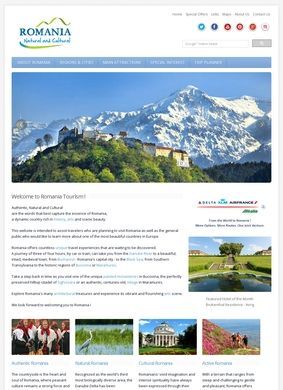
You have a week of vacation, a vague pull toward Transylvania, and no idea whether you need a visa, which castles are worth the drive, or how to get from Bucharest to the painted monasteries of the north without a rental car headache. That is the exact moment when a site like Romania Tourism starts to matter, because it tries to answer all of those questions in one place before you ever open a booking tab.
Romania Tourism presents itself as an independent, self-funded, non-profit effort. It is a travel information portal built to orient a visitor rather than an official state channel or a booking engine taking a cut of your hotel, and that framing shapes how everything on the site should be read.
What Romania Tourism covers is broad. There is an About Romania section that runs through geography, history, culture, language and basic facts, the sort of grounding you want if the country is mostly a blank on your mental map. From there it fans out into six historical regions and more than twenty cities, so someone who only knows Dracula and gymnasts gets a fuller sense of where Cluj sits relative to Brasov, and why the Danube Delta is a different trip entirely from the Carpathians.
What the trip planning tools offer
The planning material is where Romania Tourism is strongest. A dedicated Trip Planner pulls together accommodations, entry requirements, transportation notes, maps and sample itineraries. The itineraries are the piece worth lingering on, since a pre-built route is often the difference between a country feeling navigable and feeling like a logistics problem.
It goes further into the specifics too. There are named hotel recommendations, Castel Daniel in Transylvania among them, listings of organized tours, event and festival calendars, and scenic drive guides for people who intend to rent a car and point it at the mountains. None of that is booking functionality, and you should not arrive expecting a checkout. It is the reference layer that sits underneath a booking.
Special interest travel and the Dracula angle
Plenty of visitors come to Romania with one hook in mind, and Romania Tourism meets them there. The Special Interest Travel section splits into Dracula legends, food and wine, genealogy for people tracing family roots, and active vacations for hikers and cyclists.
The Dracula material is handled the way it should be, as a legend and a tourism draw tied to real places like Bran Castle, without pretending the historical Vlad and the novel are the same thing. Genealogy travel is a quieter inclusion and a smart one. It shows that whoever built the content thought about who shows up in Romania, including diaspora travelers coming back to find a village their grandparents left. Most generalist travel sites do not bother with an audience that specific.
Attractions and the breadth of coverage
The Main Attractions section is the postcard reel: castles, painted monasteries, the Danube Delta, the Carpathian Mountains, and the country's spa towns. It is organized clearly enough that you can move from a marquee sight to the region around it without backtracking through menus.
One detail worth flagging is language. The content is offered in fifteen languages. For a small non-profit that is a real investment, and it points to an intended readership well beyond an English speaker who stumbled in from a search result.
Breadth does carry a caveat. A site this wide, maintained on volunteer footing, lives or dies on how current its details stay, and entry requirements and transport specifics are the sort of thing that shift. Treat those as a strong starting point and confirm the moving parts against an official source before you commit money.
On the practical question of reaching the people behind it, there is a Contact Us link in the footer. No phone number, email or address sits on the homepage itself, so you click through to a separate page for the details. It is a mild friction, not a dead end, and for an information portal that is not asking for your credit card the bar is lower anyway.
Third-party verdicts are harder to come by. A search for reviews of Romania Tourism as a website turns up almost nothing specific; the results are dominated by reviews of Romania itself and of commercial operators like kimkim, TourRadar and various Tripadvisor-listed companies. That absence is not damning for a non-profit reference site, since the reputation such a site builds is quieter than a tour company chasing bookings, but it does mean you are judging the resource on its content rather than on a chorus of outside voices.
The site fits best in the early, disoriented stage of planning, before you know which region you want or whether your passport gets you in. Someone ready to click "book now" will get less out of it than someone still deciding where to go. It hands over the map, the context and a set of itineraries, then steps back and leaves the reserving to someone else. Romania Tourism is a guide, not a storefront, and it never tries to be both.